Conversion Rate Optimisation (CRO)

Before you buy more visitors, let us find out why the visitors already coming to your site are not buying.

Funnel Analysis Heatmaps and Recordings A/B Testing Form and Checkout Flow
AddressAtaşehir, Istanbul
Phone+90 850 335 10 87
E-mailinfo@360-soft.com
Conversion Rate Optimisation (CRO)

Not more traffic, more conversions

The first idea that comes to mind for increasing sales is to grow the ad budget. But if most of the visitors coming to your site leave without buying, raising the budget is like pouring more water into a leaking bucket: spending goes up and the holes stay the same. Conversion rate optimisation (CRO) is the work of finding those holes systematically and closing them.

CRO is not a list of “magic button colours”. It is a cycle: using data to pinpoint the step at which visitors drop out of the journey to buy, request a quote or fill in a form, forming a hypothesis about why they drop out, testing that hypothesis in a controlled experiment and making the result permanent. With every cycle, your site knows more about your users.

Who is it for?

  • E-commerce sites with steady traffic: stores that see items added to the basket but checkouts not completed, or product pages viewed but nothing added to the basket.
  • B2B sites that collect quote requests and leads: there is traffic, but forms are not filled in, or the enquiries that arrive are weak in quality.
  • Businesses with a regular Google Ads and Meta Ads budget: as the cost per click rises, they are looking for a way to get more results from the same budget.
  • SaaS and subscription products: product teams who want to improve the trial sign-up, activation and upgrade-to-paid steps.

If you need a new campaign page, our Landing Page Design page covers that work; if your site has speed problems, see Core Web Vitals Optimisation. CRO is the layer that measures the results of this work and keeps improving your existing pages.
What we do in a CRO engagement

Measurement setup audit

Checking that GA4 events, e-commerce tracking, ad conversion tags and the cookie consent integration are accurate. You cannot optimise a funnel that is measured wrongly.

Funnel and segment analysis

Drop-off at every step from the home page to checkout, compared by device, traffic source, new versus returning visitors and product category.

Heatmaps and session recordings

Click, scroll and attention maps, plus recordings that show where users hesitate, where they rage-click and which areas they never see.

Heuristic UX and technical audit

Whether product pages give enough information, trust signals, visibility of shipping and returns information, mobile usability, page speed and browser compatibility bugs.

Form optimisation

Number and order of fields, inline validation, error messages, autofill support and mobile keyboard types, with field-by-field abandonment analysis.

Basket and checkout flow

Guest checkout, number of steps, surprise costs, payment method options, ease of address entry and return errors after 3D Secure.

A/B and multivariate testing

Tests with the hypothesis, primary metric, sample size and test duration defined in advance, implemented client side or server side.

Visitor surveys

Short exit-intent or post-purchase surveys that collect a direct answer to the question “what stopped you from buying?”.

From data to testing, from testing to lasting improvement - Conversion Rate Optimisation (CRO)

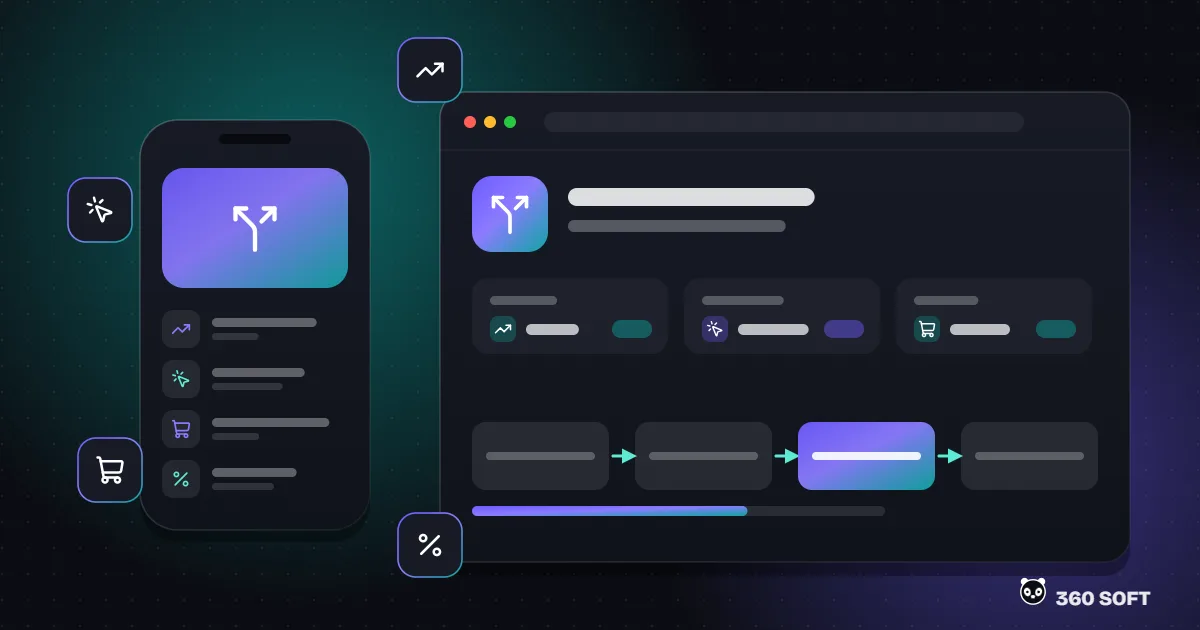
From data to testing, from testing to lasting improvement

01

Validate measurement

Analytics and ad tracking are checked and missing events are added. Until this step is done, test results cannot be trusted.

02

Research

Funnel analysis, heatmaps and recordings, a UX audit and surveys identify where visitors drop off and the likely reasons.

03

Hypotheses and prioritisation

Each finding is turned into a hypothesis in the form “if we change X, metric Y improves, because Z” and ranked by impact, confidence and effort.

04

Quick fixes

Obvious bugs that need no test (a broken field, an invisible button, a wrong redirect) are fixed straight away.

05

Test design and implementation

Variants are designed and coded for the priority hypotheses and the test is launched after quality control; no decision is made before the pre-defined duration is up.

06

Analysis, rollout and learning log

The result is reviewed by segment, the winning variant is made permanent, every test is archived with its learnings and the next cycle is planned.

Typical problems at each funnel step

This table is a starting checklist; the real drop-off points on your site are identified from your own data.
Funnel step Common reason for drop-off What we examine / test
Landing page Ad message and page content do not match, slow loading Message match, value proposition above the fold, load performance
Category / listing Awkward filters, visitors cannot find what they want Filter structure, default sort order, on-site search results
Product / service page Too little information, unclear delivery and returns terms, lack of trust Information hierarchy, image quality, delivery date display, trust signals
Basket Surprise shipping charge, a distracting coupon field Free shipping threshold display, showing the total cost early
Checkout Forced account creation, long forms, payment errors Guest checkout, fewer fields, address autocomplete, error messages
Quote / contact form Unnecessary fields, no idea what happens next Fewer fields, multi-step forms, information on what happens after submitting
What the engagement produces - Conversion Rate Optimisation (CRO)

What the engagement produces

Deliverables

  • Measurement audit report and a corrected tracking setup
  • Research report: funnel analysis, heatmap and recording findings, UX audit
  • Prioritised list of hypotheses (testing roadmap)
  • Quick fixes and test variants implemented
  • A results report for every test and a learning archive

Pricing

There is no fixed package price published on the site for conversion rate optimisation. The scope depends on your site’s platform, traffic volume and the number of flows to be tested; the initial research and audit can be planned as a one-off piece of work and the test cycles as a monthly engagement. We carry out a preliminary review using your site address and access to your existing analytics, and send a fixed-price proposal tailored to your project within 24 hours.

If you would like us to manage the traffic side as well, our Google and Meta Ads Management and SEO Agency services work on the same measurement setup. If you are thinking of renewing your e-commerce platform, take a look at our E-Commerce Packages and Pricing page.

A/B tests need a certain volume of traffic and conversions to produce statistically significant results, and the test duration is calculated from that volume. On lower-traffic sites, instead of A/B testing we work with session recordings, heatmaps, usability tests and fixes based on proven best practice. We decide which approach fits during the initial analysis, using your existing data.

Technical bugs and obvious friction points (a form field that does not work, a button that is invisible on mobile, an unexpected shipping charge) can have an effect the moment they are fixed. A/B tests, on the other hand, run until each one has collected enough data. We do not guarantee a specific uplift, because the outcome depends on your product, your price and the quality of your traffic. We report the result of every test, whether it wins or loses.

These tools can process personal data, so they have to be configured carefully. The core safeguards are masking input in form fields, switching recording off on checkout and account pages, not running the tool before cookie consent is given, and naming the tool in your privacy notice. We set them up with these safeguards in place, in line with KVKK (Turkey’s data protection law) and with GDPR where it applies; we recommend having your privacy notice approved by your legal adviser.

Google Optimize was retired in 2023. In its place you can use third-party A/B testing platforms or a testing setup implemented on the server side, in your site’s own code. We prefer server-side tests, especially on critical pages such as the checkout flow, because they cause no flicker while the page loads and do not affect performance.

Ad agencies usually focus on bringing visitors to the site: targeting, bidding and creative. What happens once the visitor arrives, meaning page speed, product page structure, forms and the checkout flow, belongs to the site itself and often requires code changes. CRO fills the gap between these two worlds, and we can work alongside your ad team on the same measurement setup.

That is up to you. We can implement test variants and permanent fixes directly on your site, or, if you have your own development team, we hand over ready-made briefs with the design and technical requirements. We work on WordPress/WooCommerce, Shopify and custom-built platforms.

The next success story
is yours.

The first consultation is free. We prepare a tailored proposal within 24 hours.

Get a free quote