Export E-Commerce Site and Marketplace Integration

Manage your product catalogue once, and keep stock, prices and orders in sync from one hub across your own multilingual site and international marketplaces.

Multilingual, Multi-Currency Site B2B and B2C on One Platform Amazon / Etsy Integration Central Stock and Orders
PriceFixed-price proposal for your project, within 24 hours
Phone+90 850 335 10 87
E-mailinfo@360-soft.com
Export E-Commerce Site and Marketplace Integration

The operational problems manufacturers face in cross-border e-commerce

For a manufacturer, selling directly abroad is no longer a process that runs only through trade fairs and intermediaries. Whether you produce in Turkey and sell to Europe and the Gulf, or ship across several regions, there is a big difference between uploading products to a marketplace and building a sustainable cross-border e-commerce channel. These are the operational problems we hear about most often in our conversations with manufacturers:

1. The same product is managed separately on every channel

If a product has one title on your own site, another on Amazon and different images on Etsy, every price change or product update has to be made by hand in three separate panels. One missed update becomes a sale at the wrong price. With a central product catalogue (the PIM approach), master data is entered once and channel-specific differences (title length, category, price multiplier) are defined as rules.

2. Overselling and cancelled orders

When the same stock is sold on more than one channel, a sync delay can lead to the last unit being sold twice. On marketplaces, the cancellation rate directly affects seller performance metrics. Reducing stock on the other channels the moment an order arrives lowers this risk.

3. A multilingual site on a single-language platform

Sites built with a translation plugin added later run into trouble with currencies, tax display, units of measure and language-based URL structure. An export site should be built from the start on a multilingual, multi-currency data model, with separate search engine optimisation possible for each language.

4. One shop window for retail and wholesale buyers

A manufacturer’s customer abroad is often not a single end user but a store or a distributor. These buyers expect price lists, minimum orders and pro forma invoices. Running B2B and B2C on the same platform with role-based pricing removes the need to build a second site.
What is in the export e-commerce platform?

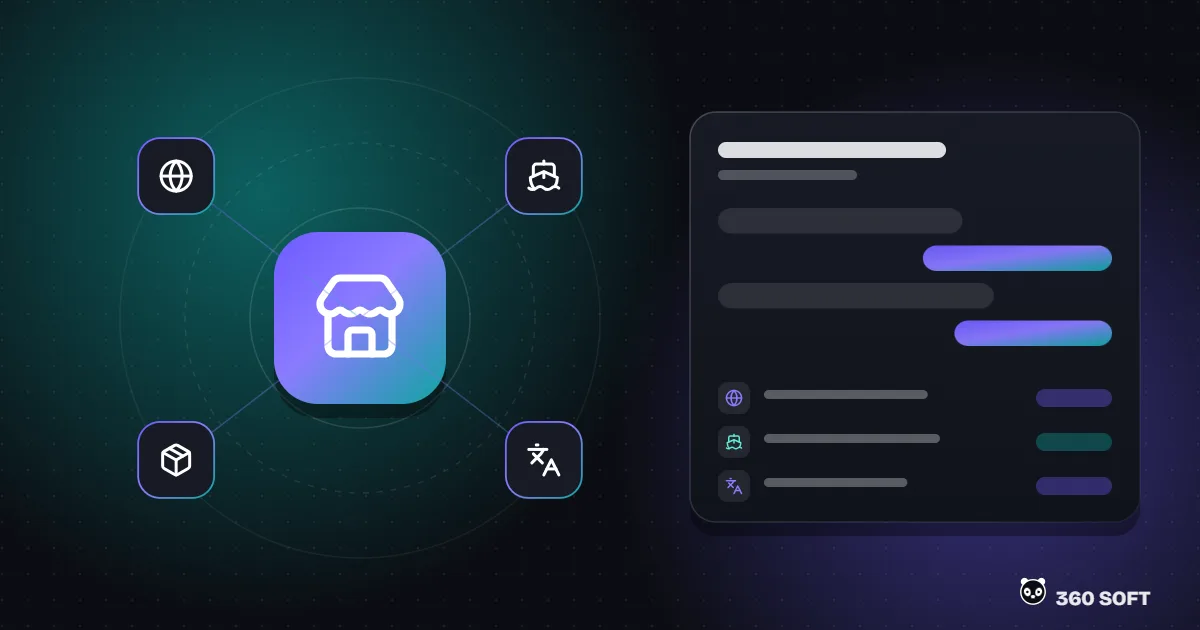
Central Product Catalogue

Variants, dimensions, materials and images kept in one place, with language-specific description fields and channel-specific title and category mapping.

Multilingual E-Commerce Site

Separate URL structure and hreflang for every language, currency selection, country-based display rules and an interface that supports right-to-left languages such as Arabic.

B2B Wholesale Buyer Module

Approved accounts, price lists per customer group, tiered pricing, minimum order quantities and pro forma requests.

Amazon Integration

Product listing, stock and price updates and pulling orders into the central panel through the Selling Partner API.

Etsy and Other Marketplaces

Listing and order synchronisation with the Etsy Open API, the eBay API and other platforms that offer an API.

Central Orders and Stock

Orders from every channel managed in one list, stock reduced on other channels at the moment of sale, and sales reports per channel.

International Payments and Shipping

Integration with providers that support international cards and local payment methods, plus labels and tracking numbers through international carriers’ APIs.

Multilingual Support Bot

An AI-assisted chatbot that answers order status, shipping and product questions in different languages; requests it cannot resolve are passed to your team.

Comparing channel strategies - Export E-Commerce Site and Marketplace Integration

Comparing channel strategies

Criterion Marketplace only Own site only Site + marketplace integration
Traffic source The platform’s own customer traffic SEO, advertising and repeat customers Both together
Customer data Largely stays with the platform Entirely yours Yours on your own site
Wholesale Limited Possible with a B2B module B2B on your own site, retail on both channels
Product management Separate on each platform One panel From a central catalogue to every channel
Stock risk Low, as there is one channel Low, as there is one channel Kept under control by synchronisation

An export e-commerce project, step by step

01

Target market and channel analysis

Which countries you will sell to, in which languages and through which channels; we also review the current state of your product data and your ERP/accounting set-up.

02

Catalogue and data model

Product attributes, variant structure and language fields are designed, and your existing product data is cleaned and migrated.

03

Site development

Multilingual design, the B2B/B2C role structure and payment and shipping integrations are developed, and technical SEO is configured for each language.

04

Marketplace connections

Channel connections are set up using the API permissions of your seller accounts, and field mappings and pricing rules are tested.

05

Go-live and monitoring

Sync errors and the order flow are monitored closely in the first weeks, and sales reports and automations are switched on.

Choosing the right platform - Export E-Commerce Site and Marketplace Integration

Choosing the right platform

Whether the platform should be built on a ready-made e-commerce package or as fully custom development depends on the number of channels and how deep your B2B needs go. If wholesale buyers carry the most weight, the structure described on our B2B portal development page is the starting point. Organic visibility in your target countries needs separate keyword research for each language; that is where our e-commerce SEO service comes in.

Connections with marketplaces and payment providers are subject to the API policies of the platforms concerned; maintaining the integrations against changes in platform rules is covered by post-launch support. To connect your existing ERP or accounting software, take a look at our ERP integration page.

Pricing: a fixed-price proposal tailored to your project, within 24 hours. Just tell us your target countries and the channels you sell on in the quote form.

Marketplaces offer ready-made traffic, but customer data and pricing rules are in the platform’s hands; your own site is a lasting channel for your brand and for repeat wholesale buyers. Many manufacturers start quickly with a marketplace and build their own site in parallel. Our recommendation is to keep product data in a central catalogue from day one; that way, whichever channel you start with, adding the second one does not turn into a data entry project.

We build integrations with platforms that offer sellers an official API, for example the Amazon Selling Partner API, the Etsy Open API and the eBay API. Domestic marketplaces and other regional platforms can be added as far as they provide API access. Because each platform has its own product templates, categories and approval rules, channel-by-channel field mapping is part of the project scope.

The platform includes language-specific fields for every product, category and page. A first draft can be produced quickly with AI-assisted translation, but we recommend having product titles and sales copy checked at native-speaker level so they read naturally in the target market. Each language gets its own URL and hreflang tags, so search engines show the right language in the right country.

We integrate with the APIs of payment providers that support international cards and local payment methods; which provider fits is decided based on your target countries and your company structure. On the shipping side, creating shipments and obtaining labels and tracking numbers through international carriers’ APIs can be automated.

Yes. When approved B2B accounts log in, they see their own price list, minimum order quantities and tiered prices, and can request a pro forma invoice. Individual visitors see retail prices in the same catalogue.

Prices for our standard e-commerce packages are published on our e-commerce packages page. For the export-specific multilingual set-up and marketplace integrations, we prepare a fixed-price proposal tailored to your project based on the number of languages, channels and integrations; the proposal is sent within 24 hours.

The next success story
is yours.

The first consultation is free. We prepare a tailored proposal within 24 hours.

Get a free quote