2D gameTeam-based word association party gameOriginal by Czech Games Edition (tasarım: Vlaada Chvátil)
Codenames is a team game built on the cleverness of pointing to several words with a single one-word clue. A grid of word cards sits on the table; each team’s spymaster knows which words are their agents and gives teammates one word and a number. Wrong guesses hand points to the other team, and the assassin card ends the game instantly. Thinking together and those “how did you get that?” moments make it highly social.
The most valuable asset for a similar digital game is a carefully curated word pool: words that are open to association and have multiple meanings without being inappropriate, ideally in each language you launch in. On top of that you build rooms with team and role assignment, a secret map visible only to spymasters, clue validation (blocking clues that are words on the grid), guess voting and voice or text communication. For friend groups playing remotely, a setup that works alongside a video call is important.
Why Codenames works: the core loop
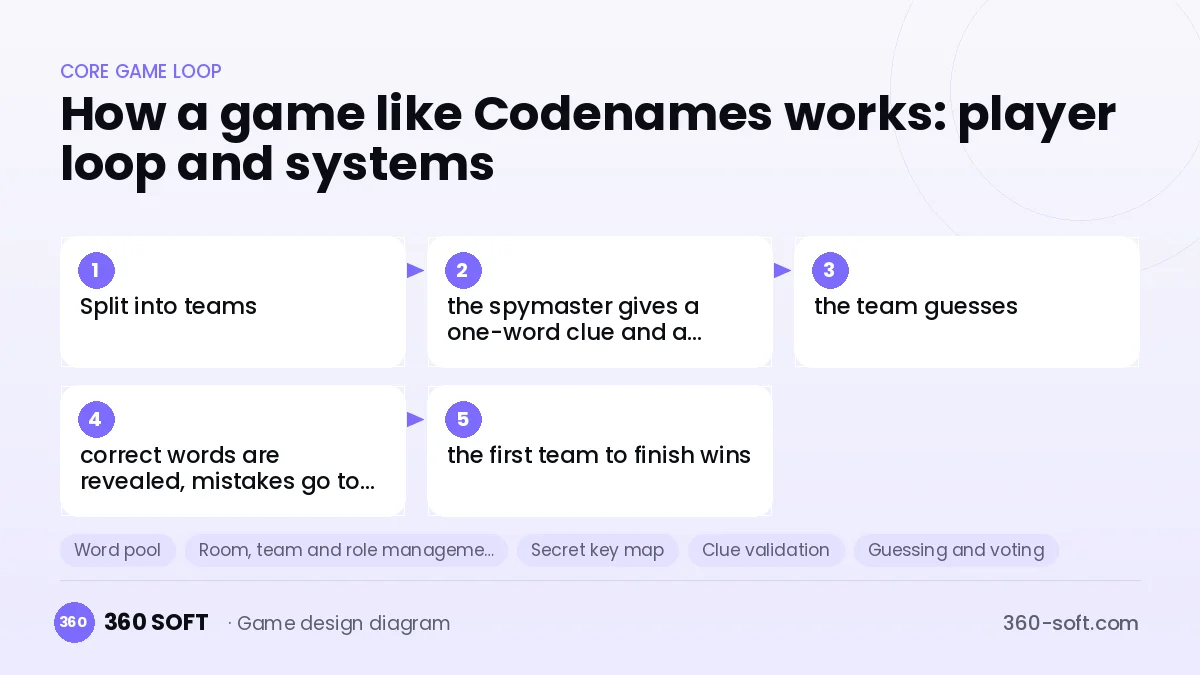
Systems you need to build a game like Codenames
Word pool
Words grouped by category with strong associative power; difficulty levels, theme packs and an inappropriate-content filter.
Room, team and role management
Room codes, team selection, the spymaster role, spectator mode and a flexible layout based on player count.
Secret key map
The colour layout shown only to spymasters; information kept on the server and sent to clients according to role.
Clue validation
Language-aware stem and inflection checks (plurals, verb forms, compounds) that block grid words or their roots from being used as clues.
Guessing and voting
Team members suggesting words and voting, the confirmed guess being revealed and turn timers.
Custom word lists
The ability to upload your own word list for a school, company event or group of friends.
What goes into the first version, what comes later
First version (soft launch)
- A core English word pool
- Friend rooms with room codes and team selection
- Spymaster map, clue and guess flow
- Clue validation and turn timer
- A responsive interface that works on web and mobile
Later updates
- A picture card mode
- A two-player co-op mode
- Theme packs and custom list sharing
- An admin panel for corporate events and classroom use
The hard parts of this genre
Word list quality
The word pool directly decides the game’s quality; words that are too easy, too hard or culturally problematic must be weeded out, and the pool should be built with a linguist’s eye.
Stem and inflection checks
An inflected form of a grid word (plurals, -ing forms, compounds) can easily slip through as a clue, and other languages bring their own morphology; stemming logic is needed.
Role-based hidden information
If the spymaster map is accidentally sent to the client, the game becomes pointless; state must be filtered by role on the server.
Team, timeline and budget
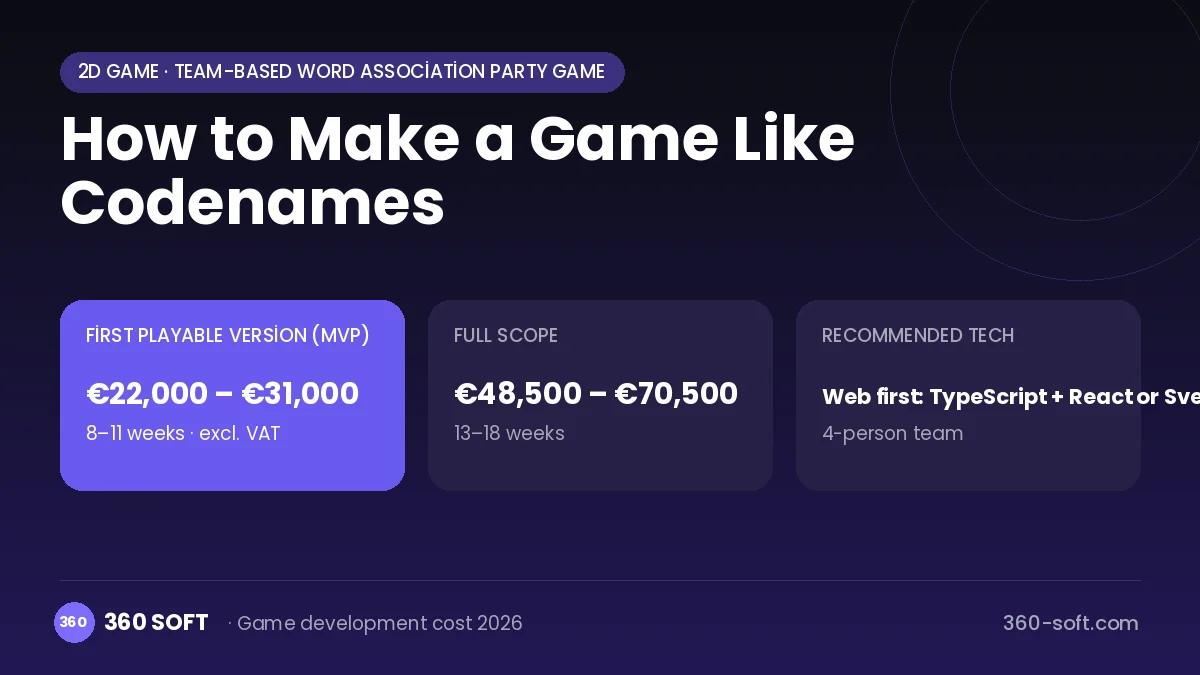
The estimate is based on the genre’s core systems, content volume, multiplayer and live-ops needs plus QA and project management: about 185 person-days for the full scope and 83 person-days for the first version. Cutting scope (fewer levels, one map, fewer characters) lowers the budget directly. Store accounts, servers, audio licences and user-acquisition budget are separate items. We send a fixed written price within 24 hours after the game design document.
Monetisation
For party word games, a free base game with paid theme and word packs, an ad-free upgrade and premium room features works well. Corporate licences or subscriptions for schools and company events are a separate revenue channel. Keeping ads from interrupting the flow of turns is important to protect the social experience.
Estimate your game budget and get a fixed quote
Let us scope it together and send a fixed written quote within 24 hours. NDA on request; you own the source code.
Calculated instantly from your choices, excl. VAT. A fixed written quote follows a free scoping call within 24 hours.
Choosing a game development company for a game like Codenames
Most people searching “make a game like codenames” are really looking for a reliable game development company. When comparing quotes, check four things:
- Can you play their released 2D games on your own phone?
- Are the source code, art files and store accounts transferred to you by contract?
- Do they build a playable prototype first and show a demo every two weeks?
- Are multiplayer servers, anti-cheat and scaling costs written into the quote?
Copyright and originality
Game mechanics on their own are generally not protected, but names, logos, characters, art, audio and level designs are. That is why we build a game “like Codenames” with your own name, art and world. This is not legal advice; we recommend a trademark search before launch.
Frequently asked questions
How long does it take to make a game like Codenames?
A web-based version with rooms and teams can be built in somewhere between a few weeks and a few months. The most effort goes into a high-quality word pool and clue validation.
Will there be copyright issues?
The team word association mechanic is generally free to use. The Codenames name, card designs, the word list itself and the rules text cannot be copied; an original game with your own word pool and design is possible. This is not legal advice.
Web or mobile app?
For friend groups, a web version that people join instantly via a link usually spreads fastest. A mobile app can be added later for notifications and store visibility.
What should I look for when choosing a word game developer?
Look at their experience with natural language processing (stemming and morphology), real-time room infrastructure and clean UI design. Always clarify who will build the word pool and how.