3D gameBattle royale shooterOriginal by Krafton, Tencent Games
What makes PUBG Mobile addictive is that every match is a survival story starting from zero. You decide where to drop from the plane, loot quickly and race both the clock and your rivals against a shrinking safe zone. The high-risk, high-reward balance and the “one more match” feeling, where even a single chance encounter becomes a memorable moment, keep players coming back.
For a similar game you need to be honest first: a huge map, crowded lobbies and dozens of weapons at the original scale are not realistic for a small team. A first release targets one compact map, smaller lobbies and a limited weapon set. Even so, server-authoritative netcode, distance-based data streaming (interest management), matchmaking, anti-cheat and optimised 3D graphics that run smoothly on mobile are essential.
Why PUBG Mobile works: the core loop
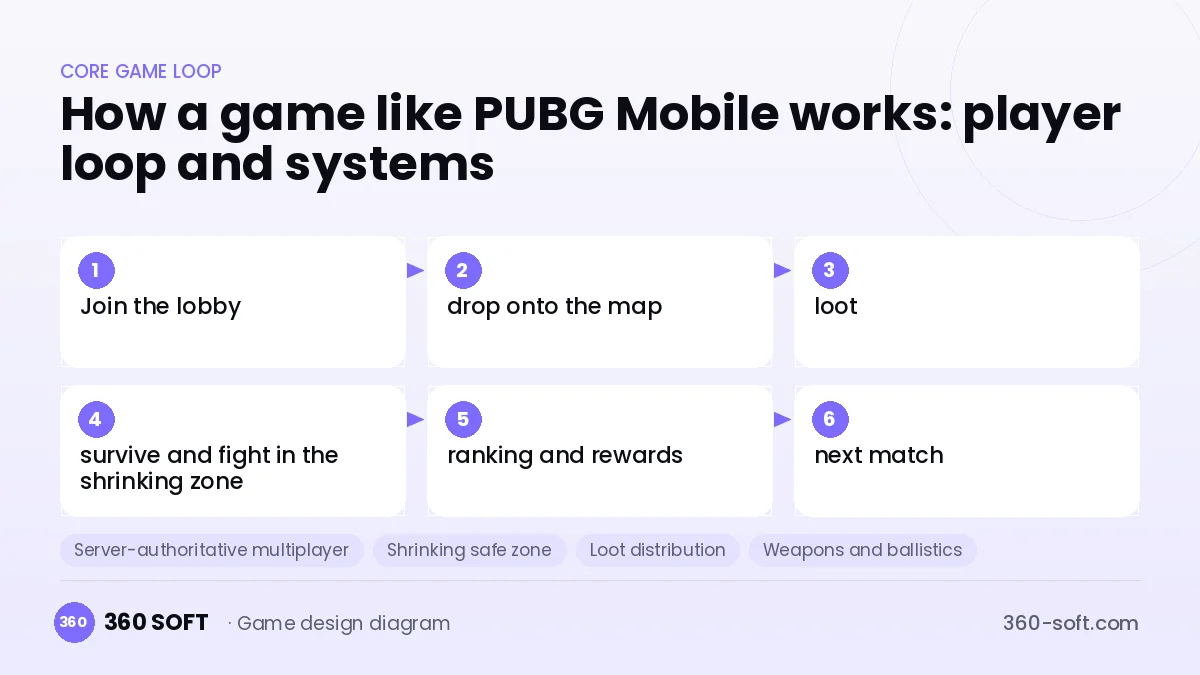
Systems you need to build a game like PUBG Mobile
Server-authoritative multiplayer
The server validates movement and shots; client-side prediction and lag compensation make hits feel fair.
Shrinking safe zone
Phase timings, escalating damage and randomised zone centres; the main system that sets match pacing.
Loot distribution
Weighted weapon, armour, attachment and healing tables by building and area type; balance must be tunable remotely.
Weapons and ballistics
Bullet drop, recoil patterns, attachment effects on recoil and touchscreen aim assist.
Matchmaking and lobby
Region- and skill-based queues, solo/duo/squad modes, bot backfill and match server spin-up.
Anti-cheat and reporting
Detection of speed hacks, wallhacks and aimbots, suspicious-match replays and a player reporting flow.
What goes into the first version, what comes later
First version (soft launch)
- One compact map (far smaller than the original)
- Smaller lobbies, with empty slots filled by bots
- Limited weapon set (a few rifles, pistols, shotguns and snipers)
- Solo and duo modes with basic matchmaking
- Basic anti-cheat and a first version of the cosmetics store
Later updates
- New maps and more vehicle variety
- Seasonal battle pass and clan system
- Ranked league, tournaments and spectator mode
- Arcade/event modes and collaboration content
The hard parts of this genre
Network cost and scale
Every match needs its own server process; as player numbers grow the server bill climbs fast, so efficient netcode is critical.
Mobile performance
Wide open areas, many players and effects drop frame rates on mid-range phones; aggressive LOD and quality tiers are needed.
Cheating and fairness
Popular shooters are prime targets for cheaters; without server validation community trust is lost quickly.
Team, timeline and budget
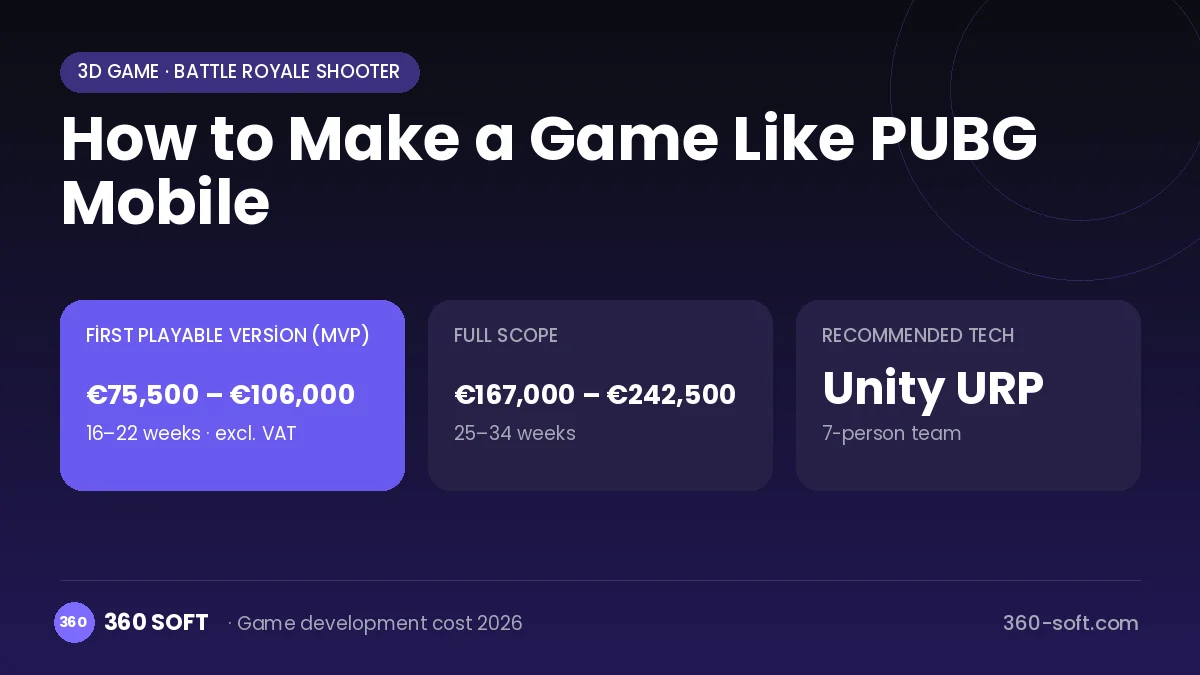
The estimate is based on the genre’s core systems, content volume, multiplayer and live-ops needs plus QA and project management: about 642 person-days for the full scope and 289 person-days for the first version. Cutting scope (fewer levels, one map, fewer characters) lowers the budget directly. Store accounts, servers, audio licences and user-acquisition budget are separate items. We send a fixed written price within 24 hours after the game design document.
Monetisation
Selling power kills games in this genre; revenue comes almost entirely from cosmetics. A seasonal battle pass, character and weapon skins, parachutes, vehicle wraps and time-limited crate or collection events are the core model. If loot boxes are used, odds must be clearly disclosed and local regulations followed. Regional pricing also has a significant effect on conversion.
Estimate your game budget and get a fixed quote
Let us scope it together and send a fixed written quote within 24 hours. NDA on request; you own the source code.
Calculated instantly from your choices, excl. VAT. A fixed written quote follows a free scoping call within 24 hours.
Choosing a game development company for a game like PUBG Mobile
Most people searching “make a game like pubg mobile” are really looking for a reliable game development company. When comparing quotes, check four things:
- Can you play their released 3D games on your own phone?
- Are the source code, art files and store accounts transferred to you by contract?
- Do they build a playable prototype first and show a demo every two weeks?
- Are multiplayer servers, anti-cheat and scaling costs written into the quote?
Copyright and originality
Game mechanics on their own are generally not protected, but names, logos, characters, art, audio and level designs are. That is why we build a game “like PUBG Mobile” with your own name, art and world. This is not legal advice; we recommend a trademark search before launch.
Frequently asked questions
How long does it take to make a game like PUBG Mobile?
A full-scale equivalent takes large teams years. A playable MVP with one map and smaller lobbies can be built by an experienced team in somewhere between a few months and a year; network infrastructure and testing drive the timeline most.
Are there copyright issues?
Battle royale mechanics (a shrinking zone, looting) are generally free to use. However, the name, logo, map design, characters, artwork and sounds cannot be copied. This is general information, not legal advice.
Can a small team build it?
A small team can succeed only by cutting scope hard: one map, fewer players, limited weapons. Starting this kind of game without a network programmer and a backend specialist is not recommended.
What should I look for in a studio that builds games like PUBG Mobile?
Check whether they have launched a real-time multiplayer game before, how they plan server costs and how they approach anti-cheat. Ask for a load-tested prototype, not just a visual demo.