3D gameOpen-world action RPG (gacha)Original by HoYoverse
What makes Genshin Impact so powerful is how it combines the curiosity of exploring a vast anime-styled open world with the passion of collecting characters. Behind every hill players see a chest, a puzzle or a new region, and team building based on elemental reactions turns every new character into both a visual and a strategic reward. Regular updates, story chapters and limited-time banners bring players back for months.
To be honest, a game at this scale takes hundreds of people and years; a small first release must cut scope radically. A realistic MVP: one limited island or region, four to six playable characters, two or three element interactions, a short story chapter and a simple gacha system. That requires a character controller, a combat system, a stylised (toon) shader, content tools and server-side inventory and pull validation.
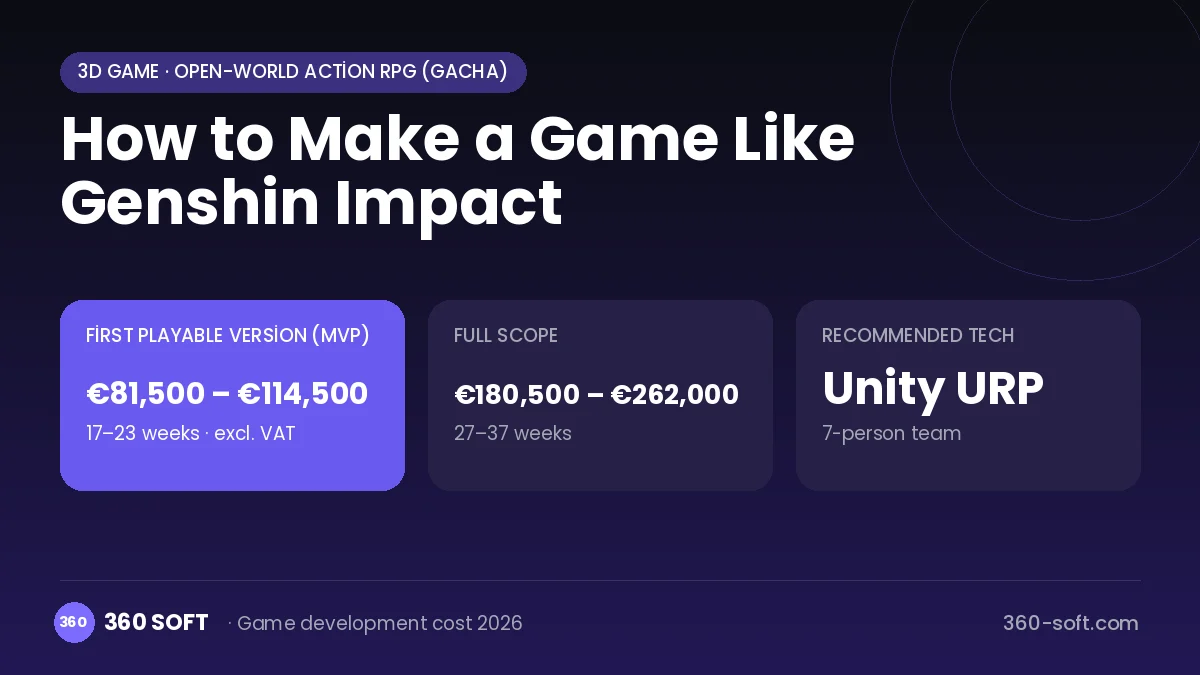
Why Genshin Impact works: the core loop
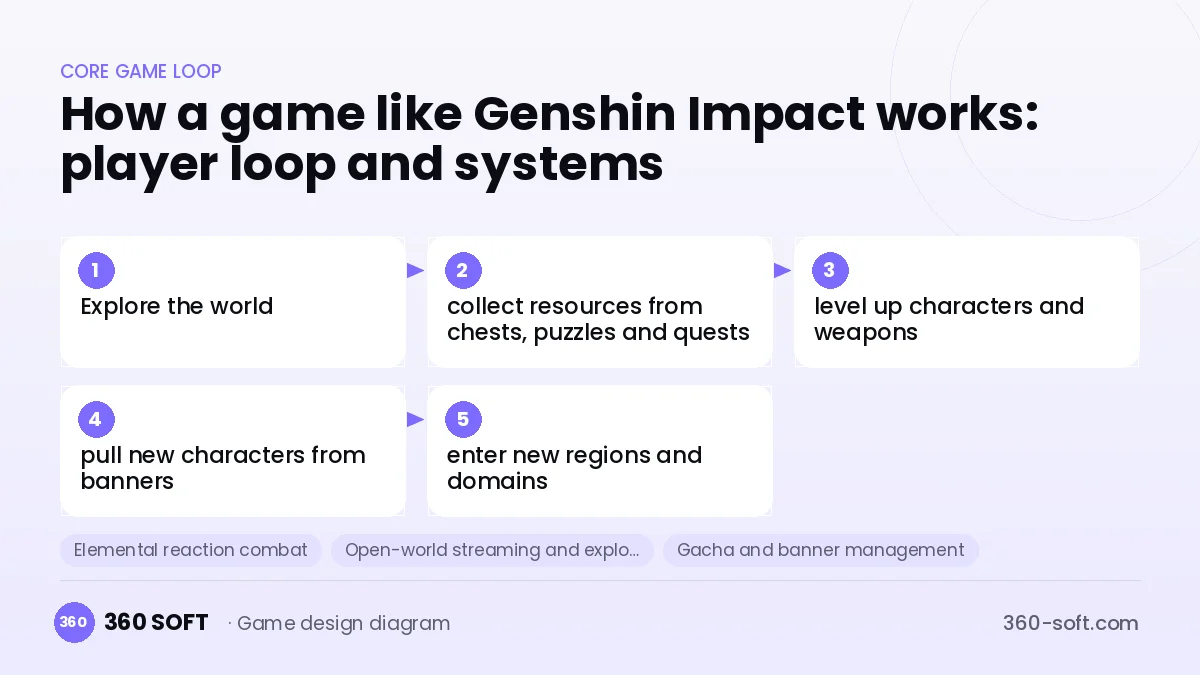
Systems you need to build a game like Genshin Impact
Elemental reaction combat
Real-time combat built on switching characters within a team, where elements such as fire, water and ice trigger each other. Damage formulas and reaction tables should be data-driven.
Open-world streaming and exploration
A world loaded piece by piece, with climbing, gliding and fast-travel points. Exploration rewards must be spread evenly across the map.
Gacha and banner management
Odds tables, pity counters and limited-time banners run on the server. Legally required odds disclosures and record keeping are mandatory.
Character and gear progression
Levels, talents, ascension materials and an artifact-style substat system. The material economy sets the player's weekly routine.
Quest and dialogue tools
A node-based quest editor for main story, side and daily quests, with cutscene and voice-over infrastructure.
Stamina and daily routine
A refilling resource that caps domain rewards, daily commissions and weekly bosses. It balances progression speed and return visits.
What goes into the first version, what comes later
First version (soft launch)
- One small hand-crafted region (feels open-world but limited in size)
- 4–6 playable characters, 2–3 elements and basic reactions
- A short main story chapter and a few side quests
- Simple gacha: one standard banner, transparent odds and a pity counter
- Cloud save, server-validated inventory and basic analytics
Later updates
- New regions, element types and story chapters
- Limited-time character banners and seasonal events
- Real-time co-op (joining a friend's world)
- Console/PC version with full voice-over and multiple languages
The hard parts of this genre
Content production speed
Players consume new regions and characters very fast. Unless the character model, animation, VFX and voice-over pipeline scales from the start, the update schedule slips.
Open-world performance on mobile
Long view distances, foliage and effects running smoothly on mid-range phones require LOD, occlusion and aggressive optimisation.
Gacha balance and regulation
An economy that is too stingy drives players away, one that is too generous earns nothing. Many markets also enforce odds disclosure and age rules.
Team, timeline and budget
The estimate is based on the genre’s core systems, content volume, multiplayer and live-ops needs plus QA and project management: about 693 person-days for the full scope and 312 person-days for the first version. Cutting scope (fewer levels, one map, fewer characters) lowers the budget directly. Store accounts, servers, audio licences and user-acquisition budget are separate items. We send a fixed written price within 24 hours after the game design document.
Monetisation
In this genre the backbone of revenue is the character and weapon gacha, which must be offered with transparent odds and a pity system. A small monthly pass (daily premium currency), a battle pass and cosmetic outfits come alongside. Ads do not fit this quality perception; revenue rests on a regular schedule of new character banners and players' emotional attachment to characters.
Estimate your game budget and get a fixed quote
Let us scope it together and send a fixed written quote within 24 hours. NDA on request; you own the source code.
Calculated instantly from your choices, excl. VAT. A fixed written quote follows a free scoping call within 24 hours.
Choosing a game development company for a game like Genshin Impact
Most people searching “make a game like genshin impact” are really looking for a reliable game development company. When comparing quotes, check four things:
- Can you play their released 3D games on your own phone?
- Are the source code, art files and store accounts transferred to you by contract?
- Do they build a playable prototype first and show a demo every two weeks?
- Are multiplayer servers, anti-cheat and scaling costs written into the quote?
Copyright and originality
Game mechanics on their own are generally not protected, but names, logos, characters, art, audio and level designs are. That is why we build a game “like Genshin Impact” with your own name, art and world. This is not legal advice; we recommend a trademark search before launch.
Frequently asked questions
How long does it take to make a game like Genshin Impact?
A game at the original scale takes large teams years. For a small team the realistic goal is to start with a vertical slice of one region and a few characters, then grow based on soft-launch data.
Are there copyright issues?
Mechanics such as an open world, elemental combat or gacha are generally free to use. However, characters, names, world design, artwork and music cannot be copied; an original world and art direction are essential. This is not legal advice.
Which engine should I use?
For a mobile-first anime style, Unity URP with a custom toon shader is the most common choice. For PC/console-focused projects with high visual targets, Unreal Engine 5 is worth considering.
What should I look for in a studio that builds games like Genshin Impact?
Look for a team with 3D character animation, open-world optimisation and server-side economy experience. A studio that honestly cuts scope and presents an MVP and roadmap in writing is more trustworthy than one that promises everything.