2D gameOnline word game (Turkish, Scrabble-style)
Kelimelik is a hugely popular online word game from Turkey, built for the Turkish language: players place letter tiles on a board to form words and score points, in the spirit of classic crossword board games. Players take turns, so you can play several opponents at once at different times of day. Showing off your vocabulary, grabbing the premium squares and long-running matches with friends create a strong social bond. The game works as both a battle of wits and a way to keep in touch.
A similar game first needs a comprehensive, accurate dictionary for each target language: inflected forms, rules for proper nouns and abbreviations, and correct handling of special characters (for Turkish, letters such as ç, ğ, ı, ö, ş and ü). On top of that come a turn-based (asynchronous) match server, move validation, notifications, matchmaking, chat, rankings and anti-cheat. Balancing the tile distribution and point table to the letter frequency of the language directly determines game quality.
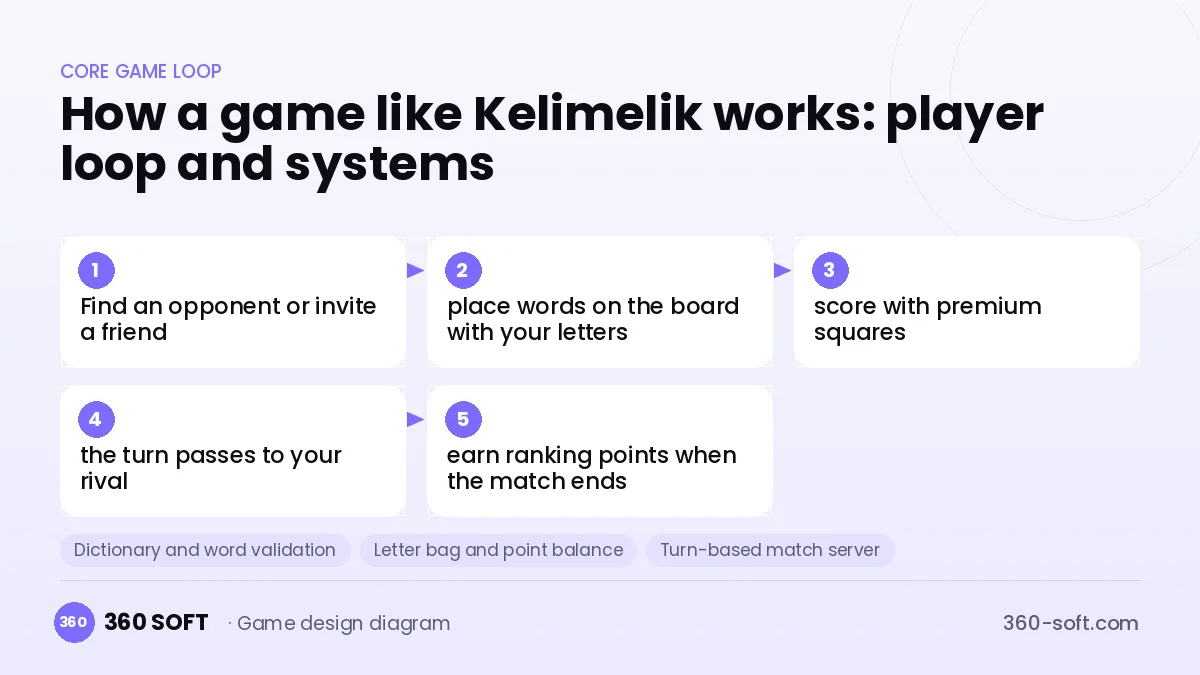
Why Kelimelik works: the core loop
Systems you need to build a game like Kelimelik
Dictionary and word validation
A fast, updatable word database that correctly handles inflected forms and language-specific characters.
Letter bag and point balance
Tile distribution, letter values and premium-square layout tuned to the letter frequency of the target language.
Turn-based match server
An asynchronous setup that stores many concurrent matches, validates moves on the server and handles timeouts.
Notifications and reminders
Push notifications sent when it is the player’s turn, when an opponent sends a message or when time is about to run out.
Matchmaking, friends and chat
Skill-based opponent search, adding friends, in-match chat and an inappropriate-content filter.
Rankings and leagues
A competitive layer that awards points based on match results, with weekly leagues and a global leaderboard.
What goes into the first version, what comes later
First version (soft launch)
- Dictionary-based word validation and the classic board
- Turn-based online matches and random matchmaking
- Friend invites and push notifications
- In-match chat and basic moderation
- Ad integration and analytics
Later updates
- A fast (timed, real-time) match mode
- Weekly leagues and tournaments
- Sales of helpers such as word hints and letter swaps
- Board themes, avatars and profile cosmetics
The hard parts of this genre
Dictionary quality
Missing or wrongly accepted words destroy player trust fastest; the dictionary needs regular maintenance and a dispute process.
Cheating and word-finder tools
External word-finder apps break competition; suspicious players should be monitored through move timing, probability analysis and reporting.
Chat moderation
Players matched with strangers face a risk of harassment and abuse; filtering, blocking and a reporting flow are essential.
Team, timeline and budget
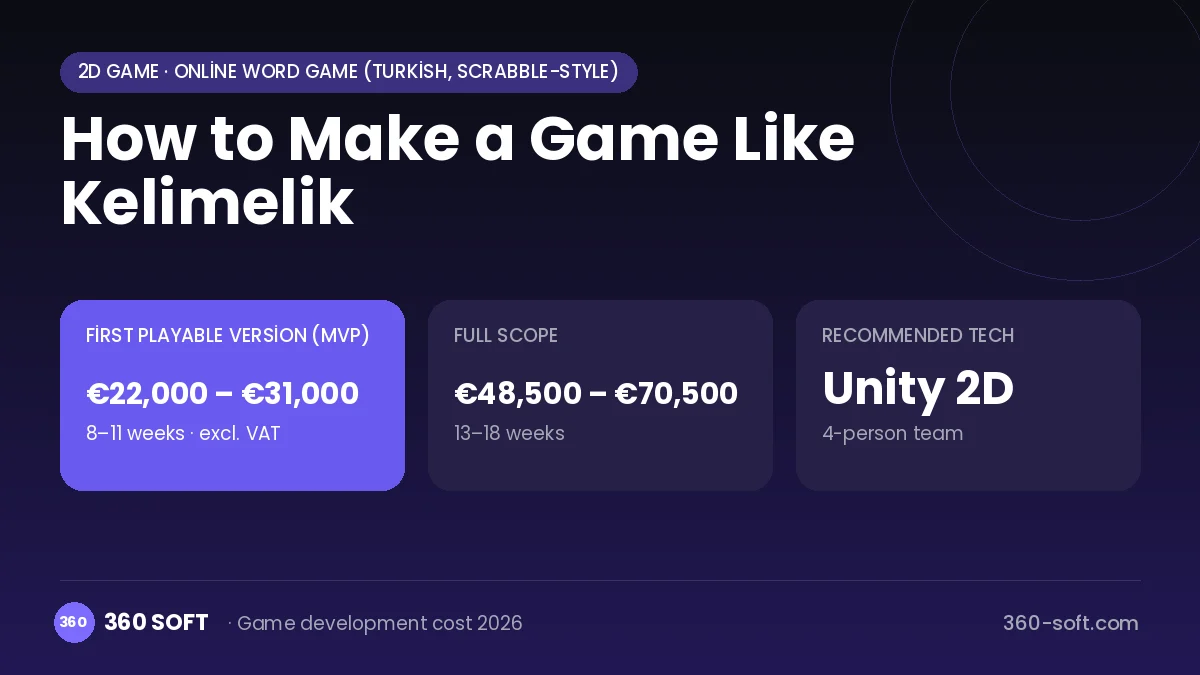
The estimate is based on the genre’s core systems, content volume, multiplayer and live-ops needs plus QA and project management: about 186 person-days for the full scope and 84 person-days for the first version. Cutting scope (fewer levels, one map, fewer characters) lowers the budget directly. Store accounts, servers, audio licences and user-acquisition budget are separate items. We send a fixed written price within 24 hours after the game design document.
Monetisation
In word games, ads between turns and after matches, plus rewarded ads watched for hints, are the main revenue sources. An ad-free membership or VIP subscription is a strong option for a large audience that plays regularly. Helpers such as letter swaps and word hints, along with board and avatar cosmetics, offer extra purchase opportunities.
Estimate your game budget and get a fixed quote
Let us scope it together and send a fixed written quote within 24 hours. NDA on request; you own the source code.
Calculated instantly from your choices, excl. VAT. A fixed written quote follows a free scoping call within 24 hours.
Choosing a game development company for a game like Kelimelik
Most people searching “make a game like kelimelik” are really looking for a reliable game development company. When comparing quotes, check four things:
- Can you play their released 2D games on your own phone?
- Are the source code, art files and store accounts transferred to you by contract?
- Do they build a playable prototype first and show a demo every two weeks?
- Are multiplayer servers, anti-cheat and scaling costs written into the quote?
Copyright and originality
Game mechanics on their own are generally not protected, but names, logos, characters, art, audio and level designs are. That is why we build a game “like Kelimelik” with your own name, art and world. This is not legal advice; we recommend a trademark search before launch.
Frequently asked questions
How long does it take to make a game like Kelimelik?
The board and word validation are set up quickly; most of the time goes into preparing the dictionary, the async match server, notifications and moderation tools. The timeline varies considerably with scope.
Will making a game like Kelimelik cause copyright problems?
The mechanic of placing words on a board with letter tiles is generally free to use. Another game’s name, logo, board design and visuals cannot be copied, and the licences of dictionary sources must also be checked. This is not legal advice.
Where can I get a dictionary for the game?
Open-source word lists with suitable licences can be a starting point, but inflected forms and special rules need custom processing, especially for agglutinative languages such as Turkish. Continuously updating the dictionary from player feedback is important.
What should I look for when choosing a studio to build a word game?
Ask about the studio’s experience with language-specific text processing, async multiplayer servers and notification infrastructure. A moderation and anti-cheat plan should also be part of the proposal.