3D gameBase-building real-time strategy (RTS)Original by Westwood Studios / Electronic Arts
The Command & Conquer series is one of the games that popularised the modern RTS formula: deploying structures from a construction yard, gathering resources with harvesters, protecting power plants and finally rocking your opponent with a superweapon. Red Alert and Generals / Zero Hour in particular became legends of LAN parties and internet cafes. Over-the-top units, fast pacing and a story told through live-action cutscenes define the series' character.
A similar game needs a fast-paced base-building and production core, power and resource dependencies, factions with distinct personalities and superweapons that can end a match. On the technical side, crowd pathfinding, destructible structures, fog of war and deterministic netcode for multiplayer matter; on the content side, a mission-based campaign, unit voice lines and a strong musical identity are key.
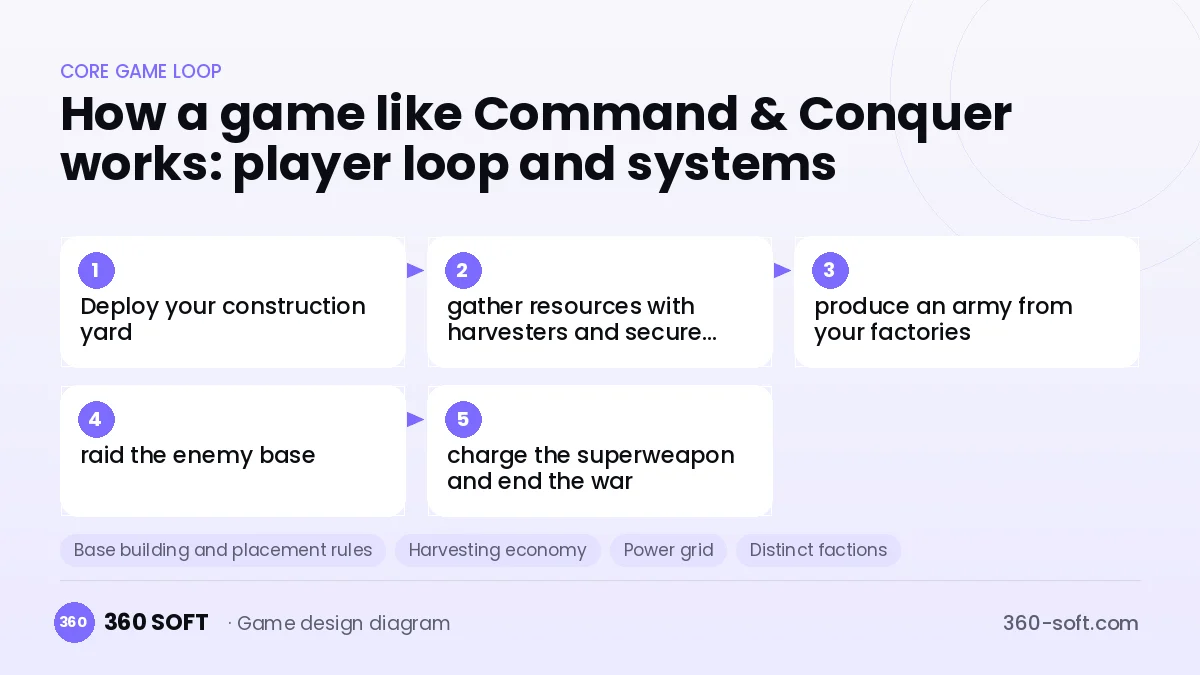
Why Command & Conquer works: the core loop
Systems you need to build a game like Command & Conquer
Base building and placement rules
A system where structures can only be built near the existing base, with a build queue and the option to sell back. Expanding the base is a strategic decision.
Harvesting economy
Income collected by harvester vehicles from resource fields on the map. Protecting your harvester and hunting the opponent's sets the rhythm of the match.
Power grid
If power plants fall, defences and production slow down. Power dependency makes target selection meaningful.
Distinct factions
Sides with clear identities, such as heavily armoured, stealth-focused or speed-focused, each with its own unit and building tree.
Superweapons and special powers
Long-cooldown abilities that warn everyone on the map and can change the course of a match. They must be balanced with countermeasures.
Mission campaign and cutscenes
Story-driven missions, a briefing screen and cutscenes. They keep the single-player audience hooked.
What goes into the first version, what comes later
First version (soft launch)
- 2 factions with 10–12 units and structures each
- Harvesting, power and production queue systems
- Skirmish mode against AI and 4 maps
- A short 6–8 mission campaign
- 1v1 online matches and LAN support
Later updates
- A third faction and sub-faction generals
- Superweapon variants and special ability trees
- 2v2 and 4-player skirmishes, ranked matchmaking
- Map editor and mod support
The hard parts of this genre
Speed versus readability
In a fast-paced RTS, players must be able to track production, defence and attack at the same time. The UI, audio cues and unit silhouettes are decisive.
Superweapon balance
An ability that can end the game is fun, but it must not feel unfair. Warning time, cost and countermeasures are tuned carefully.
Multiplayer sync
Preventing desyncs in matches with hundreds of units and destructible structures requires deterministic maths and extensive testing.
Team, timeline and budget
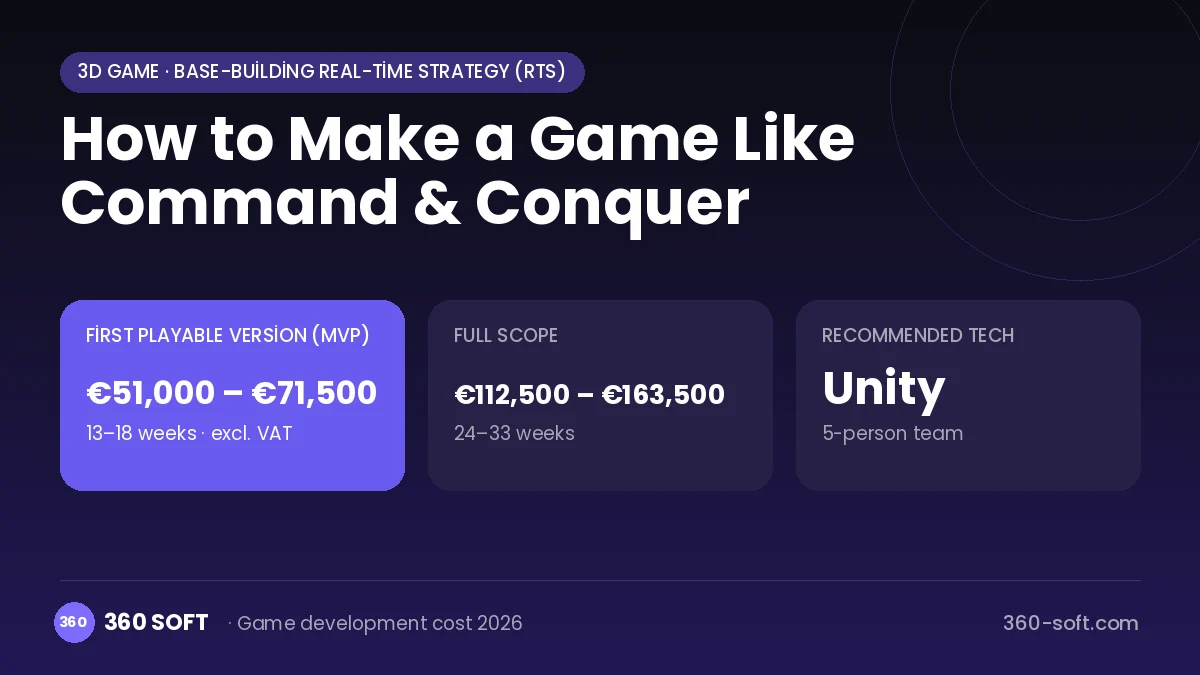
The estimate is based on the genre’s core systems, content volume, multiplayer and live-ops needs plus QA and project management: about 432 person-days for the full scope and 194 person-days for the first version. Cutting scope (fewer levels, one map, fewer characters) lowers the budget directly. Store accounts, servers, audio licences and user-acquisition budget are separate items. We send a fixed written price within 24 hours after the game design document.
Monetisation
In classic RTS games, premium sales, campaign expansions and faction packs are the core revenue sources. In a free-to-play multiplayer structure, general and unit skins, voice packs and a seasonal reward track can be used. Selling power quickly drives away the competitive audience, so keeping every unit available to everyone is recommended.
Estimate your game budget and get a fixed quote
Let us scope it together and send a fixed written quote within 24 hours. NDA on request; you own the source code.
Calculated instantly from your choices, excl. VAT. A fixed written quote follows a free scoping call within 24 hours.
Choosing a game development company for a game like Command & Conquer
Most people searching “make a game like command and conquer” are really looking for a reliable game development company. When comparing quotes, check four things:
- Can you play their released 3D games on your own phone?
- Are the source code, art files and store accounts transferred to you by contract?
- Do they build a playable prototype first and show a demo every two weeks?
- Are multiplayer servers, anti-cheat and scaling costs written into the quote?
Copyright and originality
Game mechanics on their own are generally not protected, but names, logos, characters, art, audio and level designs are. That is why we build a game “like Command & Conquer” with your own name, art and world. This is not legal advice; we recommend a trademark search before launch.
Frequently asked questions
How long does it take to make a game like Command & Conquer?
An RTS with two factions and a short campaign is a mid-to-large project. Multiplayer and netcode work takes significant extra time; a version playable against AI should be the first target.
Will there be copyright issues?
Base building, a harvesting economy and the superweapon idea are shared mechanics of the genre. The Command & Conquer name, original concepts such as Tiberium, faction names, characters and sounds cannot be copied. This is not legal advice.
Can we use a modern military theme like Generals?
Yes; modern military themes are free to use. However, narratives that target real countries and organisations should be evaluated carefully against store policies, and fictional factions are preferable.
What should I look for when choosing a studio to build an RTS?
Ask about deterministic multiplayer, crowd unit performance and AI opponent development experience. You should see the feel of base building early with a playable prototype.