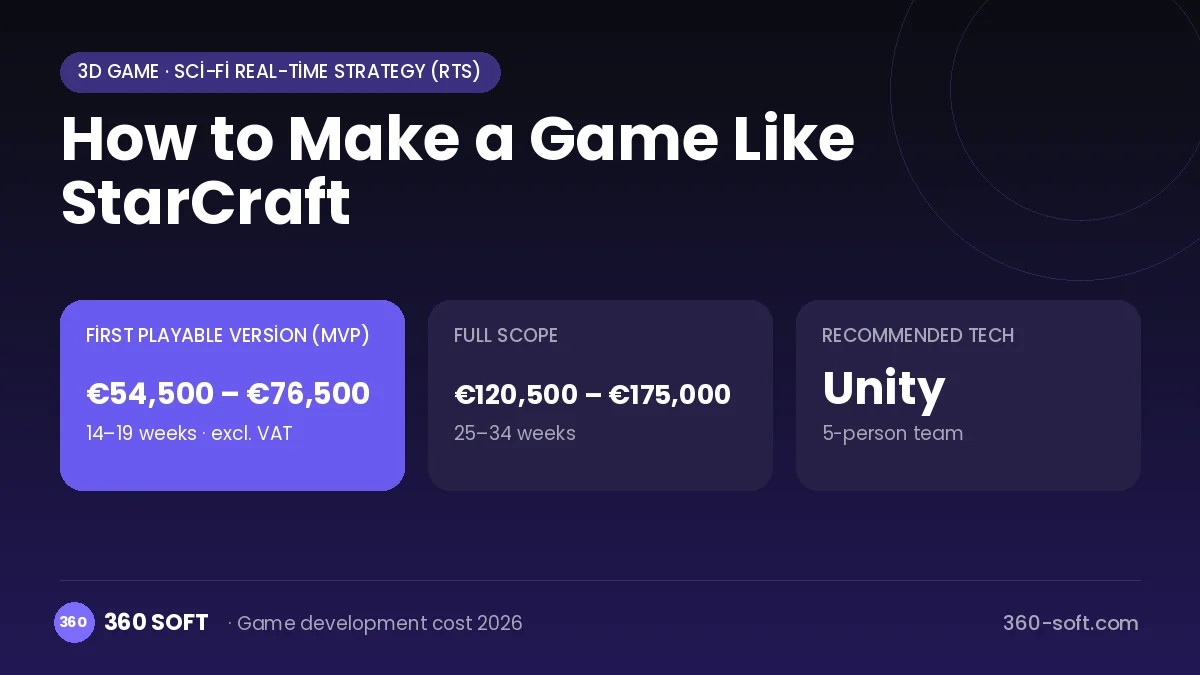
3D gameSci-fi real-time strategy (RTS)Original by Blizzard Entertainment
StarCraft became the benchmark for the RTS genre by keeping three races that play completely differently in a single competitive balance. Players manage workers, production and expansion on one hand (macro) and control units individually in the heat of battle on the other (micro). Split-second decisions deciding the outcome and a high skill ceiling kept the game at the forefront of the esports scene for many years.
Making a similar game means a deterministic simulation, fast and precise unit control and asymmetric faction design. Resource gathering, the tech tree, pathfinding, fog of war and targeting rules must work flawlessly. Multiplayer needs lockstep netcode, a replay system, ranked matchmaking and an observer mode; single-player needs a story campaign.
Why StarCraft II works: the core loop
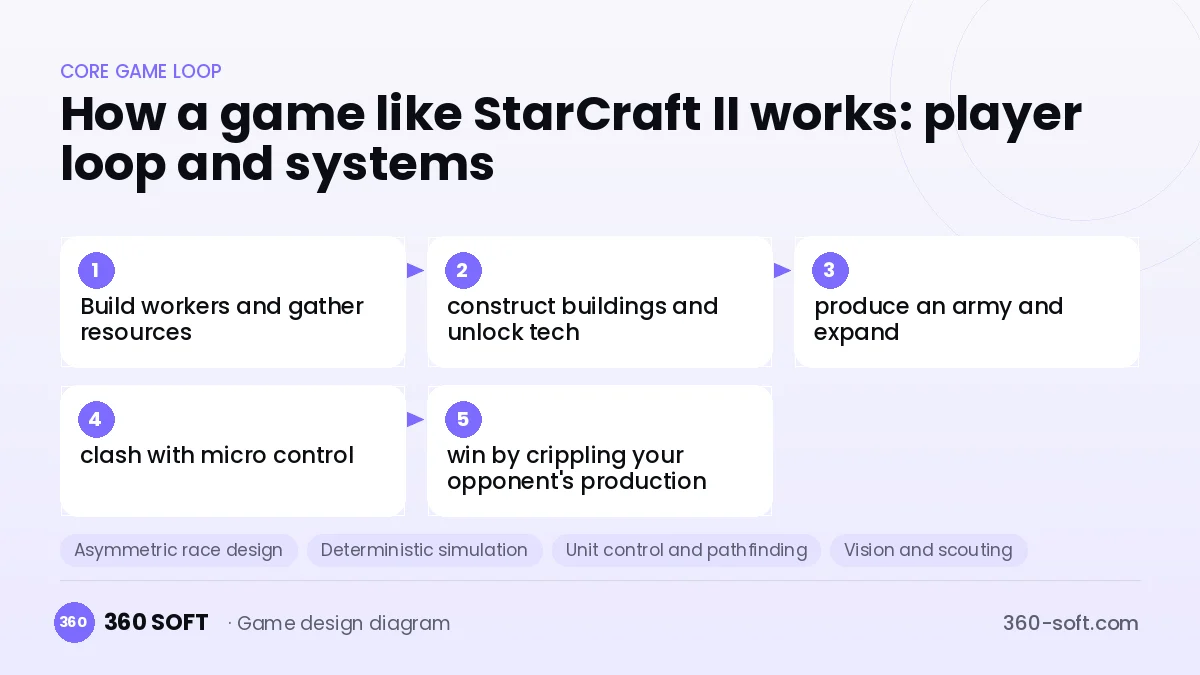
Systems you need to build a game like StarCraft II
Asymmetric race design
Factions with different economy, production and unit logic. Each race's strengths and weaknesses must be balanced numerically.
Deterministic simulation
Fixed-step game logic that produces the same result on every client; the foundation of lockstep multiplayer and the replay system.
Unit control and pathfinding
Group selection, control groups, hotkeys, swarms that move without jamming and precise targeting. Response time must be low.
Vision and scouting
Fog of war, high-ground advantage and scouting units. Incomplete information is the basis of strategic decisions.
Ranked matchmaking and leagues
Skill-rating-based matchmaking, seasonal leagues and a leaderboard. It keeps the competitive audience coming back.
Replays, observers and map editor
Match replays, a live spectator mode and an editor in which the community can create custom game modes.
What goes into the first version, what comes later
First version (soft launch)
- 2 asymmetric factions with 8–10 units each
- Resource gathering, tech tree and core buildings
- Skirmish against AI and a short tutorial campaign
- 1v1 online matches, lockstep netcode and replay recording
- 3–4 competitive maps
Later updates
- A third faction and story campaign
- Ranked leagues, seasons and 2v2 modes
- Map editor and custom game modes
- Co-op missions and commander progression
The hard parts of this genre
Deterministic netcode
Even floating-point differences cause desyncs in matches. Fixed-point maths and rigorous sync testing are essential.
Competitive balance
Building fair balance between asymmetric races requires constant data analysis and a patch cycle. The skill ceiling should be high and the entry barrier reasonable.
Winning new players
The RTS genre can be exhausting for newcomers. A good tutorial flow, co-op modes and AI matches broaden the audience.
Team, timeline and budget
The estimate is based on the genre’s core systems, content volume, multiplayer and live-ops needs plus QA and project management: about 462 person-days for the full scope and 208 person-days for the first version. Cutting scope (fewer levels, one map, fewer characters) lowers the budget directly. Store accounts, servers, audio licences and user-acquisition budget are separate items. We send a fixed written price within 24 hours after the game design document.
Monetisation
The core revenue for RTS games is premium sales on PC; campaign expansions add sales. If you move to free-to-play multiplayer, co-op commanders, cosmetic unit skins, announcer packs and a seasonal reward track generate revenue without breaking competitive balance. Any model that lets players pay directly for power quickly loses the trust of the esports audience.
Estimate your game budget and get a fixed quote
Let us scope it together and send a fixed written quote within 24 hours. NDA on request; you own the source code.
Calculated instantly from your choices, excl. VAT. A fixed written quote follows a free scoping call within 24 hours.
Choosing a game development company for a game like StarCraft II
Most people searching “make a game like starcraft” are really looking for a reliable game development company. When comparing quotes, check four things:
- Can you play their released 3D games on your own phone?
- Are the source code, art files and store accounts transferred to you by contract?
- Do they build a playable prototype first and show a demo every two weeks?
- Are multiplayer servers, anti-cheat and scaling costs written into the quote?
Copyright and originality
Game mechanics on their own are generally not protected, but names, logos, characters, art, audio and level designs are. That is why we build a game “like StarCraft II” with your own name, art and world. This is not legal advice; we recommend a trademark search before launch.
Frequently asked questions
How long does it take to make a game like StarCraft?
Even a two-faction RTS playable 1v1 online takes serious engineering because of deterministic netcode. Validating the unit feel first with a prototype played against AI is necessary.
Will there be copyright issues?
Resource gathering, the tech tree and the idea of asymmetric races are the shared heritage of the genre. The StarCraft name, race names, unit designs, story and sounds are protected and cannot be copied. This is not legal advice.
Do RTS games succeed on mobile?
Classic RTS controls are hard to carry over to touchscreens. Simplified designs with fewer units, auto-battling or card-based unit summoning work better on mobile.
What should I look for when choosing a studio to build an RTS?
Ask about deterministic simulation, lockstep netcode and crowd pathfinding experience. A team that can walk you through their replay and desync debugging processes is more reliable.