3D gameHyper-casual smash and reflex gameOriginal by Azur Games
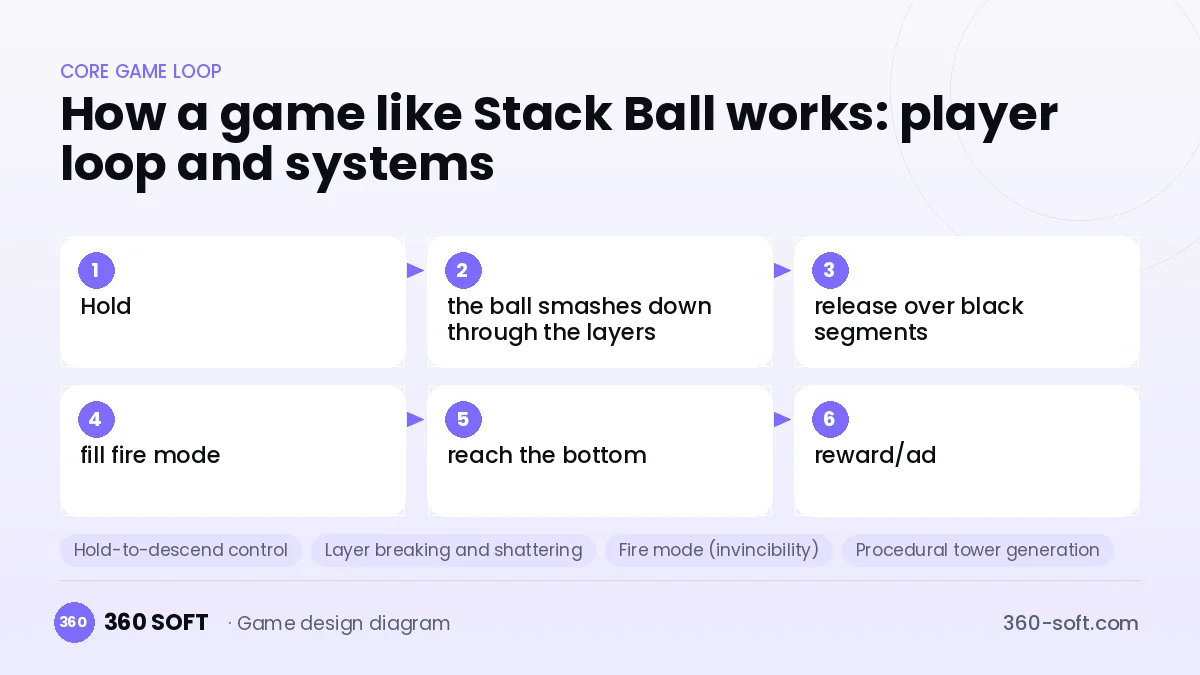
Stack Ball puts a single decision at the heart of the game: as long as you hold your finger on the screen, the ball smashes down through the rotating platform layers, and if you hit a black segment it is all over. That small tension between holding and releasing turns every second into a risk calculation. Holding for longer fills the fire mode, which hands the player a brief moment of invincibility and, together with the crunching sounds, creates one of the genre's most satisfying moments.
Making a similar game takes millimetre-precise tuning rather than complex systems: the ball's descent speed, the layer-break effect, the ratio of black to coloured segments and how fast fire mode fills. On top of that you need procedural tower generation, Remote Config to tune the difficulty curve remotely, ad mediation integration and analytics that show level drop-off points. The code is small; the real effort goes into feel testing and market tests.
Why Stack Ball works: the core loop
Systems you need to build a game like Stack Ball
Hold-to-descend control
Constant-speed descent while the finger is down and an instant stop on release. Lag-free input is what makes the game feel fair.
Layer breaking and shattering
Each layer splitting into segments that fly outwards, with short effects combined with sound and haptics. Pooled objects are used for performance.
Fire mode (invincibility)
A meter that fills with consecutive layers broken; once full, even black segments can be smashed. The core mechanic that feeds the urge to take risks.
Procedural tower generation
Layer shapes, rotation speed and black-segment ratio generated from a seed, with difficulty tuned per level number via Remote Config.
Colour palettes and ball cosmetics
Colour themes that change every level and unlockable ball skins. Visual freshness delays the simple loop from getting stale.
Ads and experimentation
Interstitial frequency, rewarded “continue” and banner placement, with A/B tests for difficulty and ad frequency.
What goes into the first version, what comes later
First version (soft launch)
- A tuned hold mechanic and layer-break effect
- Fire mode and combo feedback
- Procedural tower generation and a difficulty curve
- Rewarded continue and interstitial ad integration
- Analytics, Remote Config and basic cosmetic balls
Later updates
- New layer shapes and moving obstacles
- Boss towers and special event levels
- A cosmetic collection and a no-ads pack
- Daily missions and login rewards
The hard parts of this genre
Sense of fairness
If hitting a black segment does not feel like the player's own mistake, they quit straight away. Hitboxes and input latency must be tuned very carefully.
Effect density and performance
Hundreds of fragments flying at once can drop frames on low-end phones. Fragment counts should scale by device tier.
Fatigue from a repetitive loop
Because the mechanic is so simple, session counts fall quickly without visual variety and small twists.
Team, timeline and budget
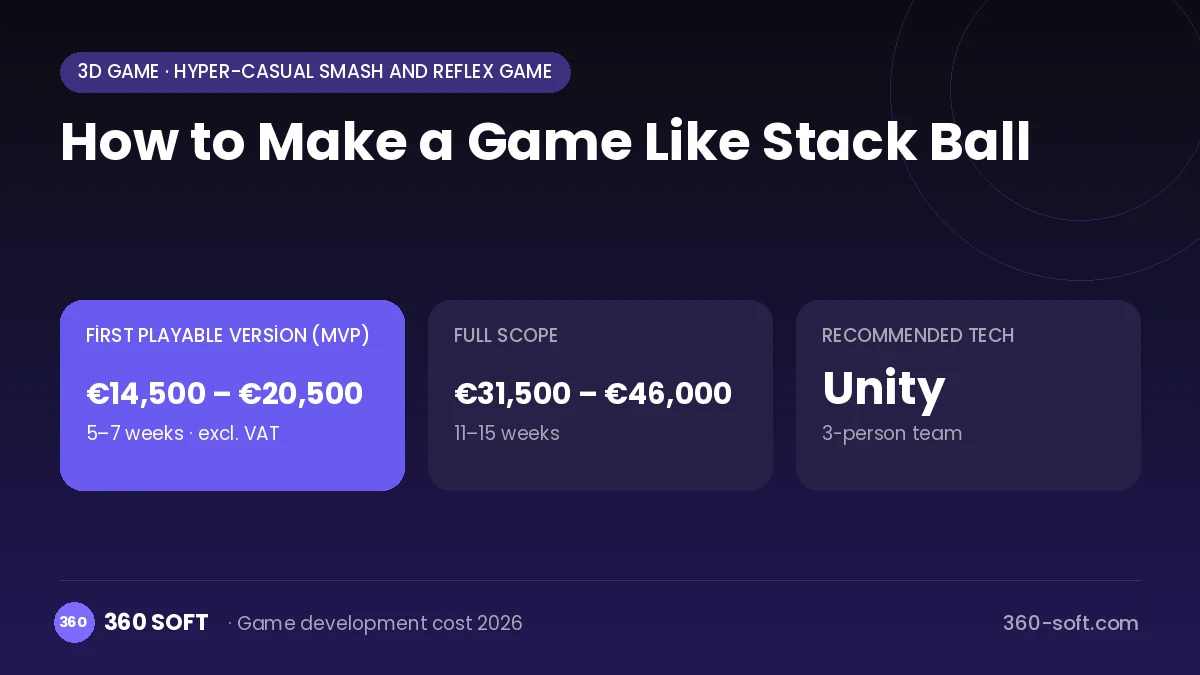
The estimate is based on the genre’s core systems, content volume, multiplayer and live-ops needs plus QA and project management: about 120 person-days for the full scope and 54 person-days for the first version. Cutting scope (fewer levels, one map, fewer characters) lowers the budget directly. Store accounts, servers, audio licences and user-acquisition budget are separate items. We send a fixed written price within 24 hours after the game design document.
Monetisation
Revenue comes mostly from ads: interstitials at level end, a rewarded “continue” after failing, doubling the level reward, and banners. A no-ads pack and a few cosmetic balls add extra income. Profitability depends on reaching enough session time at a low user acquisition cost, which is why ad frequency and the difficulty curve should be tested together.
Estimate your game budget and get a fixed quote
Let us scope it together and send a fixed written quote within 24 hours. NDA on request; you own the source code.
Calculated instantly from your choices, excl. VAT. A fixed written quote follows a free scoping call within 24 hours.
Choosing a game development company for a game like Stack Ball
Most people searching “make a game like stack ball” are really looking for a reliable game development company. When comparing quotes, check four things:
- Can you play their released 3D games on your own phone?
- Are the source code, art files and store accounts transferred to you by contract?
- Do they build a playable prototype first and show a demo every two weeks?
- Are ads, in-app purchases and analytics set up as part of the quote?
Copyright and originality
Game mechanics on their own are generally not protected, but names, logos, characters, art, audio and level designs are. That is why we build a game “like Stack Ball” with your own name, art and world. This is not legal advice; we recommend a trademark search before launch.
Frequently asked questions
How long does it take to make a game like Stack Ball?
A playable prototype comes together very quickly. For a launch-ready version, most of the time goes into feel tuning, ad integration and market tests.
Will there be copyright issues?
The mechanic of smashing down through rotating layers is generally free to use. The name, logo, exact visual style and sounds must not be copied; add an original theme and twist. This is not legal advice.
How is it different from Helix Jump? Aren't they the same game?
They look similar but the controls differ: in Helix Jump you rotate the tower, while in Stack Ball you manage how long you hold. In your own game, changing even a single control decision like this can create a new feel.
What should I look for when choosing a hyper-casual game studio?
Look at their experience with rapid prototyping and CPI testing, and their knowledge of ad mediation and analytics integration. A team that proposes testing several ideas in short cycles usually delivers healthier results.