3D gameHyper-casual reflex gameOriginal by Voodoo
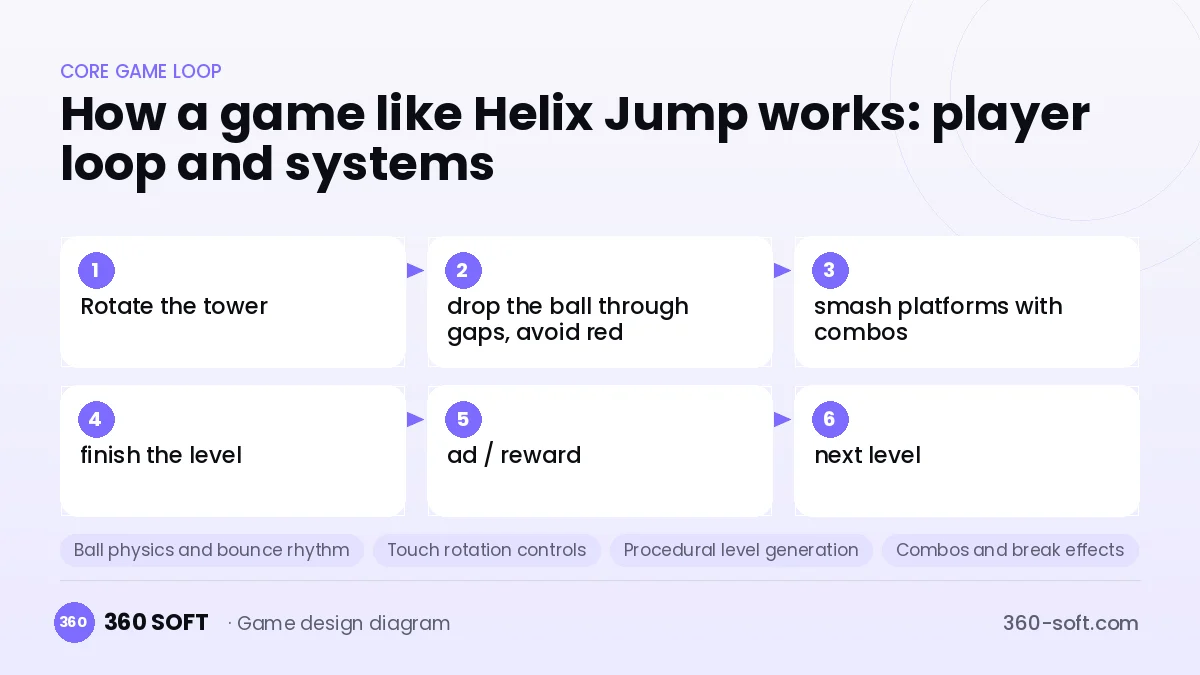
Helix Jump shows the power of a one-finger idea you understand in seconds: rotate the tower, drop the bouncing ball through the gaps and avoid the red zones. Clearing several platforms in a row lets the ball smash through everything, a small but intense moment of satisfaction. Short sessions, instant retries and a constant "just one more" feeling are the essence of hyper-casual.
In a game like this the codebase is small, but feel and tuning are everything: the bounce rhythm, camera follow, rotation sensitivity, break effects and haptics. The real work is procedural level generation, the difficulty curve, ad placement and fast A/B tests. Hyper-casual success rarely comes from a single game; it comes from putting many prototypes through quick market tests.
Why Helix Jump works: the core loop
Systems you need to build a game like Helix Jump
Ball physics and bounce rhythm
A hand-tuned, fixed bounce height and duration instead of real physics. Consistent feel matters far more than realistic simulation.
Touch rotation controls
Tower rotation driven by swipe speed, with sensitivity and inertia settings. Control feel must be tested across different screen sizes.
Procedural level generation
Seed-based generation of platform count, gap width, hazard ratio and moving parts. The difficulty curve is tuned through Remote Config.
Combos and break effects
Invincibility triggered by consecutive drops, shatter particles, sound and haptic feedback. This carries the game's payoff moment.
Cosmetics and themes
Ball skins, trail effects and tower themes. A simple unlock progression that still feels rewarding.
Ads and A/B testing stack
Frequency control for interstitial, rewarded and banner ads; remote experiments for difficulty, colours and ad intervals.
What goes into the first version, what comes later
First version (soft launch)
- Tuned ball-and-tower mechanic with a combo system
- Procedural level generation and difficulty curve
- A handful of cosmetic balls and themes
- Rewarded continue and interstitial ads
- Analytics (level drop-off points) and Remote Config
Later updates
- New obstacle types and moving platforms
- Daily challenge and leaderboard
- Expanded cosmetic collection and a no-ads pack
- Seasonal themes and a mission system
The hard parts of this genre
Finding an idea that sticks
Hyper-casual games are measured with short ad tests before launch, and many prototypes are cut after the first test. A rapid prototyping culture is essential.
User acquisition cost
If revenue per player stays below the cost of acquiring that player through ads, the game cannot scale. Early retention and session length metrics are critical.
Ad density balance
Too many ads drive players away; too few make no money. Ad frequency has to be found through experiments per player segment.
Team, timeline and budget
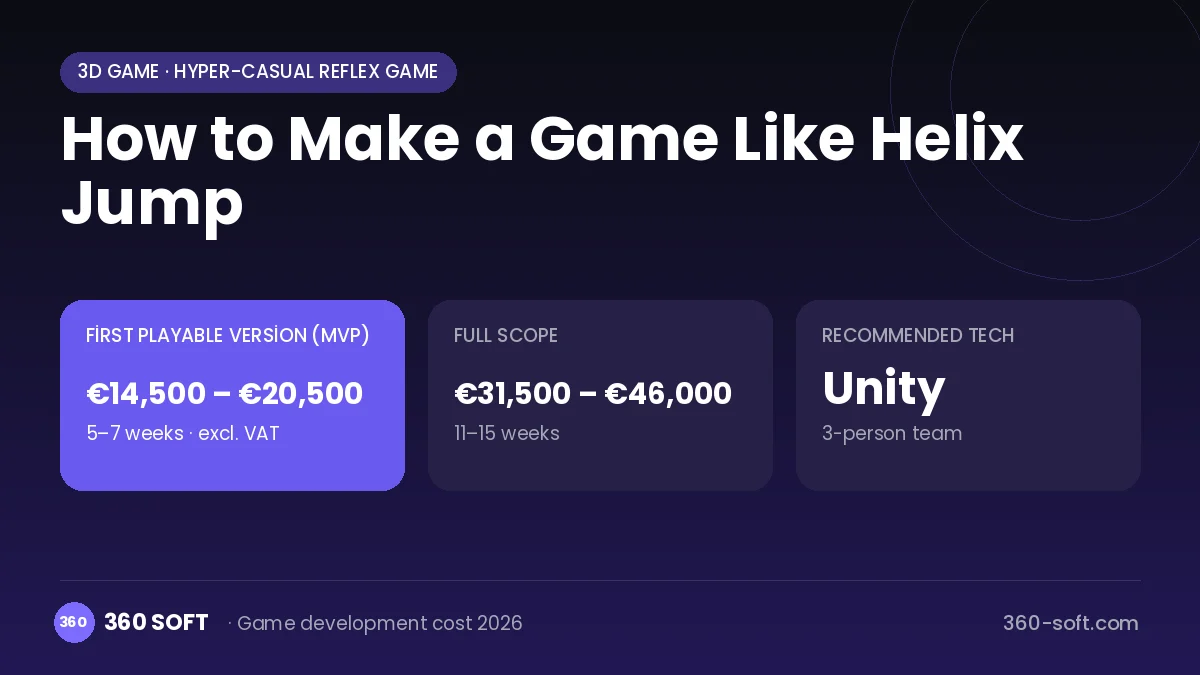
The estimate is based on the genre’s core systems, content volume, multiplayer and live-ops needs plus QA and project management: about 120 person-days for the full scope and 54 person-days for the first version. Cutting scope (fewer levels, one map, fewer characters) lowers the budget directly. Store accounts, servers, audio licences and user-acquisition budget are separate items. We send a fixed written price within 24 hours after the game design document.
Monetisation
Hyper-casual games earn almost all their revenue from ads: interstitials between levels, rewarded ads to continue or double a reward, and banners. A no-ads pack and a few cosmetic purchases add a small extra. Success depends on acquiring players cheaply and keeping them long enough.
Estimate your game budget and get a fixed quote
Let us scope it together and send a fixed written quote within 24 hours. NDA on request; you own the source code.
Calculated instantly from your choices, excl. VAT. A fixed written quote follows a free scoping call within 24 hours.
Choosing a game development company for a game like Helix Jump
Most people searching “make a game like helix jump” are really looking for a reliable game development company. When comparing quotes, check four things:
- Can you play their released 3D games on your own phone?
- Are the source code, art files and store accounts transferred to you by contract?
- Do they build a playable prototype first and show a demo every two weeks?
- Are ads, in-app purchases and analytics set up as part of the quote?
Copyright and originality
Game mechanics on their own are generally not protected, but names, logos, characters, art, audio and level designs are. That is why we build a game “like Helix Jump” with your own name, art and world. This is not legal advice; we recommend a trademark search before launch.
Frequently asked questions
How long does it take to make a game like Helix Jump?
A playable prototype can be ready very quickly. For a launch-ready version, most of the time goes into tuning feel, integrating ads and running market tests.
Will there be copyright issues?
The ball-falling-down-a-tower mechanic is generally free to use. Do not copy the name, logo, exact visual style or sounds; adding an original theme and twist is better both legally and commercially. This is not legal advice.
Can I build it on my own?
Yes, this is one of the few genres a solo developer can realistically build. Marketing tests, ad optimisation and publisher relationships, however, need extra know-how and budget.
What should I look for in a hyper-casual game development company?
Look at their prototyping speed and their experience with ad and analytics integration. A good sign is a process that tests several ideas quickly rather than spending months on a single game.