2D gameResource and trading strategy board gameOriginal by Klaus Teuber, Catan GmbH
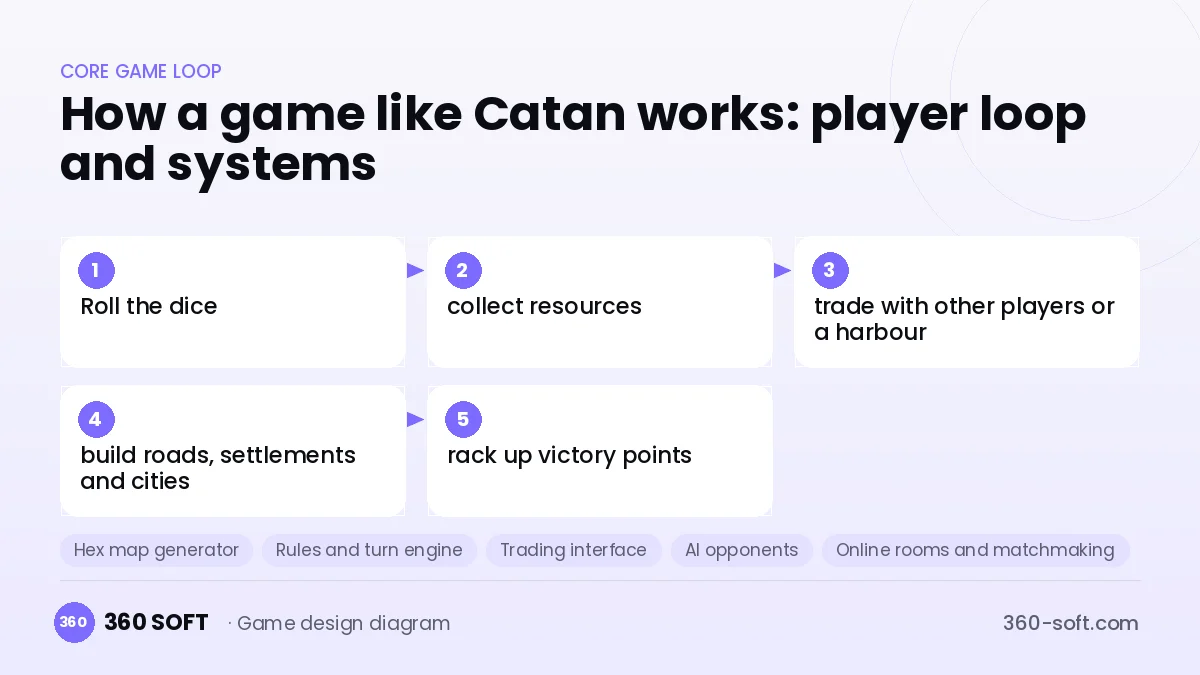
Catan’s success comes from balancing dice luck with negotiation between players. The island, made of hexagonal tiles, is laid out differently every game, and settlements and cities collect the resources the dice bring. The real excitement is in trading: the player with too much grain has to strike a deal with the one who needs brick. Nobody is fully eliminated and everyone has a chance until the final turn, which is why it has become a staple of family and friends’ game nights.
For a similar digital game, you first build a rules engine: hex map generation, road and settlement placement rules, resource distribution, development cards and victory point calculation. On top of that you need a player-to-player trading interface, harbour rates, AI opponents that make sensible offers and an online room system. The hardest part digitally is turning the table-talk of negotiation into a fast, clear interface.
Why Catan works: the core loop
Systems you need to build a game like Catan
Hex map generator
Random or fixed layout options that spread resource tiles and number tokens evenly and prevent overpowered clusters.
Rules and turn engine
Settlement distance rule, road connectivity, robber movement, hand limits and server-side validation of victory points.
Trading interface
Quick offers, counter-offers, multi-player offers and harbour/bank trades; negotiating in a few taps on mobile.
AI opponents
Bots across difficulty levels that pick spots based on resource needs and make and accept sensible trades.
Online rooms and matchmaking
Friend rooms, quick match, turn timeouts and a bot taking over for disconnected players.
Rating and profile
An ELO-style rating, match history, achievements and cosmetic table themes.
What goes into the first version, what comes later
First version (soft launch)
- A full game with base rules and a random map
- Player-to-player and harbour trading
- AI opponents at two difficulty levels
- Friend rooms and quick match
- A guided first game (tutorial)
Later updates
- Extended maps and extra rule sets
- Asynchronous (play-when-it’s-your-turn) mode
- Ranked leagues and seasons
- Cosmetic table, piece and dice themes
The hard parts of this genre
Bringing trading into digital
Free-form bargaining at the table is fast; digital offer screens can be slow and tedious. Suggested trades and quick-reply buttons need to be designed.
Believable AI
Bots must play well without making unfair trades that exploit the player; this needs probability calculations and personality profiles.
Licensing and original content
The Catan name and visuals are protected; capturing a similar feel with an original theme, map and rule variation takes real design effort.
Team, timeline and budget
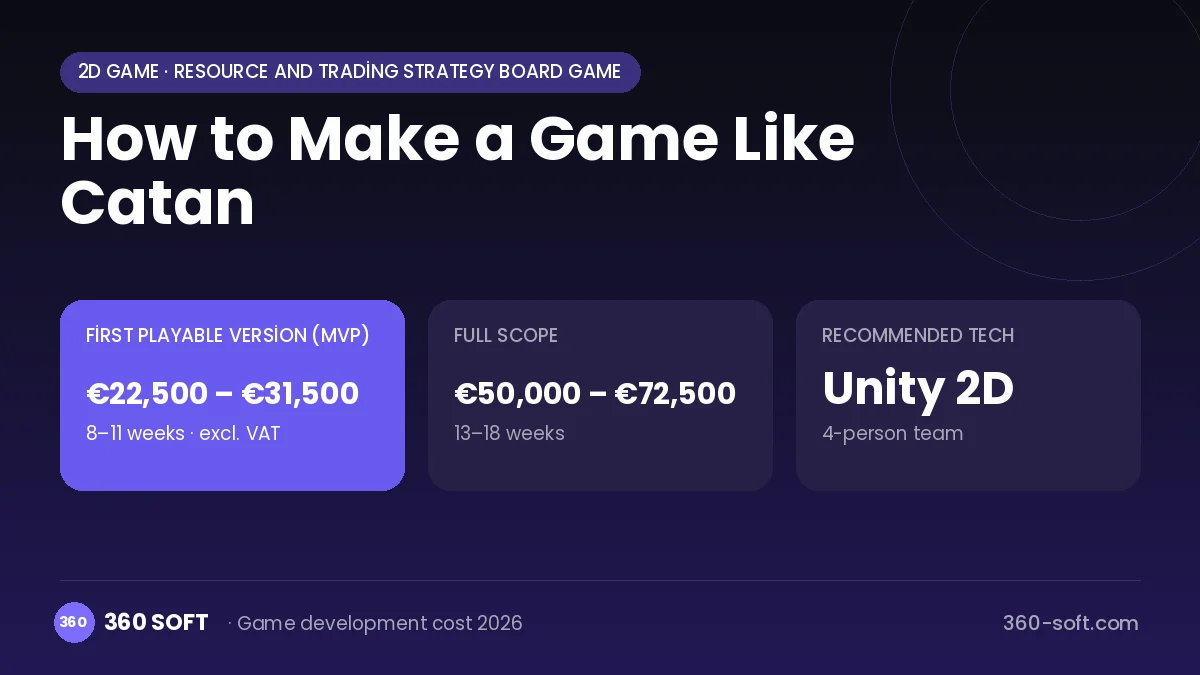
The estimate is based on the genre’s core systems, content volume, multiplayer and live-ops needs plus QA and project management: about 191 person-days for the full scope and 86 person-days for the first version. Cutting scope (fewer levels, one map, fewer characters) lowers the budget directly. Store accounts, servers, audio licences and user-acquisition budget are separate items. We send a fixed written price within 24 hours after the game design document.
Monetisation
The most common models for digital board games are a free base game with paid extra rule sets and map packs, or a one-off premium version. Cosmetic table themes, piece and dice sets, an ad-free upgrade and an optional subscription can be added. Paid advantages that affect competition are not accepted in this genre.
Estimate your game budget and get a fixed quote
Let us scope it together and send a fixed written quote within 24 hours. NDA on request; you own the source code.
Calculated instantly from your choices, excl. VAT. A fixed written quote follows a free scoping call within 24 hours.
Choosing a game development company for a game like Catan
Most people searching “make a game like catan” are really looking for a reliable game development company. When comparing quotes, check four things:
- Can you play their released 2D games on your own phone?
- Are the source code, art files and store accounts transferred to you by contract?
- Do they build a playable prototype first and show a demo every two weeks?
- Are multiplayer servers, anti-cheat and scaling costs written into the quote?
Copyright and originality
Game mechanics on their own are generally not protected, but names, logos, characters, art, audio and level designs are. That is why we build a game “like Catan” with your own name, art and world. This is not legal advice; we recommend a trademark search before launch.
Frequently asked questions
How long does it take to make a digital game like Catan?
A version with base rules, AI and online rooms can be built within a few months. The parts that take the most time are polishing the AI and the trading interface.
Can I port Catan to digital one-to-one?
No; the Catan name, visuals and rules text belong to the rights holder, and an official digital adaptation requires a licence. General mechanics like resource gathering and trading are free to use, so a similar game with an original theme and names is possible. This is not legal advice.
Do I need AI opponents?
Bots are essential to keep the game playable while the online player count is low. They are also used to take over for players who disconnect.
What should I look for when choosing a board game adaptation studio?
Look at their experience with turn-based multiplayer infrastructure, rules engines and AI. Ask for examples showing how they turned a complex board game into a clean mobile interface.