3D gameCinematic interactive drama (branching choice-based adventure)Original by Quantic Dream
Detroit: Become Human is a cinematic drama in which the player's decisions genuinely change the story. In chapters told from the perspectives of three different characters, a dialogue choice, a moment's hesitation or a failed quick-time event can lead to a character's death or send the story in a completely different direction. The flowchart shown at the end of each chapter reveals which paths you missed and sparks the urge to replay.
For a similar game the biggest investment is narrative design and cinematic production: a branching script, condition and variable tracking, a flowchart UI, performance capture (face and body), high-quality character models and camera direction. Technically you build a scene manager, a QTE system, an investigation/clue mode and checkpoints. Production cost grows exponentially as the number of branches increases, so the branching structure must be planned at the very start.

Why Detroit: Become Human works: the core loop
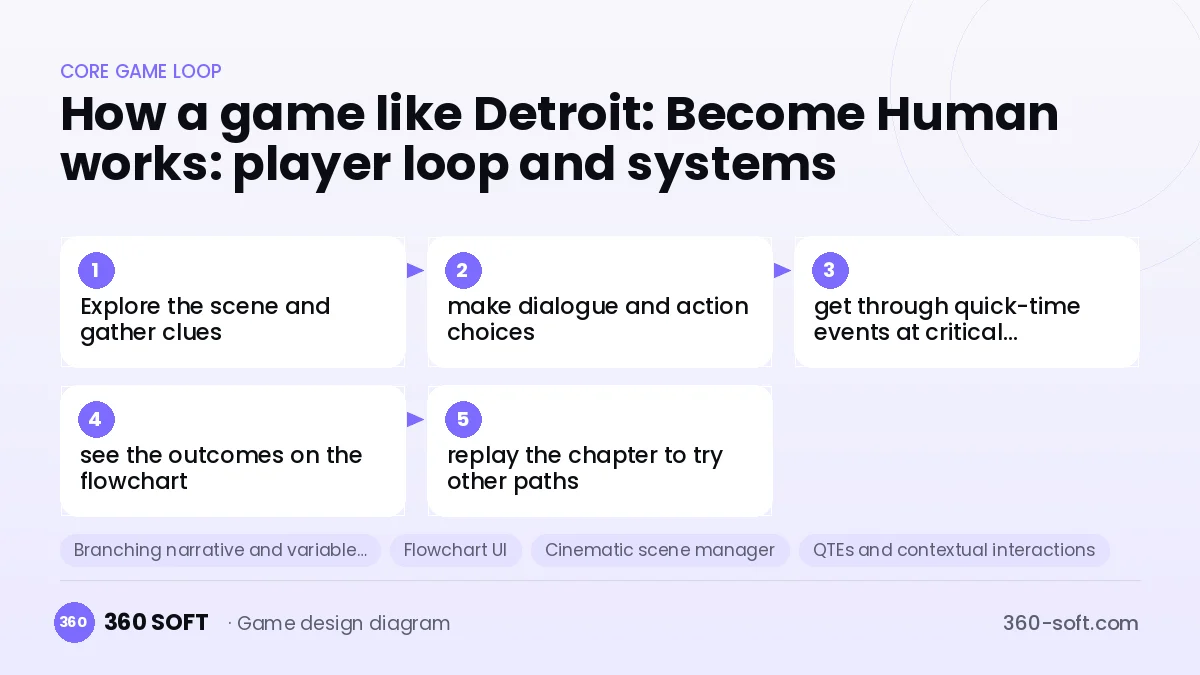
Systems you need to build a game like Detroit: Become Human
Branching narrative and variable tracking
A state system that records every choice and outcome, with later scenes that change depending on whether characters are still alive.
Flowchart UI
A branching map that opens at the end of each chapter and shows discovered and locked paths. The single most important driver of replayability.
Cinematic scene manager
A timeline-based system that handles camera cuts, dialogue timing, voice-over and animation.
QTEs and contextual interactions
Tension-raising quick-time events and contextual interaction with objects; even failure should be a story outcome.
Investigation and reconstruction mode
Gathering clues at a scene, combining them and reconstructing the event. Adds a gameplay layer specific to the character's abilities.
Performance capture pipeline
Face and body motion capture, actor recording sessions and cleanup. The source of emotional believability.
What goes into the first version, what comes later
First version (soft launch)
- One main character and a short 3–4 chapter story
- 2–3 meaningful branches and different endings per chapter
- Flowchart and chapter replay
- QTE and dialogue choice system
- Save system, settings and analytics
Later updates
- A second and third playable character
- Interaction between storylines and more endings
- Full voice-over and multiple languages
- Console versions
The hard parts of this genre
Branching explosion
Every choice requires new scenes; if the number of branches is not controlled, content cost multiplies. Build a structure where branches merge back at set points.
Cinematic quality expectations
In this genre players expect film-quality acting and visuals. Facial animation, lighting and camera direction take up most of the budget.
Meaningful choices
If choices have no felt consequence, players feel cheated. Important choices must have visible and lasting effects.
Team, timeline and budget
The estimate is based on the genre’s core systems, content volume, multiplayer and live-ops needs plus QA and project management: about 413 person-days for the full scope and 186 person-days for the first version. Cutting scope (fewer levels, one map, fewer characters) lowers the budget directly. Store accounts, servers, audio licences and user-acquisition budget are separate items. We send a fixed written price within 24 hours after the game design document.
Monetisation
Premium sales are the best fit for this genre; episodic release can split development costs into parts and bring in early revenue. Later story expansions and a digital art book or soundtrack add income. Microtransactions and ads do not fit this experience. Players' desire to discover different endings extends word-of-mouth promotion and the sales lifespan.
Estimate your game budget and get a fixed quote
Let us scope it together and send a fixed written quote within 24 hours. NDA on request; you own the source code.
Calculated instantly from your choices, excl. VAT. A fixed written quote follows a free scoping call within 24 hours.
Choosing a game development company for a game like Detroit: Become Human
Most people searching “make a game like detroit become human” are really looking for a reliable game development company. When comparing quotes, check four things:
- Can you play their released 3D games on your own phone?
- Are the source code, art files and store accounts transferred to you by contract?
- Do they build a playable prototype first and show a demo every two weeks?
- Are ads, in-app purchases and analytics set up as part of the quote?
Copyright and originality
Game mechanics on their own are generally not protected, but names, logos, characters, art, audio and level designs are. That is why we build a game “like Detroit: Become Human” with your own name, art and world. This is not legal advice; we recommend a trademark search before launch.
Frequently asked questions
How long does it take to make a game like Detroit: Become Human?
Because of cinematic quality and branching volume, it is a long and costly project. For small teams it is realistic to start with a short single-character story and grow episodically.
Will there be copyright issues?
Mechanics such as branching choices, flowcharts and QTEs are generally free to use. Characters, story, world, dialogue and visual designs cannot be copied. This is not legal advice.
Is motion capture required?
For a near-film-quality experience, face and body performance capture makes a big difference. On a lower budget, a strong narrative can also be built with stylised characters and hand-keyed animation.
What should I look for in a studio that builds interactive dramas?
Look at experience with narrative design, cinematic direction and character animation. Choose a studio that maps out the branching structure in advance and plans content cost accordingly.