3D gameOpen-world action RPG (soulslike)Original by FromSoftware
Elden Ring brings the punishing, teach-by-failure combat of the soulslike genre into a vast open world. It never holds your hand: you head for a castle on the horizon, lose to a boss again and again, learn its patterns and, when you finally win, feel genuine mastery. Death is a learning tool, not a punishment. Hidden passages, optional bosses and a story told in fragments keep curiosity alive.
A game at this scale demands a huge world, dozens of bosses and heavy animation work, so for an independent team cutting scope is essential. A realistic MVP: one interconnected region instead of an open world, stamina-based melee, three or four weapon types, five or six bosses and a checkpoint system. The real investment should go into precise animation timing and learnable enemy AI.
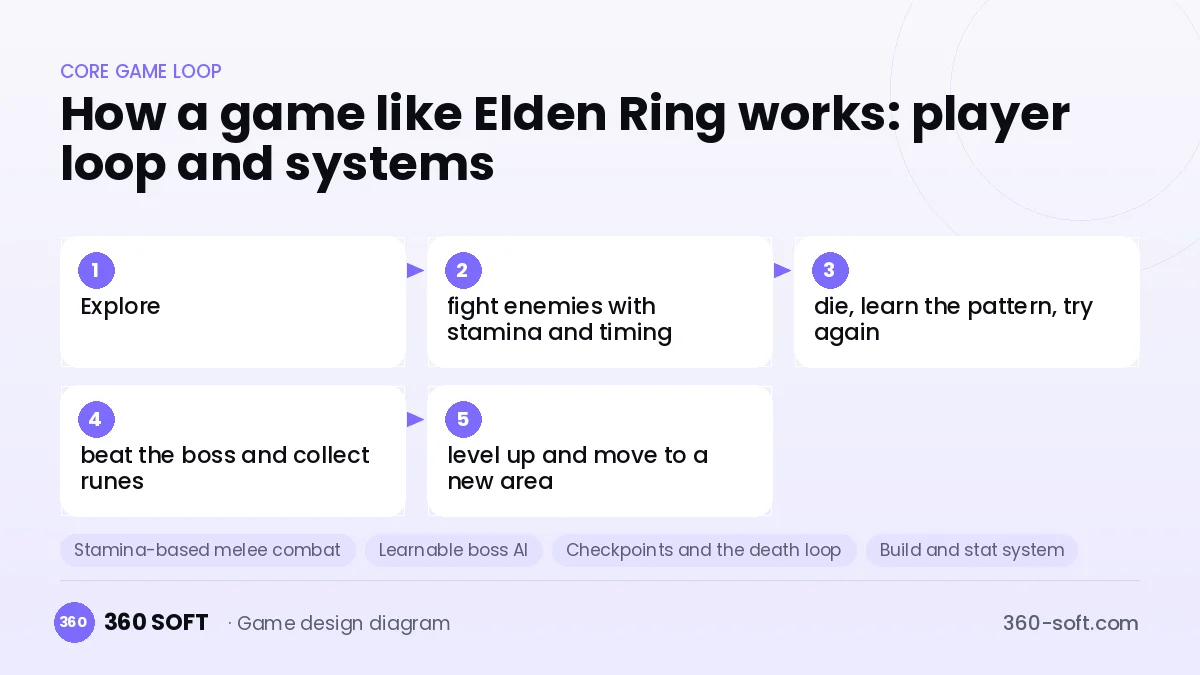
Why Elden Ring works: the core loop
Systems you need to build a game like Elden Ring
Stamina-based melee combat
Shared stamina for attacks, blocks, rolls and sprinting; animation cancel rules and invincibility frames. Whether combat feels fair depends on this precise timing.
Learnable boss AI
Readable wind-up animations, phases, range-based attack selection and punish windows. Every boss is a design project of its own.
Checkpoints and the death loop
Rest points, currency lost on death with a chance to recover it, and respawning enemies. This sets the balance between risk and repetition.
Build and stat system
Stats such as strength, dexterity and magic, weapon scaling and equip load limits. This makes very different playstyles possible.
Interconnected world design
Shortcuts, hidden passages, vertical spaces and optional areas. Level design determines how rewarding exploration feels.
Asynchronous player traces
Lightweight social systems such as messages and death marks left by other players. They add a sense of community to a single-player game.
What goes into the first version, what comes later
First version (soft launch)
- One large interconnected region and a mini dungeon
- Stamina-based combat and 3–4 weapon types
- 5–6 bosses and 15–20 enemy types
- Checkpoint, death and currency recovery loop
- Basic build variety through stats and weapon scaling
Later updates
- Open-world regions and mounted travel
- Sorcery and summoning systems
- Online co-op and an asynchronous message system
- An expansion with a new region and bosses
The hard parts of this genre
Hard but fair combat balance
If difficulty feels unfair, players quit. Accurate hitboxes, readable animations and consistent punish windows require intensive testing.
Animation and boss production cost
Every boss needs bespoke animation, audio and AI. This is where content budgets blow up; never trade quality for boss count.
Exploration without hand-holding
In a world without quest markers, keeping players from getting lost and bored takes skilled use of visual cues, lighting and silhouettes.
Team, timeline and budget
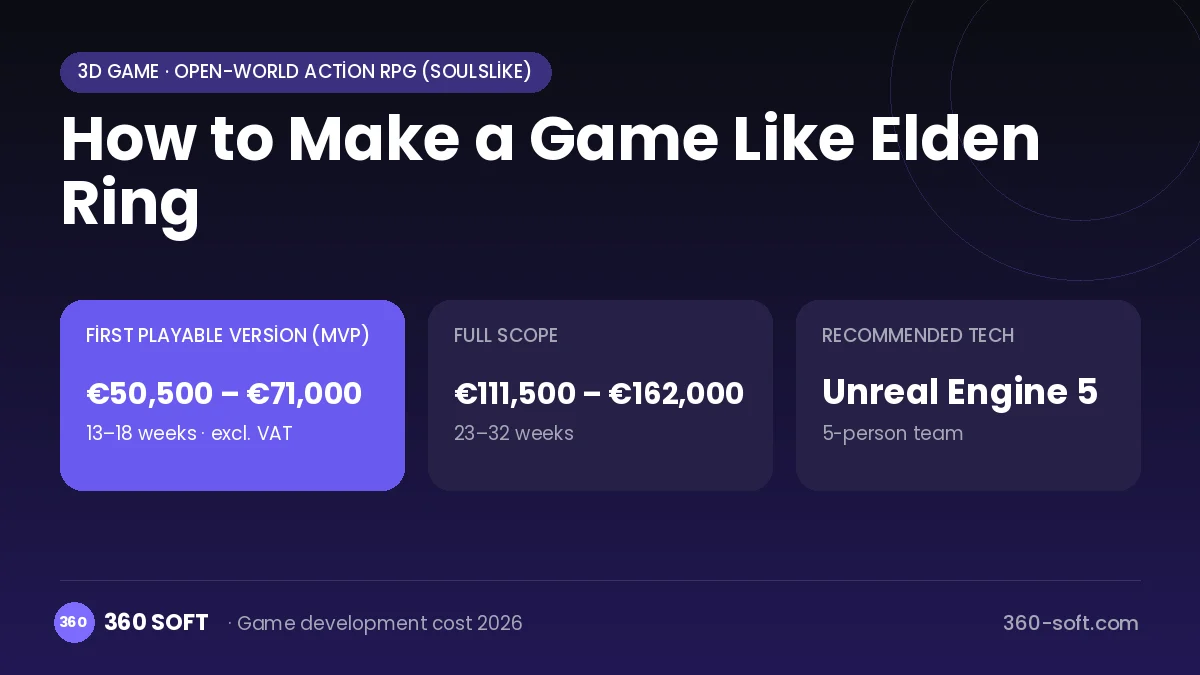
The estimate is based on the genre’s core systems, content volume, multiplayer and live-ops needs plus QA and project management: about 428 person-days for the full scope and 192 person-days for the first version. Cutting scope (fewer levels, one map, fewer characters) lowers the budget directly. Store accounts, servers, audio licences and user-acquisition budget are separate items. We send a fixed written price within 24 hours after the game design document.
Monetisation
In this genre the premium sale is almost the only viable model: a one-time purchase plus large DLC expansions. Microtransactions and selling power clash with what this audience expects. Early access is one of the better ways for an independent team to earn revenue while gathering community feedback.
Estimate your game budget and get a fixed quote
Let us scope it together and send a fixed written quote within 24 hours. NDA on request; you own the source code.
Calculated instantly from your choices, excl. VAT. A fixed written quote follows a free scoping call within 24 hours.
Choosing a game development company for a game like Elden Ring
Most people searching “make a game like elden ring” are really looking for a reliable game development company. When comparing quotes, check four things:
- Can you play their released 3D games on your own phone?
- Are the source code, art files and store accounts transferred to you by contract?
- Do they build a playable prototype first and show a demo every two weeks?
- Are ads, in-app purchases and analytics set up as part of the quote?
Copyright and originality
Game mechanics on their own are generally not protected, but names, logos, characters, art, audio and level designs are. That is why we build a game “like Elden Ring” with your own name, art and world. This is not legal advice; we recommend a trademark search before launch.
Frequently asked questions
How long does it take to make a game like Elden Ring?
A full-scale open-world soulslike needs a large team and several years. A vertical slice with one region and a few bosses is a realistic first step for an indie team and something you can show to investors.
Will I run into copyright issues?
Mechanics such as stamina combat, checkpoints and losing currency on death are shared genre language and generally free to use. The world, characters, boss designs, names and audio cannot be copied. This is not legal advice.
Which engine should I use?
Unreal Engine 5 is a strong choice for a realistic, dark visual target. Unity HDRP also works; what matters most is a solid root-motion animation and precise hitbox foundation.
What should I look for in a studio to build a soulslike?
Look for a team that can show a playable prototype covering melee combat, animation and enemy AI. The right studio proves combat feel with a demo, not just with pretty visuals.