3D gameMinecraft server, plugin and mod developmentOriginal by Mojang Studios
A big reason for Minecraft’s longevity is the server and mod ecosystem that has grown around it. Community servers offer completely different experiences such as survival, skyblock, mini-games, role-play and factions, and players come as much for the community and friendships as for the game itself. What makes a server succeed is an original game mode, a fair economy, regular events and a well-managed community.
The work here is not a game from scratch but building systems on top of the existing game. On Java Edition, you develop plugins with the Paper or Spigot API, a multi-server network with Velocity or BungeeCord, and client mods with Fabric or NeoForge; on Bedrock, add-ons and bridges such as Geyser are used. On top of that come hosting, DDoS protection, a database, a store and moderation. Everything must comply with Mojang’s EULA and usage guidelines.
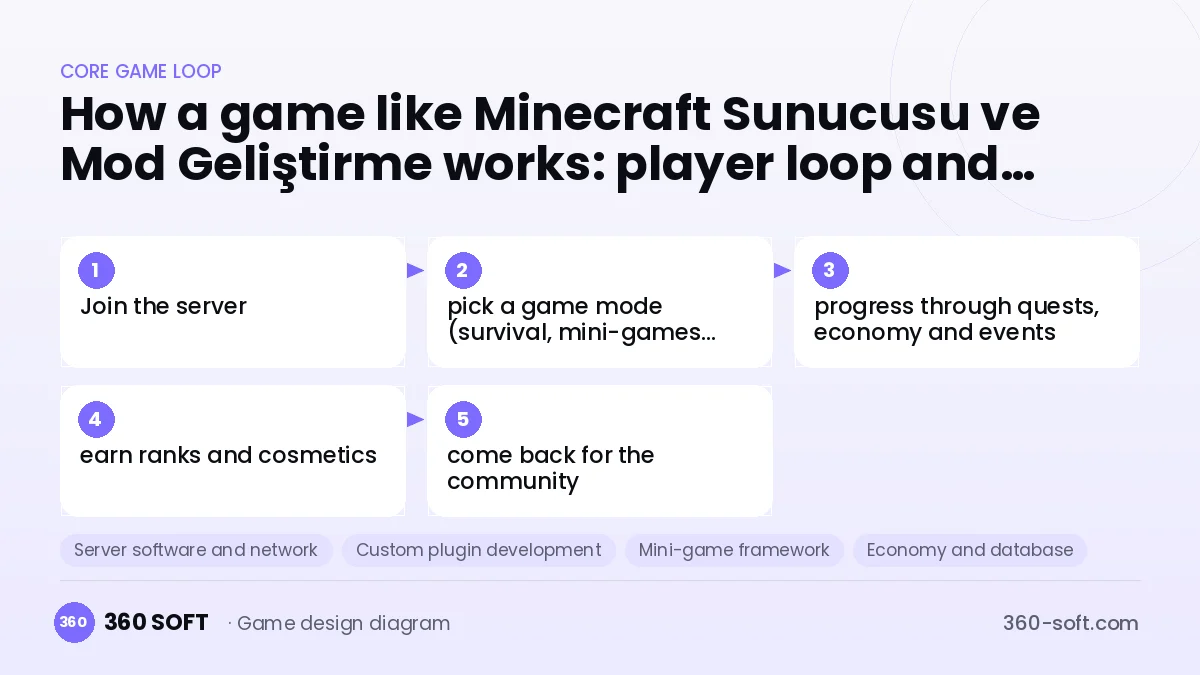
Why Minecraft Sunucusu ve Mod Geliştirme works: the core loop
Systems you need to build a game like Minecraft Sunucusu ve Mod Geliştirme
Server software and network
Paper/Spigot-based game servers, a Velocity or BungeeCord proxy for moving between lobby and mode servers, and a bridge for Bedrock players where needed.
Custom plugin development
Custom game modes, commands, quest systems and GUI menus written in Java or Kotlin, combined with off-the-shelf plugins.
Mini-game framework
Queues, map resets, team assignment, scoring and rewards; running many mini-games on a shared foundation.
Economy and database
Keeping in-game currency, markets, ranks and stats in sync across the network with a data layer such as MySQL or Redis.
EULA-compliant store
Selling cosmetics and server support; no pay-to-win items that grant gameplay advantages, per Mojang’s rules.
Admin, moderation and anti-cheat
Permission system, punishment logs, chat filter, anti-cheat plugins and an admin panel.
What goes into the first version, what comes later
First version (soft launch)
- A Paper-based server with one original game mode
- A lobby and basic proxy network
- Core mechanics and economy via a custom plugin
- Permission, moderation and anti-cheat plugins
- An EULA-compliant cosmetic store and a Discord community
Later updates
- New mini-games and seasonal map resets
- Crossplay support for Bedrock players
- Custom content via a client mod or resource pack
- A web panel, stats pages and tournaments
The hard parts of this genre
Performance and tick stability
A Minecraft server is largely single-threaded; crowds, lots of entities and badly written plugins cause lag. Profiling and optimisation are essential.
EULA and monetisation rules
Mojang’s rules limit what servers can sell; servers that sell gameplay advantages or try to look official can face enforcement. The rules can change, so check them regularly.
Version updates
Every Minecraft update can break plugin and mod compatibility; choose maintained dependencies and plan your updates.
Team, timeline and budget
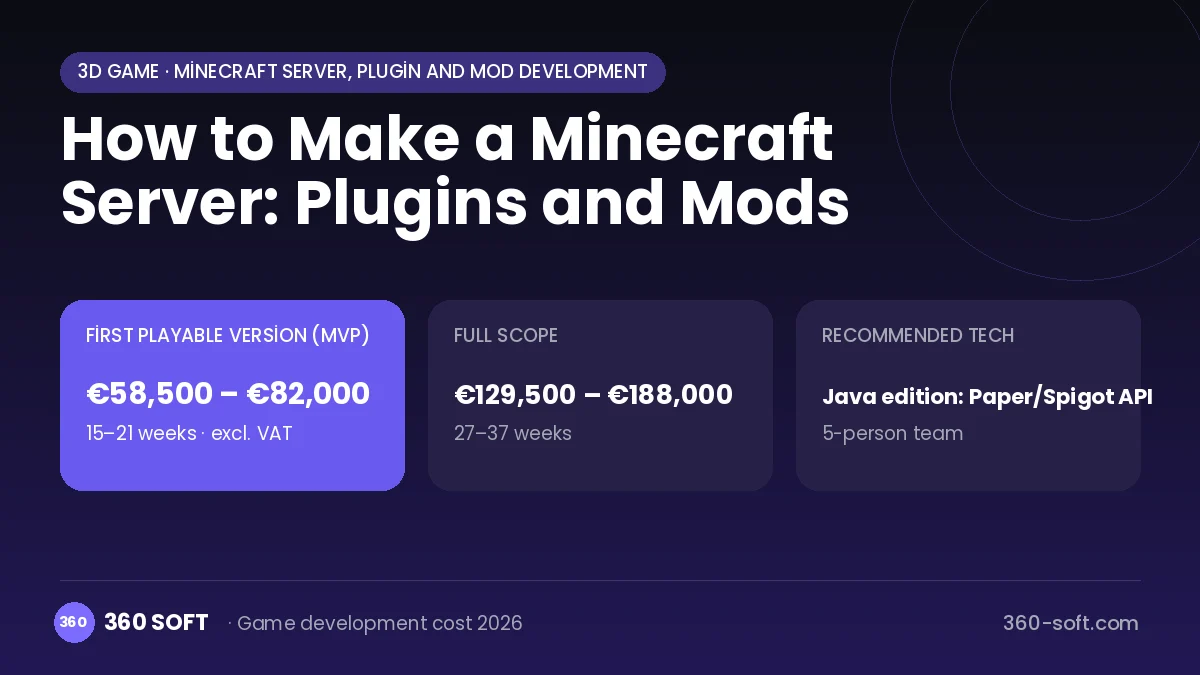
The estimate is based on the genre’s core systems, content volume, multiplayer and live-ops needs plus QA and project management: about 498 person-days for the full scope and 224 person-days for the first version. Cutting scope (fewer levels, one map, fewer characters) lowers the budget directly. Store accounts, servers, audio licences and user-acquisition budget are separate items. We send a fixed written price within 24 hours after the game design document.
Monetisation
Minecraft server revenue comes from cosmetics, cosmetic-perk ranks and server support packages that comply with Mojang’s EULA and usage guidelines. Selling items that grant gameplay advantages breaks the rules. Large networks can diversify with sponsorships, creator partnerships and corporate event servers; the Bedrock Marketplace requires a separate partner programme.
Estimate your game budget and get a fixed quote
Let us scope it together and send a fixed written quote within 24 hours. NDA on request; you own the source code.
Calculated instantly from your choices, excl. VAT. A fixed written quote follows a free scoping call within 24 hours.
Choosing a game development company for a game like Minecraft Sunucusu ve Mod Geliştirme
Most people searching “make a minecraft server” are really looking for a reliable game development company. When comparing quotes, check four things:
- Can you play their released 3D games on your own phone?
- Are the source code, art files and store accounts transferred to you by contract?
- Do they build a playable prototype first and show a demo every two weeks?
- Are multiplayer servers, anti-cheat and scaling costs written into the quote?
Copyright and originality
Game mechanics on their own are generally not protected, but names, logos, characters, art, audio and level designs are. That is why we build a game “like Minecraft Sunucusu ve Mod Geliştirme” with your own name, art and world. This is not legal advice; we recommend a trademark search before launch.
Frequently asked questions
How long does it take to set up a Minecraft server?
A basic server with off-the-shelf plugins can be up quickly. A professional setup with an original game mode, custom plugins and a multi-server network can take anywhere from a few weeks to a few months.
Is it legal to make money from a Minecraft server?
Mojang’s usage guidelines let servers earn revenue under certain conditions; cosmetics are generally allowed, while selling gameplay advantages is prohibited. The rules can change, so read the current EULA and usage guidelines; this is not legal advice.
Should I develop plugins or mods?
Plugins run server-side and need no extra install from players, so they are usually the right choice for community servers. Mods can add new blocks, entities and mechanics, but players have to install the mod too.
What should I look for when choosing a Minecraft plugin developer?
Look at their Paper/Spigot API and Java experience, performance optimisation examples on high-population servers and their knowledge of the EULA. Always clarify whether the source code will be handed over to you.