3D game3D vertical climbing platformerOriginal by SCKR Games
Only Up! drops players onto a huge vertical obstacle course made of real-world objects stretching into the sky. Every jump across pipes, cranes, buildings and floating islands is risky; a single misstep can wipe out minutes of progress. That high risk, combined with streamers' reactions, made the game as much fun to watch as to play.
A similar game needs a finely tuned 3D platformer character controller, clearly readable jump distances, a tall map split into themed sections and a continuous save system. Level streaming and draw distance optimisation are needed to render such a giant world smoothly. Being careful about licensing and originality in asset use is also critical for projects like this.
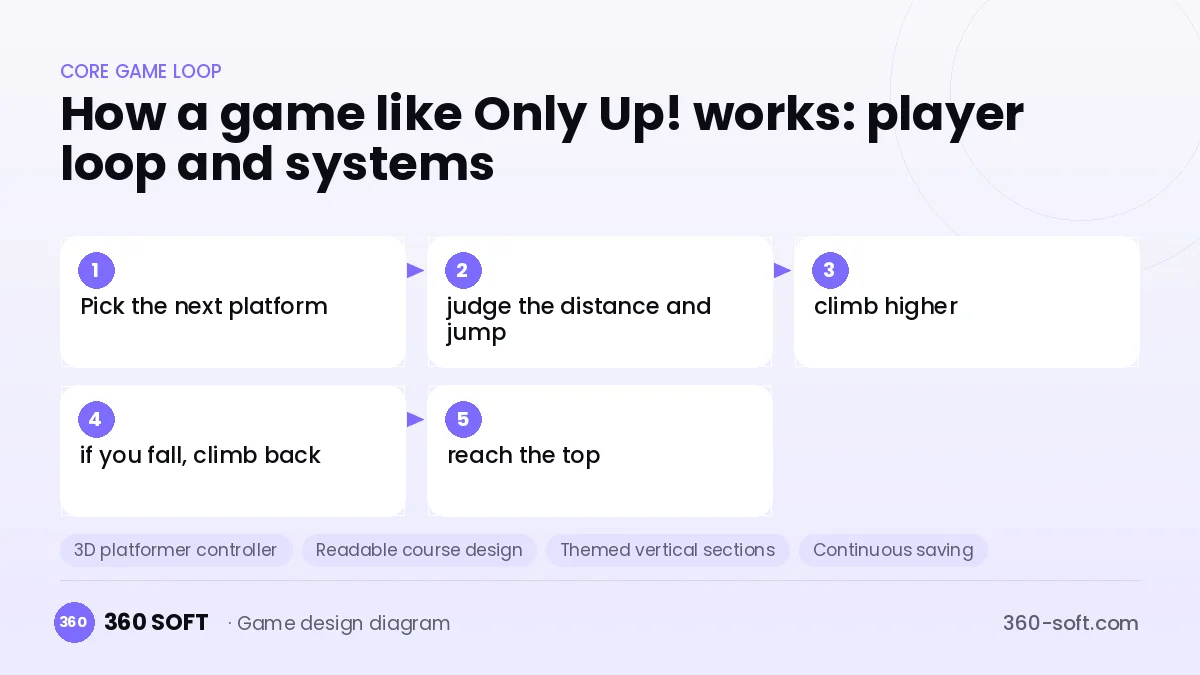
Why Only Up! works: the core loop
Systems you need to build a game like Only Up!
3D platformer controller
A third-person character with fine-tuned running, jumping, air steering, ledge grabbing and landing slide behaviour.
Readable course design
Jump points built with shadows, scale cues and camera angles that let players judge distances correctly.
Themed vertical sections
Layers split into different visual themes such as city, industrial and sky, each introducing a new obstacle type.
Continuous saving
A system that stores the player's exact position without checkpoints and resumes from the same spot when they return.
Level streaming and performance
LOD and draw distance management that loads the giant map in chunks and simplifies distant objects.
Speedrun and stats
Stat screens that are meaningful for streamers, showing time, number of falls and highest point reached.
What goes into the first version, what comes later
First version (soft launch)
- Polished 3D jump and ledge-grab controls
- A vertical route made of two themed sections
- Continuous position saving
- Distance readability through camera and shadows
- Time and fall statistics
Later updates
- New themed layers and hidden routes
- Cosmetic character skins
- Speedrun leaderboard
- Console version and gamepad polish
The hard parts of this genre
Asset licences
Games like this tend to rely on many ready-made models; every asset's commercial licence must be documented and no one else's work used without permission.
3D depth perception
Judging jump distance in three dimensions is hard; falls that feel unfair lose players quickly.
Short lifespan
Once the content runs out, players have little reason to return; updates or a speedrun community should be planned to stay relevant after the streaming buzz fades.
Team, timeline and budget
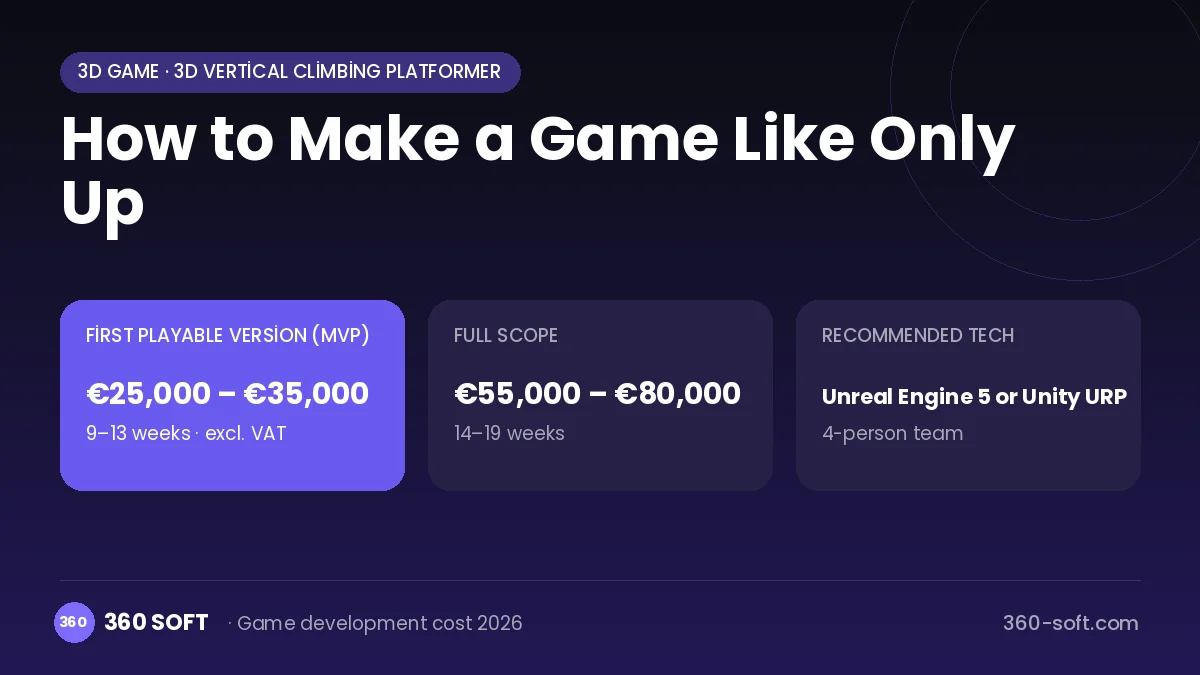
The estimate is based on the genre’s core systems, content volume, multiplayer and live-ops needs plus QA and project management: about 210 person-days for the full scope and 95 person-days for the first version. Cutting scope (fewer levels, one map, fewer characters) lowers the budget directly. Store accounts, servers, audio licences and user-acquisition budget are separate items. We send a fixed written price within 24 hours after the game design document.
Monetisation
The most common model in this genre is a low-priced one-off sale on PC; visibility on streams and short-form video drives sales. Cosmetic character skins can add revenue. For a mobile adaptation, options such as a second chance via rewarded ads can be considered, but forced ads damage the spirit of the genre.
Estimate your game budget and get a fixed quote
Let us scope it together and send a fixed written quote within 24 hours. NDA on request; you own the source code.
Calculated instantly from your choices, excl. VAT. A fixed written quote follows a free scoping call within 24 hours.
Choosing a game development company for a game like Only Up!
Most people searching “make a game like only up” are really looking for a reliable game development company. When comparing quotes, check four things:
- Can you play their released 3D games on your own phone?
- Are the source code, art files and store accounts transferred to you by contract?
- Do they build a playable prototype first and show a demo every two weeks?
- Are ads, in-app purchases and analytics set up as part of the quote?
Copyright and originality
Game mechanics on their own are generally not protected, but names, logos, characters, art, audio and level designs are. That is why we build a game “like Only Up!” with your own name, art and world. This is not legal advice; we recommend a trademark search before launch.
Frequently asked questions
How long does it take to make a game like Only Up?
Because the mechanics are simple, a small team can reach a first release in a relatively short time. Testing a long vertical map and optimising performance, however, take longer than expected.
Will there be copyright issues?
Vertical climbing and platforming mechanics are generally free to use. The map layout, character, name and especially the 3D models and music used must be licensed and original. This is not legal advice.
Is it a problem to use ready-made assets?
Store assets with a commercial licence can be used, but the licence terms must be recorded for each asset. Models and music of unclear origin can cause serious problems after launch.
What should we look for when choosing a studio to build a game like Only Up?
Check the studio's experience with 3D character controls and performance optimisation in large scenes. Make sure to ask how they manage asset licences, too.