2D gameClassic 2D top-down MMORPGOriginal by CipSoft
Tibia is one of the oldest MMORPGs and keeps a loyal community despite its simple 2D top-down graphics. Its appeal comes from a harsh death penalty, the tension of open PvP, quests that need no manual but reward exploration, and vocations that make players depend on one another. Because every deep dungeon carries real risk, each item and level earned feels especially valuable.
A similar game should be built on a tile-based world and an authoritative server. You need a map editor, tile movement and line of sight, vocations and a spell system, death penalty and item loss rules, NPC dialogue and quests, plus housing and depot systems. Being 2D lowers art costs, but the server, economy and anti-cheat work is no smaller than in other MMOs.
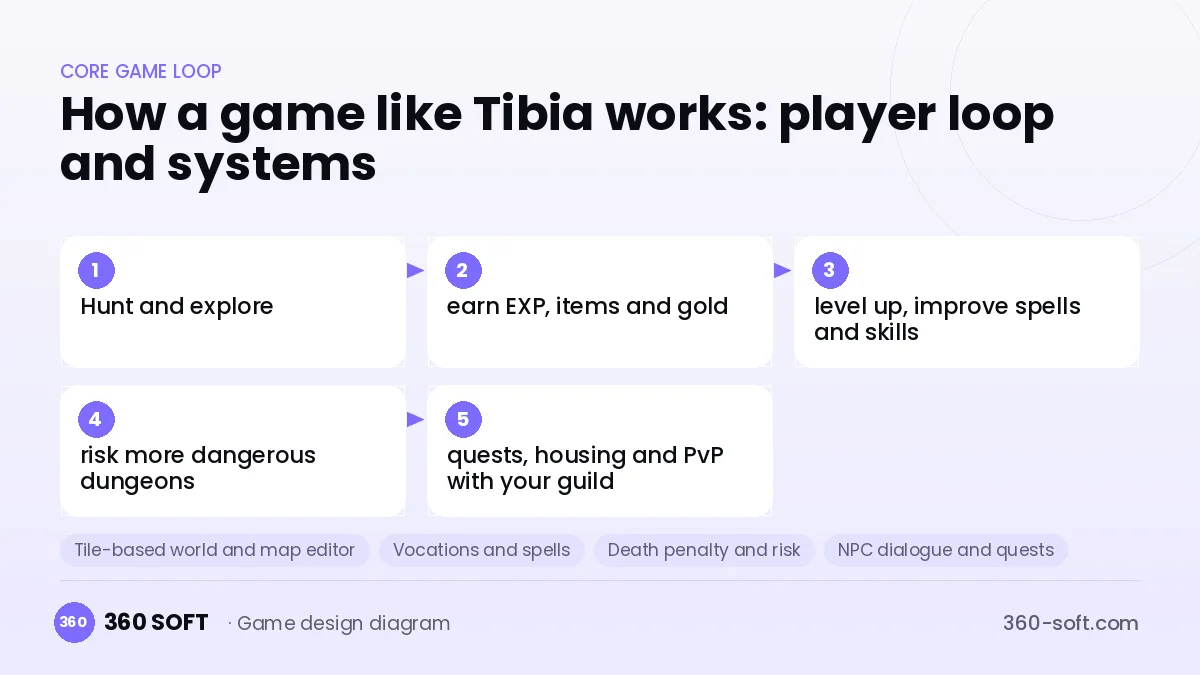
Why Tibia works: the core loop
Systems you need to build a game like Tibia
Tile-based world and map editor
Multi-floor underground and surface maps with tile movement and collision. The centre of content production.
Vocations and spells
Knight, paladin, sorcerer and druid-style vocations; skill levels and spells cast with keywords.
Death penalty and risk
Loss of EXP and items on death, with protective items to manage the risk. Creates the game’s tension.
NPC dialogue and quests
NPCs you talk to via keywords, exploration-focused quests and hidden areas.
Open PvP and penalty system
A PvP model that allows player killing but limits it with skull and penalty rules.
Housing, depots and trading
Rentable houses, depots, NPC and player trading and a market.
What goes into the first version, what comes later
First version (soft launch)
- 4 vocations, basic spells and skill levels
- A starter island, 2 cities on the main continent and 6–8 dungeons
- Death penalty and protective items
- NPC trading, depots and 15–20 quests
- Tile-based authoritative server and GM tools
Later updates
- Open PvP rules and guild wars
- Housing system and player market
- New continents, bosses and advanced dungeons
- Mobile client or browser version
The hard parts of this genre
Balancing harsh rules
A heavy death penalty and open PvP keep loyal players engaged but can scare off newcomers. Starter zones and protection mechanics must be designed well.
Map content volume
A large, multi-floor world with dungeons needs intensive map design. Without a strong map editor, content production is slow.
Bots and auto-hunting
Tile-based movement is highly open to automation software. Server-side behaviour analysis and bot detection must be planned from the start.
Team, timeline and budget
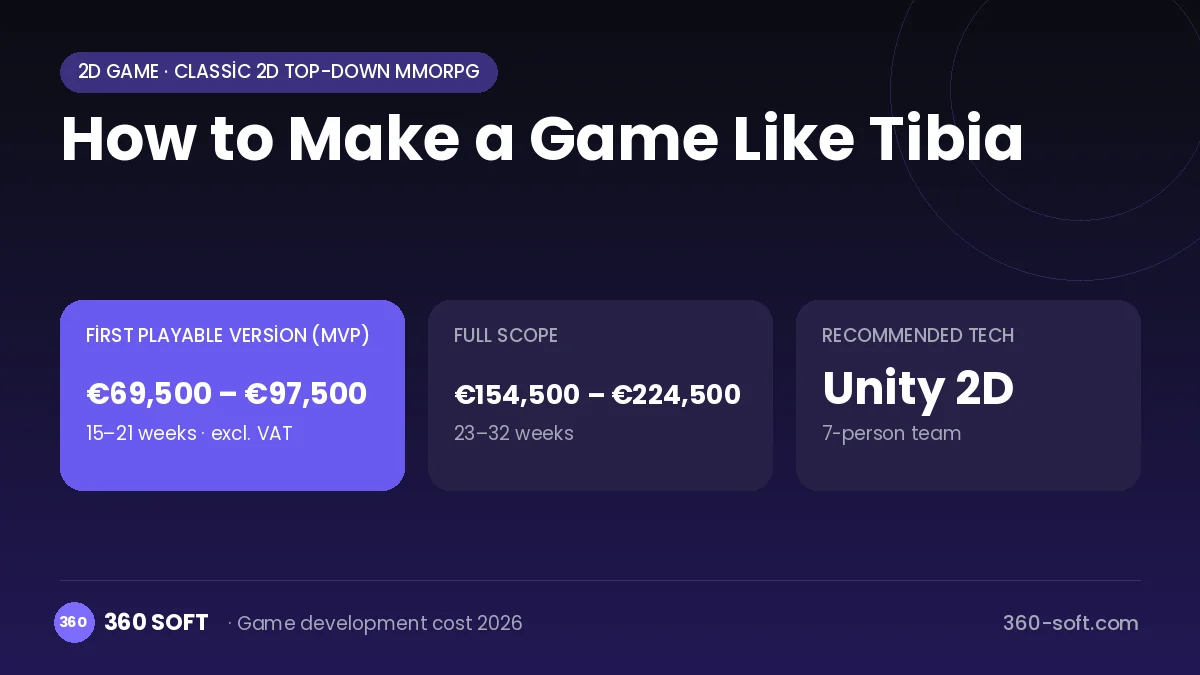
The estimate is based on the genre’s core systems, content volume, multiplayer and live-ops needs plus QA and project management: about 594 person-days for the full scope and 267 person-days for the first version. Cutting scope (fewer levels, one map, fewer characters) lowers the budget directly. Store accounts, servers, audio licences and user-acquisition budget are separate items. We send a fixed written price within 24 hours after the game design document.
Monetisation
Common models in this genre are free-to-play with a premium account (extra areas, comfort and speed) and a cosmetic store: outfits, mounts and house items. Official premium-time items that can be traded in game can pull real-money trading into an official channel. Selling power directly leads to a loss of trust in a loyal community.
Estimate your game budget and get a fixed quote
Let us scope it together and send a fixed written quote within 24 hours. NDA on request; you own the source code.
Calculated instantly from your choices, excl. VAT. A fixed written quote follows a free scoping call within 24 hours.
Choosing a game development company for a game like Tibia
Most people searching “make a game like tibia” are really looking for a reliable game development company. When comparing quotes, check four things:
- Can you play their released 2D games on your own phone?
- Are the source code, art files and store accounts transferred to you by contract?
- Do they build a playable prototype first and show a demo every two weeks?
- Are multiplayer servers, anti-cheat and scaling costs written into the quote?
Copyright and originality
Game mechanics on their own are generally not protected, but names, logos, characters, art, audio and level designs are. That is why we build a game “like Tibia” with your own name, art and world. This is not legal advice; we recommend a trademark search before launch.
Frequently asked questions
How long does it take to make a game like Tibia?
2D graphics lower costs, but an authoritative server and a large map require serious effort. A closed beta with a small world and limited vocations is a realistic start.
Can I build a game with Open Tibia (OT) server files?
The licences of open-source server software should be assessed separately; however, the original game’s maps, sprites, names and content are protected by copyright. A lasting product needs original art and an original world. This is not legal advice.
Which engine is suitable?
Unity 2D or Godot 4 suit a tile-based client. The heavy lifting is in the tile-based authoritative server and the map editor.
What should I look for in an MMORPG development company?
Look for a team that has built tile-based or similar multiplayer servers and has bot prevention and live operations experience. Ask how they build map and content tools.