2D gameOnline multiplayer pool (billiards) gameOriginal by Miniclip
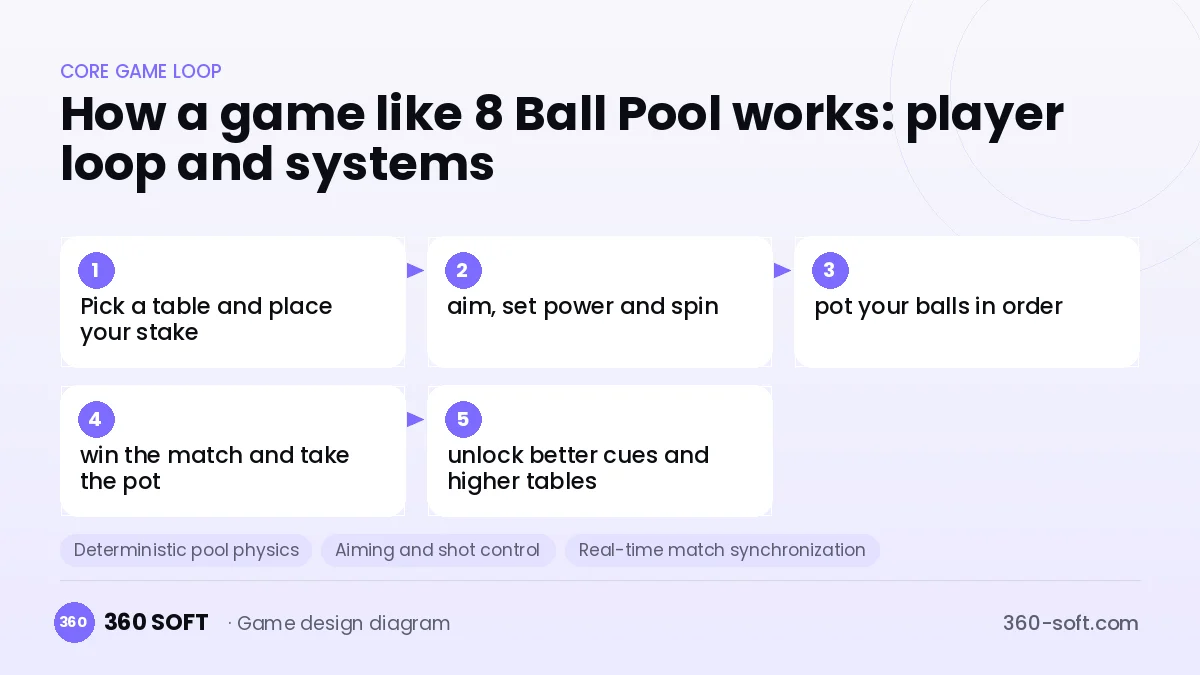
8 Ball Pool delivers short, tense one-on-one pool matches against real opponents. Players aim, set shot power and spin, and try to pot their balls in order. The thrill of turning a match around with a single shot, the drive to reach high-stakes tables and collectible cues make it a highly addictive competitive arena. The rules are familiar, but mastering them takes time.
A similar game demands deterministic, reliable pool physics: ball collisions, cushion rebounds, friction, spin and pocket behavior. Shots must be validated on the server, both players must see exactly the same outcome and latency must be hidden. Matchmaking, stake-based cities, cue collections and upgrades, tournaments, clubs and anti-cheat systems complete the game.
Why 8 Ball Pool works: the core loop
Systems you need to build a game like 8 Ball Pool
Deterministic pool physics
An engine that calculates ball-to-ball and ball-to-cushion collisions, friction and spin so that every device gets exactly the same result.
Aiming and shot control
A precise yet easy-to-learn control scheme with an aim line, power bar and spin control.
Real-time match synchronization
Sending shot data to the opponent, validating the outcome on the server and replaying it on both screens.
Matchmaking and stake tables
City and table tiers split by entry fee, plus skill-based opponent matching.
Cue collection and upgrades
Cues with different force, aim and spin attributes, and a system for levelling them up.
Tournaments, clubs and anti-cheat
Knockout tournaments, club rivalries and a security layer that detects aim-assist tools.
What goes into the first version, what comes later
First version (soft launch)
- 8-ball rules with deterministic physics
- Real-time one-on-one matches and matchmaking
- Stake-based table tiers and a coin economy
- A starter cue collection
- In-app purchases, rewarded ads and analytics
Later updates
- 9-ball and other game modes
- Tournaments and a club system
- Season pass and cue upgrades
- Private matches with friends and chat
The hard parts of this genre
Consistent physics across platforms
Floating-point differences can produce different results on different devices; fixed-point math or server validation is required.
Cheats and aim assistants
Hacked tools that extend the aim line are widespread; shot-data analysis and server-side checks are essential.
Cue power versus fairness
If purchased cues give too much of an edge, competition breaks down; skill must always remain the deciding factor.
Team, timeline and budget
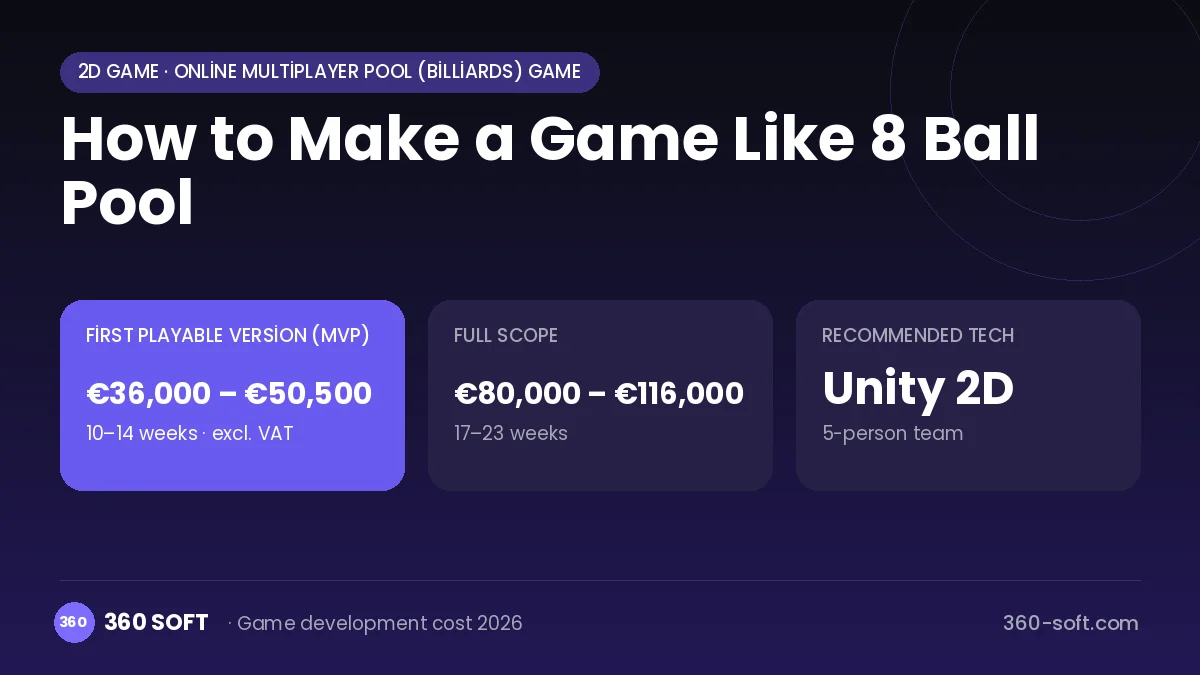
The estimate is based on the genre’s core systems, content volume, multiplayer and live-ops needs plus QA and project management: about 306 person-days for the full scope and 138 person-days for the first version. Cutting scope (fewer levels, one map, fewer characters) lowers the budget directly. Store accounts, servers, audio licences and user-acquisition budget are separate items. We send a fixed written price within 24 hours after the game design document.
Monetisation
Pool games earn from coin and premium currency packs, cue sales and a season pass. Rewarded ads are offered for extra coins or a daily spin. VIP membership, table and cue cosmetics and tournament entries are additional revenue streams. It is crucial that in-game coins can never be converted into real money.
Estimate your game budget and get a fixed quote
Let us scope it together and send a fixed written quote within 24 hours. NDA on request; you own the source code.
Calculated instantly from your choices, excl. VAT. A fixed written quote follows a free scoping call within 24 hours.
Choosing a game development company for a game like 8 Ball Pool
Most people searching “make a game like 8 ball pool” are really looking for a reliable game development company. When comparing quotes, check four things:
- Can you play their released 2D games on your own phone?
- Are the source code, art files and store accounts transferred to you by contract?
- Do they build a playable prototype first and show a demo every two weeks?
- Are multiplayer servers, anti-cheat and scaling costs written into the quote?
Copyright and originality
Game mechanics on their own are generally not protected, but names, logos, characters, art, audio and level designs are. That is why we build a game “like 8 Ball Pool” with your own name, art and world. This is not legal advice; we recommend a trademark search before launch.
Frequently asked questions
How long does it take to make a game like 8 Ball Pool?
The physics engine and a single-player mode can be prototyped quickly; real-time sync, server validation, the economy and anti-cheat take up most of the schedule.
Will there be copyright issues?
Pool rules and general mechanics are free to use. 8 Ball Pool's name, logo, interface, cue designs and artwork cannot be copied. This is not legal advice.
Which engine and physics solution should I use?
Unity 2D with custom deterministic physics or a Box2D-based solution is common. For multiplayer consistency, the physics must produce identical results on every device.
What should I look for in a studio that builds pool games?
Ask about their experience with real-time multiplayer and physics synchronization. Request their anti-cheat and server validation approach in writing at the proposal stage.