2D gameVector graphics space shooter arcade gameOriginal by Atari
Asteroids is the arcade classic, remembered for its vector graphics, about shattering rocks with a small ship that drifts on inertia. Its originality lies in the skill depth created by a ship steered with thrust and rotation that never brakes. Large rocks split into smaller, faster pieces when hit, so every shot briefly increases the danger on screen, forcing the player to make constant decisions about position and fire.
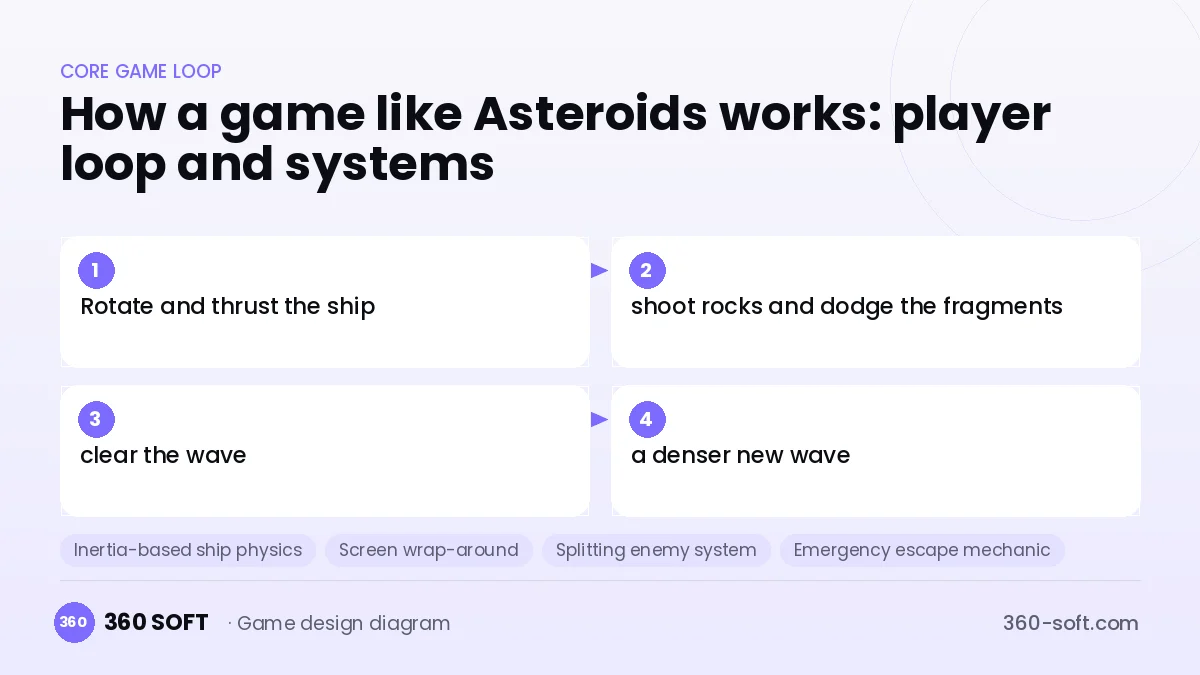
For a similar game, inertia physics, screen wrap-around and splitting enemies are the core systems. Emergency escapes such as a hyperspace jump, enemy ships and wave design add variety. Modern takes often add roguelite upgrades, particle effects and multiplayer arenas. The Asteroids name and original presentation are protected, so reinterpret the retro vector aesthetic with your own ship and universe design.
Why Asteroids works: the core loop
Systems you need to build a game like Asteroids
Inertia-based ship physics
An adjustable control model with thrust, rotation and frictionless drifting that demands skill.
Screen wrap-around
A play area that feels boundless because objects leaving one edge re-enter from the opposite side.
Splitting enemy system
A structure where hit rocks break into smaller, faster pieces, with points awarded by size.
Emergency escape mechanic
A last-resort ability on a cooldown, such as a risky teleport or shield, for players who get cornered.
Waves and enemy ship design
Pacing control through waves of growing rock density and enemy ships that aim at the player.
Visual effects and feedback
Satisfying hit feel with neon vector lines, particle explosions and screen shake.
What goes into the first version, what comes later
First version (soft launch)
- Inertia physics and a control scheme tuned for mobile
- Splitting rocks and screen wrap
- Wave system and an enemy ship
- Original vector or neon visual identity
- Local high scores and analytics
Later updates
- Roguelite upgrade choices
- Multiplayer arena mode
- Ship collection and skins
- Daily challenges and leaderboards
The hard parts of this genre
Mobile controls
Inertia and rotation are harder on a touchscreen, so virtual sticks, auto-aim or alternative schemes must be tested.
Screen clutter
Splitting fragments fill the screen fast, so object count, readability and performance must be balanced together.
Original identity
The Asteroids name and presentation are protected; while you use a vector aesthetic, the ship, enemy and universe design must be yours.
Team, timeline and budget
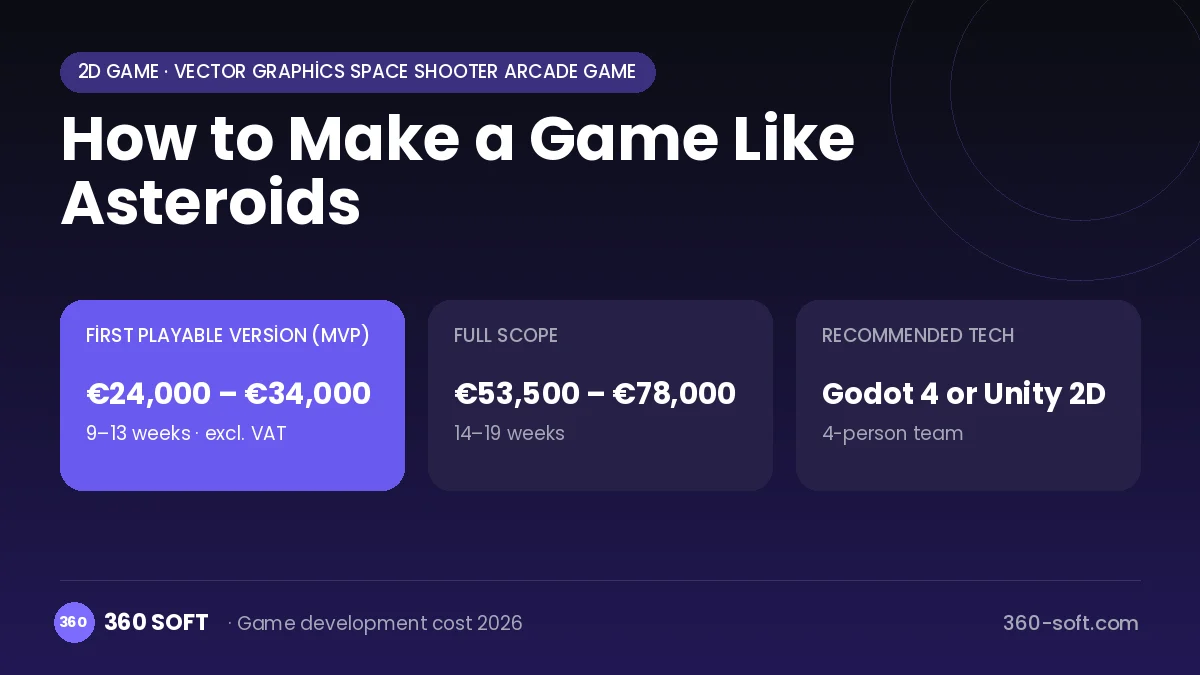
The estimate is based on the genre’s core systems, content volume, multiplayer and live-ops needs plus QA and project management: about 205 person-days for the full scope and 92 person-days for the first version. Cutting scope (fewer levels, one map, fewer characters) lowers the budget directly. Store accounts, servers, audio licences and user-acquisition budget are separate items. We send a fixed written price within 24 hours after the game design document.
Monetisation
Retro space shooters rely on rewarded ads for continues or upgrades, end-of-session ads and a paid ad-free version. Ship skins, trail effects and colour palettes can be sold as cosmetics. On PC, a version with roguelite depth is well suited to a low-priced premium release.
Estimate your game budget and get a fixed quote
Let us scope it together and send a fixed written quote within 24 hours. NDA on request; you own the source code.
Calculated instantly from your choices, excl. VAT. A fixed written quote follows a free scoping call within 24 hours.
Choosing a game development company for a game like Asteroids
Most people searching “make a game like asteroids” are really looking for a reliable game development company. When comparing quotes, check four things:
- Can you play their released 2D games on your own phone?
- Are the source code, art files and store accounts transferred to you by contract?
- Do they build a playable prototype first and show a demo every two weeks?
- Are ads, in-app purchases and analytics set up as part of the quote?
Copyright and originality
Game mechanics on their own are generally not protected, but names, logos, characters, art, audio and level designs are. That is why we build a game “like Asteroids” with your own name, art and world. This is not legal advice; we recommend a trademark search before launch.
Frequently asked questions
How long does it take to make a game like Asteroids?
A playable version with basic physics and waves is ready quickly. Roguelite progression, a multiplayer mode and extensive visual effects extend the timeline.
Will there be copyright issues?
Rock shooting and inertia mechanics are generally free to use, but the Asteroids name and original presentation are protected. You can use a nostalgic vector aesthetic, but create the name, ship and enemy designs yourself; this is not legal advice.
Which engine is suitable?
Godot 4 and Unity 2D handle vector and particle effects well; for the browser, Phaser or PixiJS get fast results. With so many objects on screen, use object pooling.
How do I modernise this classic?
Adding an upgrade choice after each wave, boss enemies or a co-op mode works well. Preserving the inertia feel is important so the game keeps its essence.