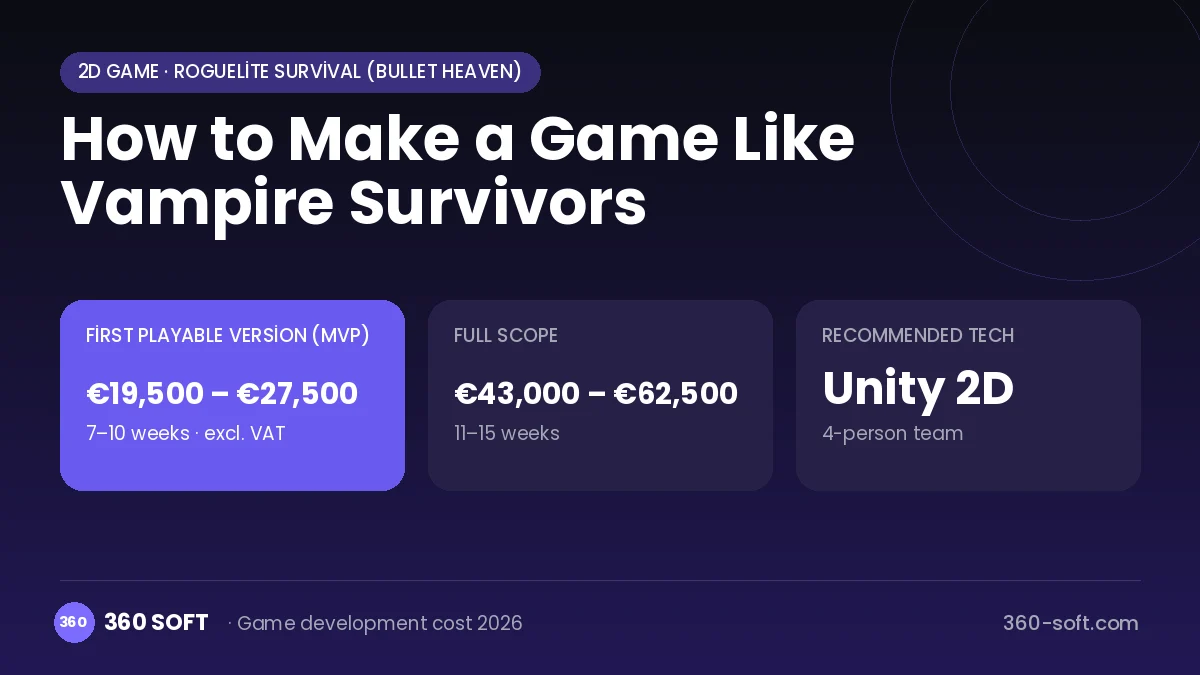
2D gameRoguelite survival (bullet heaven)Original by poncle
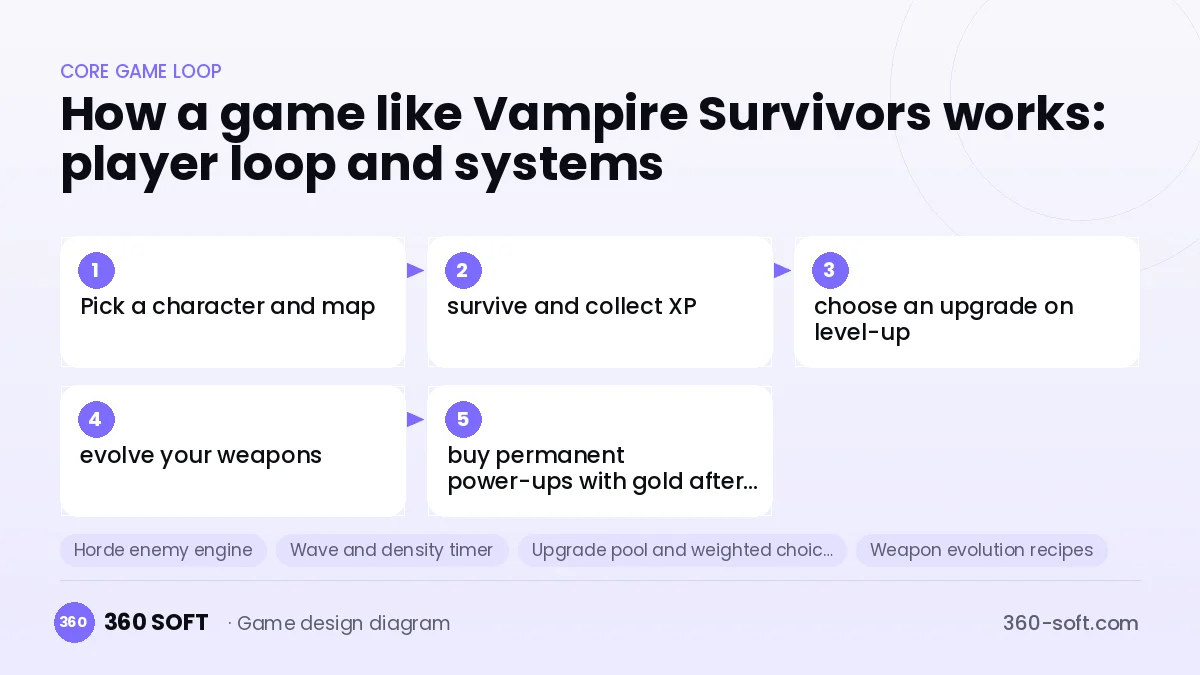
Vampire Survivors leaves players with nothing but movement; attacks fire automatically. The real decision is choosing between three or four upgrades offered at every level-up. Hundreds of enemies filling the screen, ever-stronger weapon and passive item synergies and the moment a weapon “evolves” create a huge power fantasy even in short sessions. Every run ends, but permanent gold and unlocked characters pull players straight into the next attempt.
A similar game must first establish a performance foundation that handles thousands of enemies smoothly at once: object pooling, batched rendering (GPU instancing) and simple, cheap collision checks. On top come a wave timer, an upgrade pool, evolution recipes, a permanent progression shop and map/character content. The balance sheet is the most critical content; the backend is mostly analytics, remote config and cloud saves.
Why Vampire Survivors works: the core loop
Systems you need to build a game like Vampire Survivors
Horde enemy engine
Managing hundreds to thousands of enemies with object pooling, batched rendering and lightweight physics without dropping frames.
Wave and density timer
A designer-editable, data-driven flow that sets enemy type, count and boss/elite spawns by the minute.
Upgrade pool and weighted choice
Generating level-up options based on luck, owned items and reroll/banish charges.
Weapon evolution recipes
A synergy system where a specific weapon paired with a passive item transforms into a new form at max level.
Permanent meta progression
Characters, maps and permanent stat upgrades unlocked with gold earned from runs.
Achievements and unlock tree
A quest list that ties hidden characters and items to specific conditions, keeping curiosity about discovery alive.
What goes into the first version, what comes later
First version (soft launch)
- One map and 3–4 playable characters
- 15–20 weapons and passive items, with a few evolution recipes
- A minute-based wave system and at least one boss
- A permanent upgrade shop using gold
- Analytics and remote balance tuning
Later updates
- New maps and themed DLC packs
- Local or online co-op mode
- Daily/weekly challenge runs and leaderboards
- Console and Steam Deck optimisation
The hard parts of this genre
Performance and readability
As the screen fills up, it is hard both to hold the frame rate and to let players pick out their own character and the threats.
Combination balance
When multipliers from dozens of weapons and items stack, broken combos emerge; simulation and testing tools are needed.
Preventing early boredom
If the first minutes drag, players quit; the power curve must be designed to be felt from the very first run.
Team, timeline and budget
The estimate is based on the genre’s core systems, content volume, multiplayer and live-ops needs plus QA and project management: about 165 person-days for the full scope and 74 person-days for the first version. Cutting scope (fewer levels, one map, fewer characters) lowers the budget directly. Store accounts, servers, audio licences and user-acquisition budget are separate items. We send a fixed written price within 24 hours after the game design document.
Monetisation
The natural model for this genre on PC and console is a low-priced premium release plus DLC packs. On mobile, a free download, rewarded ads that double end-of-run rewards, a remove-ads purchase and character/map packs offer a balanced mix. Aggressive energy systems are not recommended because they break the genre’s flow.
Estimate your game budget and get a fixed quote
Let us scope it together and send a fixed written quote within 24 hours. NDA on request; you own the source code.
Calculated instantly from your choices, excl. VAT. A fixed written quote follows a free scoping call within 24 hours.
Choosing a game development company for a game like Vampire Survivors
Most people searching “make a game like vampire survivors” are really looking for a reliable game development company. When comparing quotes, check four things:
- Can you play their released 2D games on your own phone?
- Are the source code, art files and store accounts transferred to you by contract?
- Do they build a playable prototype first and show a demo every two weeks?
- Are ads, in-app purchases and analytics set up as part of the quote?
Copyright and originality
Game mechanics on their own are generally not protected, but names, logos, characters, art, audio and level designs are. That is why we build a game “like Vampire Survivors” with your own name, art and world. This is not legal advice; we recommend a trademark search before launch.
Frequently asked questions
How long does it take to make a game like Vampire Survivors?
A playable prototype comes together in a few weeks; most of the time goes into balance, content variety and performance optimisation. Scope and the number of platforms directly determine the timeline.
Will making a game like Vampire Survivors cause copyright problems?
Mechanics such as auto-attacks and upgrade selection are generally free to use. The name, characters, visuals, sounds and original content cannot be copied. This is not legal advice.
Which engine is the better fit?
To show thousands of objects smoothly, Unity’s Jobs/Burst or ECS stack, or Godot 4, deliver good results. What matters more than the engine is discipline in object pooling and batched rendering.
Can it be done with a small team?
Yes, this genre suits small teams; the visual workload can be kept low with simple pixel art. You do, however, need to set aside serious time for balance testing and performance profiling.