2D gameDragon raising, breeding and collectionOriginal by Social Point
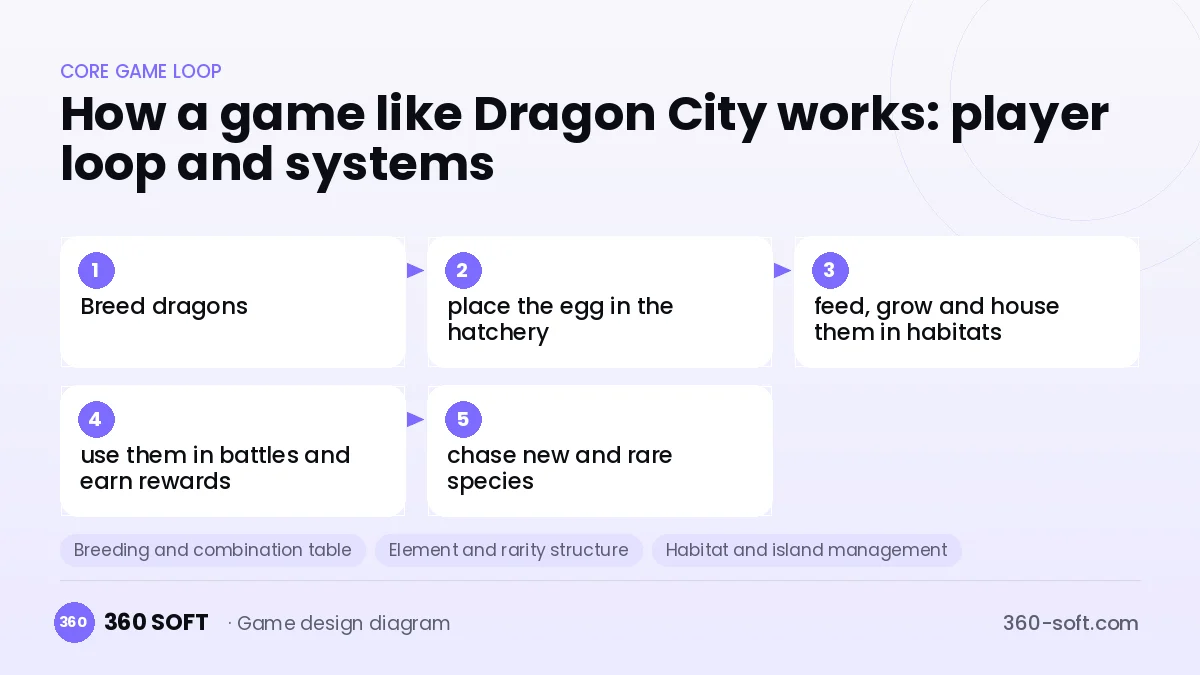
Dragon City combines the passion for collecting with a charming island-building game. The player breeds dragons of different elements to get new species, puts eggs in the hatchery, feeds and grows the dragons and tests them in turn-based battles. Discovering which two dragons produce which new species, limited-time event dragons and a steady stream of new species keep players hooked on the goal of catching them all.
For a similar game, the real investment is the breeding combination table and a huge volume of creature content. The element and rarity structure, breeding odds, habitat capacities, food farms, battle skills and the event calendar must be designed together. Because several growth stages have to be drawn for every dragon, an art pipeline and remote content delivery must be set up from the start.
Why Dragon City works: the core loop
Systems you need to build a game like Dragon City
Breeding and combination table
Probability-based new dragon generation from element and species pairings. The core system that feeds the curiosity to discover.
Element and rarity structure
Elements such as fire, water and earth plus rarity tiers; they also define advantages in battle.
Habitat and island management
Element habitats where dragons live, capacity limits, food farms and decorations.
Feeding and growth stages
Levelling up with food and visual growth from baby to adult. Each species needs extra art assets.
Turn-based battles and leagues
PvE and PvP battles with dragon teams, skill selection and league rankings.
Limited-time event dragons
Species available only for a set period, plus event quests. They drive return visits and spending.
What goes into the first version, what comes later
First version (soft launch)
- 4–6 elements and 40–60 dragon species
- Breeding, hatching and feeding loop
- Habitats, food farms and island layout
- Turn-based PvE battles
- A first limited-time dragon event
Later updates
- PvP leagues and a ranking system
- New elements and legendary species
- Guilds/alliances and shared events
- Dragon skins and island themes
The hard parts of this genre
Volume of art production
Each dragon needs several growth stages and animations. Without a style guide and an efficient animation pipeline, the content flow cannot be sustained.
Combination and probability balance
As the breeding table grows, how easily each species can be obtained shapes the economy. Tools and transparency are needed to manage the odds.
Server validation of timers
If hatching and breeding times are not validated on the server, device clock-change cheats spread.
Team, timeline and budget
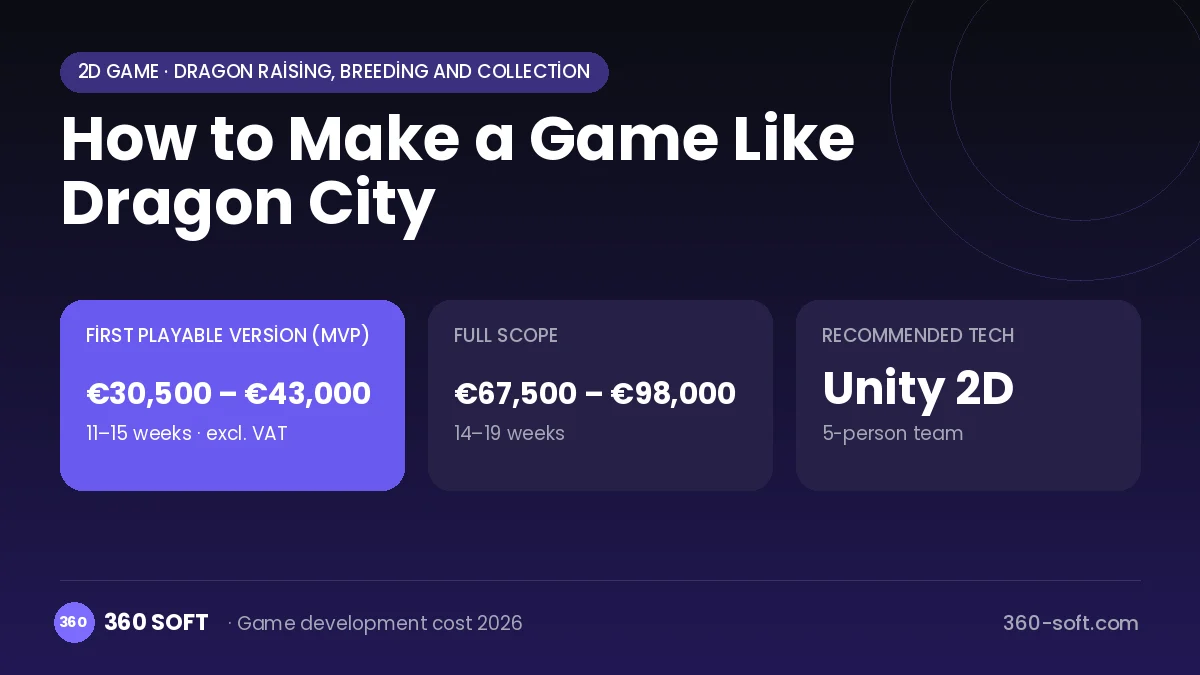
The estimate is based on the genre’s core systems, content volume, multiplayer and live-ops needs plus QA and project management: about 258 person-days for the full scope and 116 person-days for the first version. Cutting scope (fewer levels, one map, fewer characters) lowers the budget directly. Store accounts, servers, audio licences and user-acquisition budget are separate items. We send a fixed written price within 24 hours after the game design document.
Monetisation
Revenue comes through IAP: time skips with premium currency, rare dragon bundles, event passes and limited offers. Rewarded ads are a great fit for extra food, speed-ups or a second try. For probability-based content, transparent odds display and target market rules, such as EU and UK loot box guidance, must be taken into account.
Estimate your game budget and get a fixed quote
Let us scope it together and send a fixed written quote within 24 hours. NDA on request; you own the source code.
Calculated instantly from your choices, excl. VAT. A fixed written quote follows a free scoping call within 24 hours.
Choosing a game development company for a game like Dragon City
Most people searching “make a game like dragon city” are really looking for a reliable game development company. When comparing quotes, check four things:
- Can you play their released 2D games on your own phone?
- Are the source code, art files and store accounts transferred to you by contract?
- Do they build a playable prototype first and show a demo every two weeks?
- Are multiplayer servers, anti-cheat and scaling costs written into the quote?
Copyright and originality
Game mechanics on their own are generally not protected, but names, logos, characters, art, audio and level designs are. That is why we build a game “like Dragon City” with your own name, art and world. This is not legal advice; we recommend a trademark search before launch.
Frequently asked questions
How long does it take to make a game like Dragon City?
The breeding and island core comes together fairly quickly; the time-consuming parts are dragon art and event content. Starting with a limited roster of species and speeding up the content pipeline after launch is common.
Does the idea of dragon breeding raise copyright issues?
Creature collection and breeding mechanics are a general genre. However, dragon designs, names, logo, UI and sounds cannot be copied one-to-one. This is not legal advice.
Which engine should we use?
With 2D sprites and skeletal animation, Unity or Cocos Creator are good choices. Being able to update combination tables remotely is as important as the engine.
What should I look for when choosing a studio for this kind of game?
Look for a team with a strong 2D art and animation pipeline and LiveOps event experience. Ask about their approach to economy design and odds transparency.