3D gameMMORPG (massively multiplayer online role-playing game)Original by Ymir Entertainment / Gameforge
Metin2 is a Korean-made MMORPG that became a phenomenon in Turkey and across Europe, defining a generation's memories of internet cafes and guilds. In an East Asian-inspired world, players smash metin stones, grind monsters to level up, risk upgrading their gear to +9 and fight shoulder to shoulder with their guild in kingdom wars, building deep community bonds. Market trading, rare item hunts and reputation turn the game into a social economy.
Realistically, an MMORPG at this scale needs always-on servers, years of accumulated content and a large live-ops team, so a small first release must cut scope radically. A realistic MVP: one kingdom and two or three maps, three classes, level 1–30 content, basic item upgrading, parties and guilds, and player-to-player trading. This requires an authoritative game server, a database, and protection against cheating and item duplication (dupes).
Why Metin2 works: the core loop
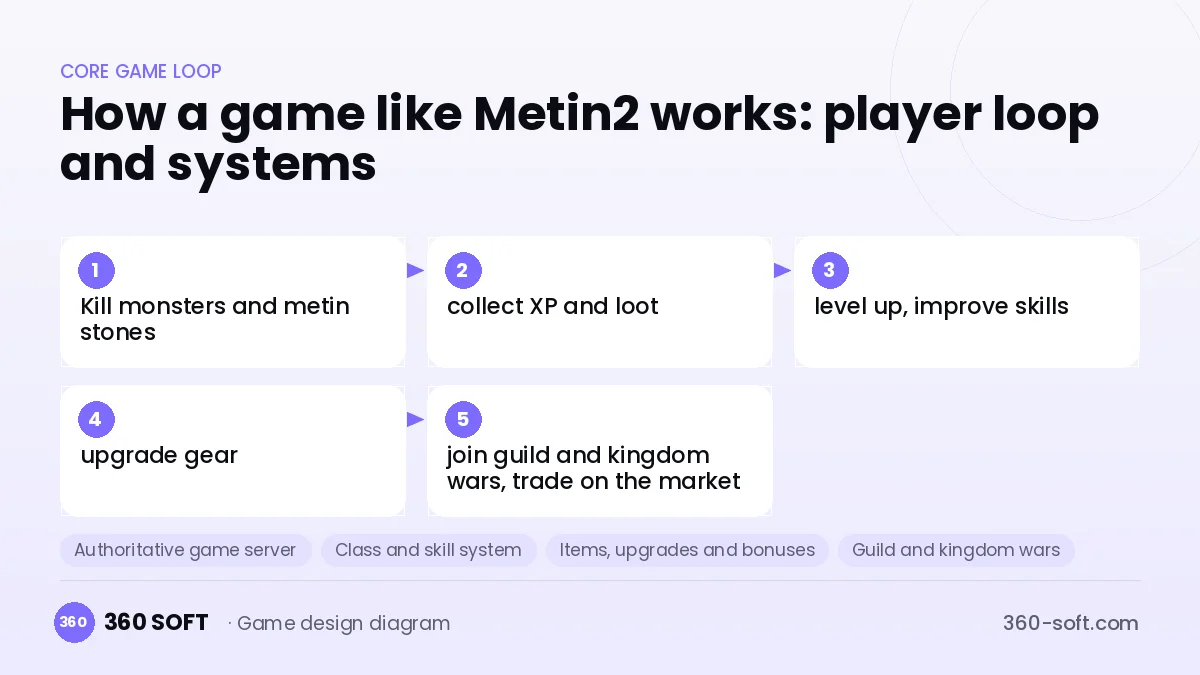
Systems you need to build a game like Metin2
Authoritative game server
An architecture split into channels and maps where movement, combat, damage and loot drops are calculated entirely on the server. The most critical and most expensive part of an MMORPG.
Class and skill system
Archetypes similar to warrior, ninja, sura and shaman, each with its own skill trees. Balance between classes determines the health of PvP.
Items, upgrades and bonuses
Risky gear upgrades (the item can be lost on failure), random bonus stats and rare items. This system is the economic heart of the game.
Guild and kingdom wars
Guild creation, guild buildings, scheduled guild wars and PvP between kingdoms. The social core that holds the community together.
Market and player trading
Player shops, a trade window and, if needed, an auction house. Every transaction must be logged to fight dupes and bots.
Live ops and GM tools
An admin panel for starting events, player support, bans, log review and server maintenance. Tools you will use every day after launch.
What goes into the first version, what comes later
First version (soft launch)
- One kingdom, 2–3 maps and a level 1–30 range
- 3 playable classes with basic skill trees
- Monsters, metin stones, dungeons and loot drops
- Item upgrading, parties, guilds and player trading
- Authoritative server, anti-cheat / anti-dupe and a GM panel
Later updates
- Kingdom wars and guild wars
- New maps, high-level dungeons and bosses
- Mounts, pets and costume systems
- Mobile client or cross-platform support
The hard parts of this genre
Server architecture and scale
Keeping the server alive when hundreds of players fight on one map requires area-of-interest (AOI) management, a channel system and load balancing.
Cheats, bots and item duplication
In MMORPGs, auto-farming bots, speed hacks and dupe exploits wreck the economy fast. Server-side validation, log analysis and a fast patch process are mandatory.
Content consumption and live ops
Players finish content far faster than it can be built. Plan a team for continuous events, new maps and balance updates after launch.
Team, timeline and budget
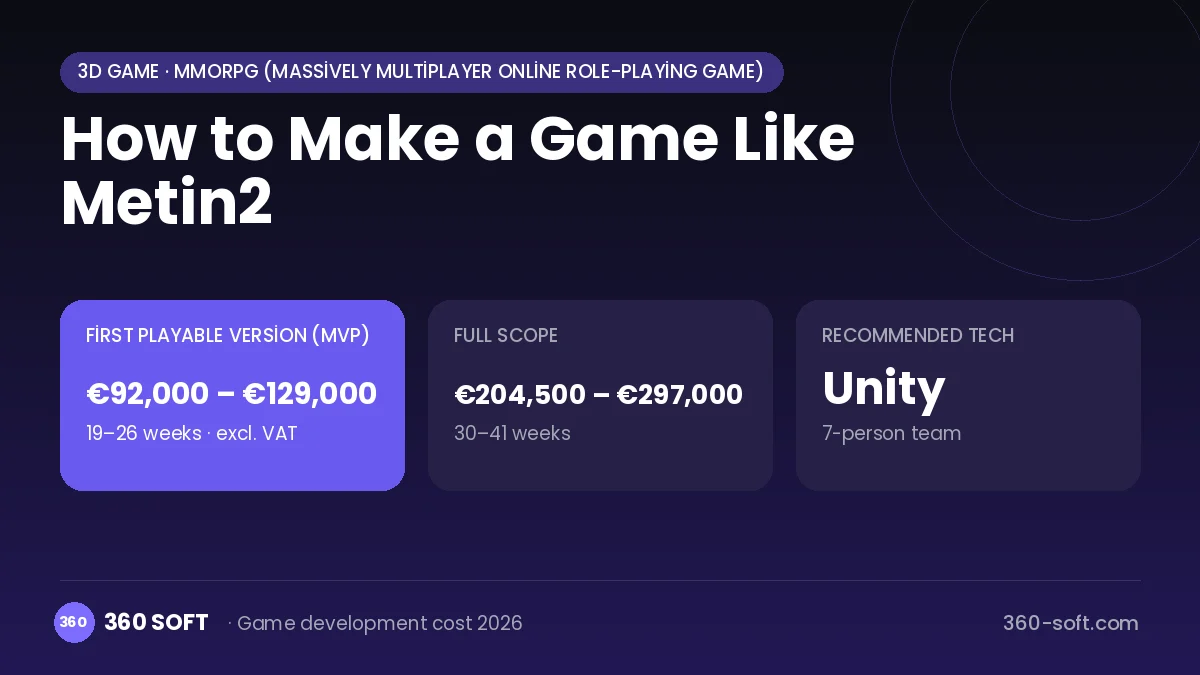
The estimate is based on the genre’s core systems, content volume, multiplayer and live-ops needs plus QA and project management: about 786 person-days for the full scope and 354 person-days for the first version. Cutting scope (fewer levels, one map, fewer characters) lowers the budget directly. Store accounts, servers, audio licences and user-acquisition budget are separate items. We send a fixed written price within 24 hours after the game design document.
Monetisation
The common model in this genre is free-to-play plus an item shop: costumes, mounts, pets, inventory expansions, upgrade protection items and premium membership. Items that widen the power gap between players too much are the community's most frequent complaint; cosmetic and convenience-focused sales are healthier in the long run. Seasonal events and new server launches create revenue peaks.
Estimate your game budget and get a fixed quote
Let us scope it together and send a fixed written quote within 24 hours. NDA on request; you own the source code.
Calculated instantly from your choices, excl. VAT. A fixed written quote follows a free scoping call within 24 hours.
Choosing a game development company for a game like Metin2
Most people searching “make a game like metin2” are really looking for a reliable game development company. When comparing quotes, check four things:
- Can you play their released 3D games on your own phone?
- Are the source code, art files and store accounts transferred to you by contract?
- Do they build a playable prototype first and show a demo every two weeks?
- Are multiplayer servers, anti-cheat and scaling costs written into the quote?
Copyright and originality
Game mechanics on their own are generally not protected, but names, logos, characters, art, audio and level designs are. That is why we build a game “like Metin2” with your own name, art and world. This is not legal advice; we recommend a trademark search before launch.
Frequently asked questions
How long does it take to make a game like Metin2?
A full-scale MMORPG needs a large team and years. For a small team, the realistic path is a closed beta with one kingdom, a few maps and a limited level range, then growing with player feedback.
Can I build a game from Metin2 private server files?
No. Leaked or unlicensed server files, clients and content are copyright infringement and carry serious legal risk. A lasting product needs original code, world and art assets. This is not legal advice.
Which engine and server technology should I use?
Unity or Unreal Engine 5 work for the client. What really matters is a scalable, authoritative server architecture, usually custom-built in C++, Go or.NET.
What should I look for in an MMORPG development company?
Look for a team that has actually built multiplayer server infrastructure and has anti-cheat and live-ops experience. A company that can walk you through server load testing, not just client graphics, is trustworthy.