2D gameMetroidvania action platformerOriginal by Moon Studios
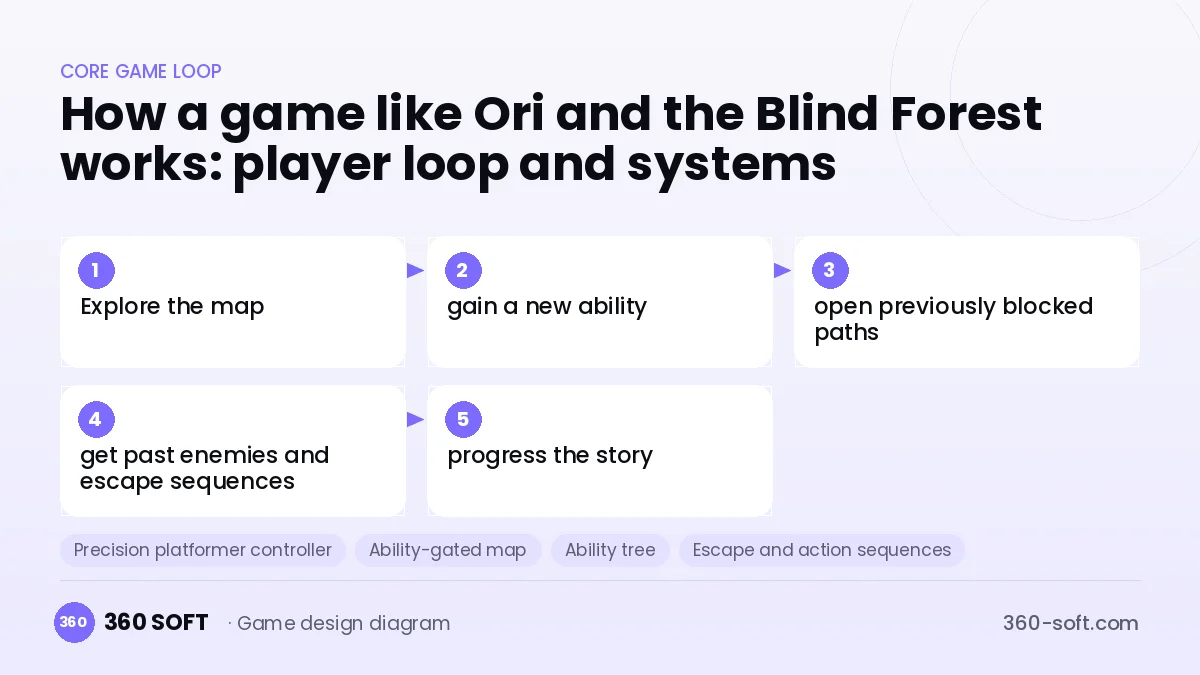
What makes the Ori series unforgettable is the combination of an incredibly fluid sense of movement with forest scenes that look like paintings. As abilities such as double jump, wall cling and launching off enemy projectiles unlock, the map is rediscovered. Emotional storytelling and an orchestral score, combined with demanding escape sequences, leave players both in awe and genuinely challenged.
A similar game needs a finely tuned platformer character controller, a Metroidvania map linked together by ability gates, a save and checkpoint system, and enemy and boss designs. Art direction built from layered backgrounds, lighting effects and particles is the largest part of the budget. Escape sequences on their own demand meticulous level design.
Why Ori and the Blind Forest works: the core loop
Systems you need to build a game like Ori and the Blind Forest
Precision platformer controller
Character movement fine-tuned through acceleration, jump height, air control, wall cling and input tolerance windows.
Ability-gated map
A Metroidvania world structure that links regions together, with passages opened by new movement abilities and hidden areas.
Ability tree
A progression system that upgrades combat, exploration and movement skills with collected experience, letting players choose to suit their play style.
Escape and action sequences
Scripted runs such as a flood or a collapsing tree, with little margin for error and synced to the music.
Saves and checkpoints
Fixed save points, or a flexible checkpoint system where players spend a resource to create their own save.
Art and lighting pipeline
A visual production process that adds depth to scenes with parallax backgrounds, dynamic lighting, fog and particles.
What goes into the first version, what comes later
First version (soft launch)
- Polished core movement: running, jumping, wall clinging
- A connected map of two regions
- Two new abilities and the paths they open
- One boss or escape sequence
- Save system and map screen
Later updates
- New regions and abilities
- An expanded ability tree and side quests
- Difficulty options and accessibility settings
- Console versions and an achievements system
The hard parts of this genre
Movement feel
In this genre, quality depends heavily on how the controls feel; millisecond tolerance tweaks and animation transitions take a long time to get right.
Map design
For backtracking to feel rewarding rather than tedious, region connections, shortcuts and ability order must be planned from the start.
Art quality
Hand-painted-looking, richly lit scenes require a very high art budget; the style should be chosen to match how fast the team can produce it.
Team, timeline and budget
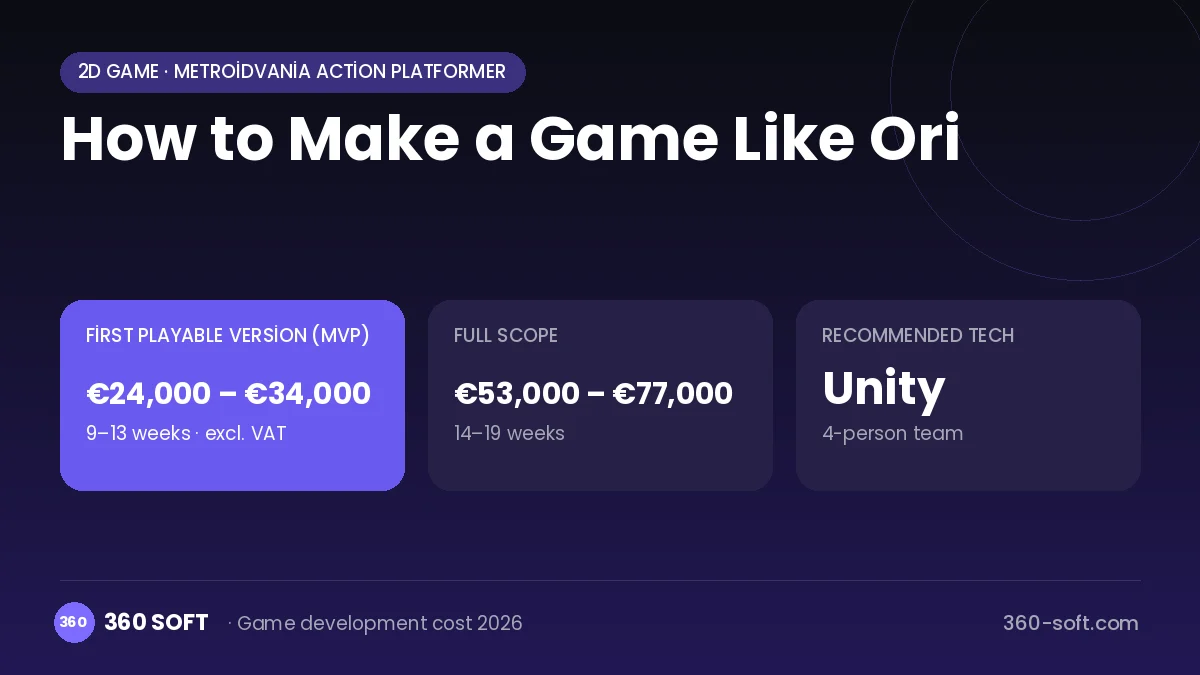
The estimate is based on the genre’s core systems, content volume, multiplayer and live-ops needs plus QA and project management: about 203 person-days for the full scope and 91 person-days for the first version. Cutting scope (fewer levels, one map, fewer characters) lowers the budget directly. Store accounts, servers, audio licences and user-acquisition budget are separate items. We send a fixed written price within 24 hours after the game design document.
Monetisation
Metroidvania games almost always earn through premium sales on PC and console. Extended editions, soundtracks and art books, plus deals with platform subscription services, can be additional channels. In-app purchases provoke a backlash in this genre and are not recommended.
Estimate your game budget and get a fixed quote
Let us scope it together and send a fixed written quote within 24 hours. NDA on request; you own the source code.
Calculated instantly from your choices, excl. VAT. A fixed written quote follows a free scoping call within 24 hours.
Choosing a game development company for a game like Ori and the Blind Forest
Most people searching “make a game like ori” are really looking for a reliable game development company. When comparing quotes, check four things:
- Can you play their released 2D games on your own phone?
- Are the source code, art files and store accounts transferred to you by contract?
- Do they build a playable prototype first and show a demo every two weeks?
- Are ads, in-app purchases and analytics set up as part of the quote?
Copyright and originality
Game mechanics on their own are generally not protected, but names, logos, characters, art, audio and level designs are. That is why we build a game “like Ori and the Blind Forest” with your own name, art and world. This is not legal advice; we recommend a trademark search before launch.
Frequently asked questions
How long does it take to make a game like Ori?
Because of the interconnected map and heavy art production, Metroidvanias are long-running projects. Producing a one-region vertical slice first and getting the control feel and art style signed off is a healthy approach.
Will there be copyright issues?
The Metroidvania structure and movement abilities are generally free to use. Character designs, names, world and story elements, music and visual assets must be original. This is not legal advice.
Can it be made with a small team?
Small teams can produce Metroidvanias, but the art style should be simplified and the map size kept realistic. Ori-level visual density needs a strong art team.
What should we look for when choosing a studio to build a game like Ori?
Ask for playable samples that demonstrate platformer control feel. Also ask about their level design and 2D art direction experience, and how well they know console publishing processes.