2D gameClassic maze arcade gameOriginal by Namco (Toru Iwatani)
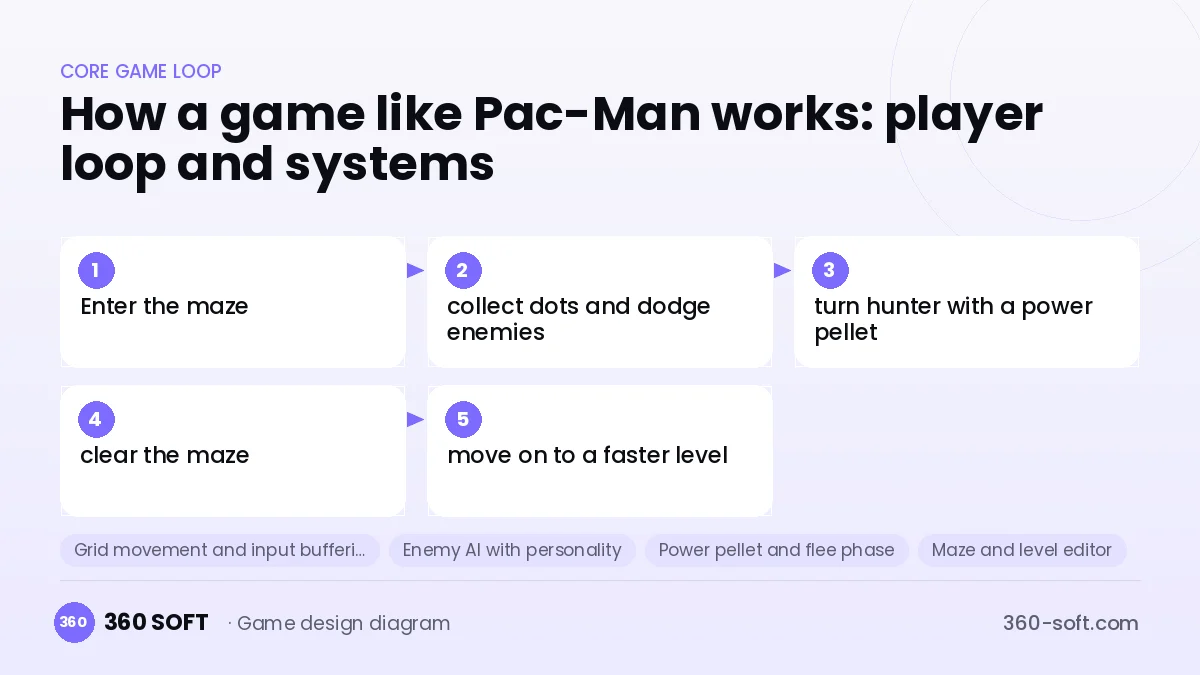
Pac-Man is the arcade classic about eating dots in a maze while escaping the ghosts on your tail. Its power lies in the sudden rush of switching from hunted to hunter: the moment you swallow a power pellet, the ghosts flee and the player gets a few seconds of revenge. Because each ghost behaves differently, the maze becomes a puzzle you can learn but never fully trust.
For a similar game the real work is building enemy AI with personality: rivals that switch between chase, ambush and scatter phases, each picking a different target. On top of that you need grid-based movement, input buffering for corners, a maze editor and a level speed curve. The Pac-Man name, characters and ghost designs are protected, so you must keep the nostalgic feel while creating entirely original characters and a world of your own.
Why Pac-Man works: the core loop
Systems you need to build a game like Pac-Man
Grid movement and input buffering
A control layer that keeps the character gliding through corridors and lets the player queue a turn before reaching the corner.
Enemy AI with personality
A behaviour system where each enemy chooses a different target point and switches between chase, scatter and frightened phases on a timer.
Power pellet and flee phase
A power window that briefly reverses roles, awards escalating points for consecutive catches and shortens as levels progress.
Maze and level editor
An internal tool for visually designing tunnels, gates and pellet placement and testing them quickly.
Bonus fruit and leaderboards
Bonus items that appear at set moments, extra life thresholds and local and global high score tables.
Difficulty and speed curve
A table that tunes player and enemy speeds, power duration and enemy aggression as levels progress.
What goes into the first version, what comes later
First version (soft launch)
- Precise grid movement with touch and swipe controls
- Four enemy types with distinct behaviour
- Power pellets, bonus items and a lives system
- Several original mazes and original character designs
- Local high scores and basic analytics
Later updates
- Maze editor and player-made levels
- Weekly challenges and global leaderboards
- Character and maze theme store
- Simultaneous two-player chase mode
The hard parts of this genre
Balancing enemy behaviour
Enemies that are too smart feel unfair and enemies that are too predictable feel boring; phase timings need long playtesting to tune.
Control precision on mobile
Without a physical joystick, swipe controls need input buffering and tolerance so players do not miss turns.
Copyright and trademark limits
The Pac-Man name, the yellow character and the ghost designs are protected, so the maze chase idea has to be reimagined with original characters, theme and sound.
Team, timeline and budget
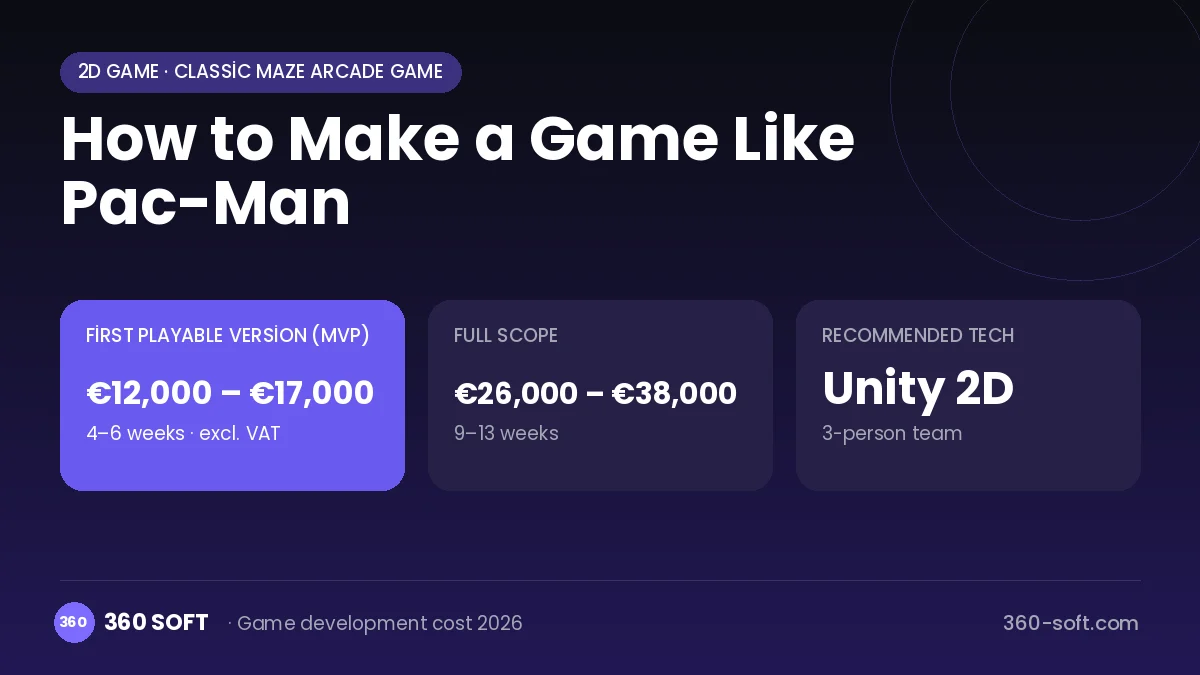
The estimate is based on the genre’s core systems, content volume, multiplayer and live-ops needs plus QA and project management: about 99 person-days for the full scope and 45 person-days for the first version. Cutting scope (fewer levels, one map, fewer characters) lowers the budget directly. Store accounts, servers, audio licences and user-acquisition budget are separate items. We send a fixed written price within 24 hours after the game design document.
Monetisation
Retro arcade games most commonly use rewarded ads for extra lives or continues, interstitials between levels and a paid ad-free version. Character skins, maze themes and special challenge packs can be sold as cosmetics. On PC, a low-priced premium release is also a good option.
Estimate your game budget and get a fixed quote
Let us scope it together and send a fixed written quote within 24 hours. NDA on request; you own the source code.
Calculated instantly from your choices, excl. VAT. A fixed written quote follows a free scoping call within 24 hours.
Choosing a game development company for a game like Pac-Man
Most people searching “make a game like pac-man” are really looking for a reliable game development company. When comparing quotes, check four things:
- Can you play their released 2D games on your own phone?
- Are the source code, art files and store accounts transferred to you by contract?
- Do they build a playable prototype first and show a demo every two weeks?
- Are ads, in-app purchases and analytics set up as part of the quote?
Copyright and originality
Game mechanics on their own are generally not protected, but names, logos, characters, art, audio and level designs are. That is why we build a game “like Pac-Man” with your own name, art and world. This is not legal advice; we recommend a trademark search before launch.
Frequently asked questions
How long does it take to make a game like Pac-Man?
A basic single-player maze game becomes playable relatively quickly. Time grows as you add polished enemy behaviour, many mazes, an editor and online leaderboards.
Will there be copyright issues?
The mechanic of collecting in a maze while being chased is generally free to use, but the Pac-Man name, characters, ghost designs, sounds and original maze layout are protected. You can nod to nostalgia, but the characters must be yours; this is not legal advice.
How do I capture a retro feel?
Pixel art or a neon vector look, a limited colour palette and chiptune-style sound strongly evoke nostalgia. What matters most is not the look but getting the fast, sharp game feel right.
How do I make a classic arcade game stand out?
You can add a new theme, shifting mazes, power-ups or a multiplayer mode. Adding a small but clear twist to a familiar rule gives players a reason to try it.