3D gameCar soccer (physics-based competitive sport)Original by Psyonix
The secret of Rocket League is how it pairs an idea everyone understands (football with cars) with a mastery ceiling that takes years to reach. Just touching the ball is fun in your first match; hundreds of hours later, aerial shots, wall bounces and team rotations come into play. Five-minute matches, fair starting conditions and purely cosmetic progression make players say one more match even after a loss.
The heart of a similar game is deterministic physics and netcode far more than graphics. You need a car controller (jump, flip, boost, air control), a ball collision model, server-authoritative simulation, client-side prediction and rollback correction. On top of that come skill-based matchmaking, ranked leagues, match replays, a cosmetic inventory, and anti-cheat and quit-penalty systems.
Why Rocket League works: the core loop
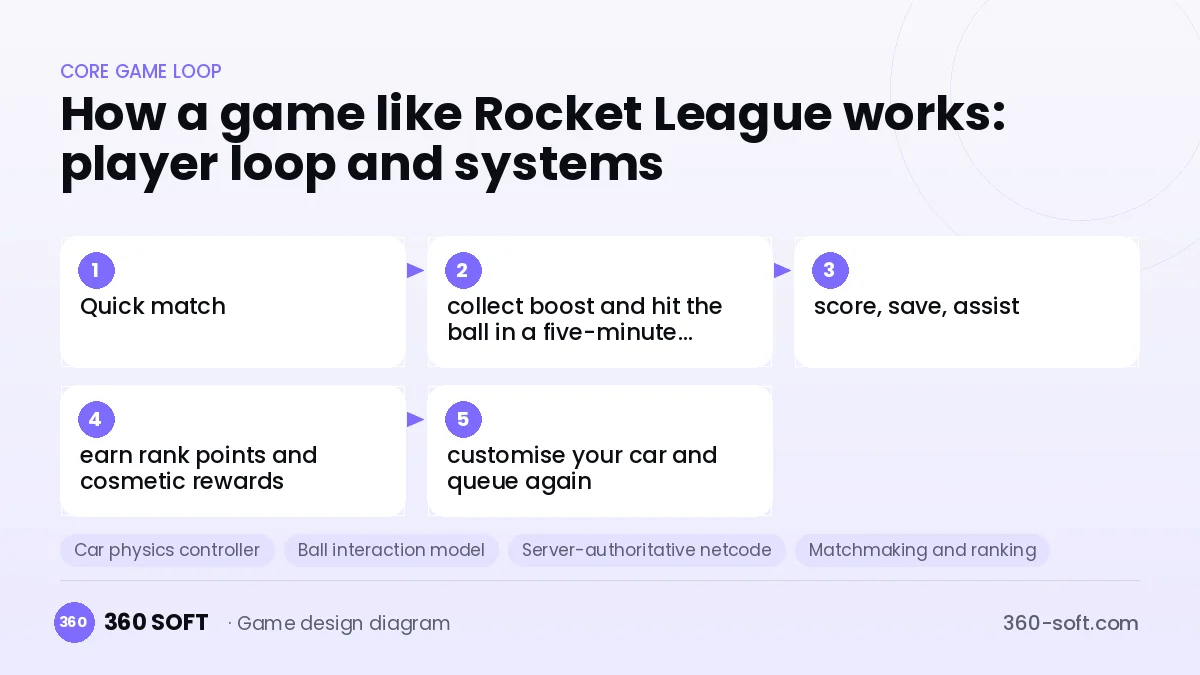
Systems you need to build a game like Rocket League
Car physics controller
Jump, double jump, flips, boost and in-air steering must run on fixed-tick physics. The feel decides the fate of the whole game.
Ball interaction model
How the ball bounces off the car surface, its spin and shot power must be predictable. Repeating the same hit should give the same result.
Server-authoritative netcode
Dedicated server simulation, client prediction and rollback correction on divergence. Even a small desync in ball position turns into a goal dispute.
Matchmaking and ranking
MMR-based matchmaking, 1v1/2v2/3v3 playlists, seasonal league badges and party (play with friends) matchmaking rules.
Cosmetic inventory
Items that do not affect gameplay, such as car bodies, wheels, boost trails and goal explosions; a server-side inventory and store rotation.
Replay and training modes
Match replay recording, a free-play training arena and preset shot scenarios. In games with a high skill ceiling, these are the main retention tools.
What goes into the first version, what comes later
First version (soft launch)
- One stadium, 3–4 car bodies and a single, well-tuned physics profile
- 1v1 and 3v3 online matches on dedicated servers
- Basic MMR matchmaking and post-match stats
- Offline matches against bots and free-play training
- Small cosmetic store and a server-validated inventory
Later updates
- Seasonal ranked leagues, tournament mode and battle pass
- Alternative rule modes such as basketball and ice hockey
- Cross-play matchmaking and parties
- Replay sharing and spectator mode
The hard parts of this genre
Physics feel
Car weight, air control and ball bounce are tuned through countless iterations. This feel cannot be copied; plan serious time for the prototype phase.
Latency-tolerant sync
A fast-moving ball and collisions must look fair even at high ping. Prediction, rollback and regional server placement are essential.
Player pool and matchmaking
Competitive games produce long queues and unbalanced matches without enough players. At launch, use bot backfill and a small number of modes so the pool is not split.
Team, timeline and budget
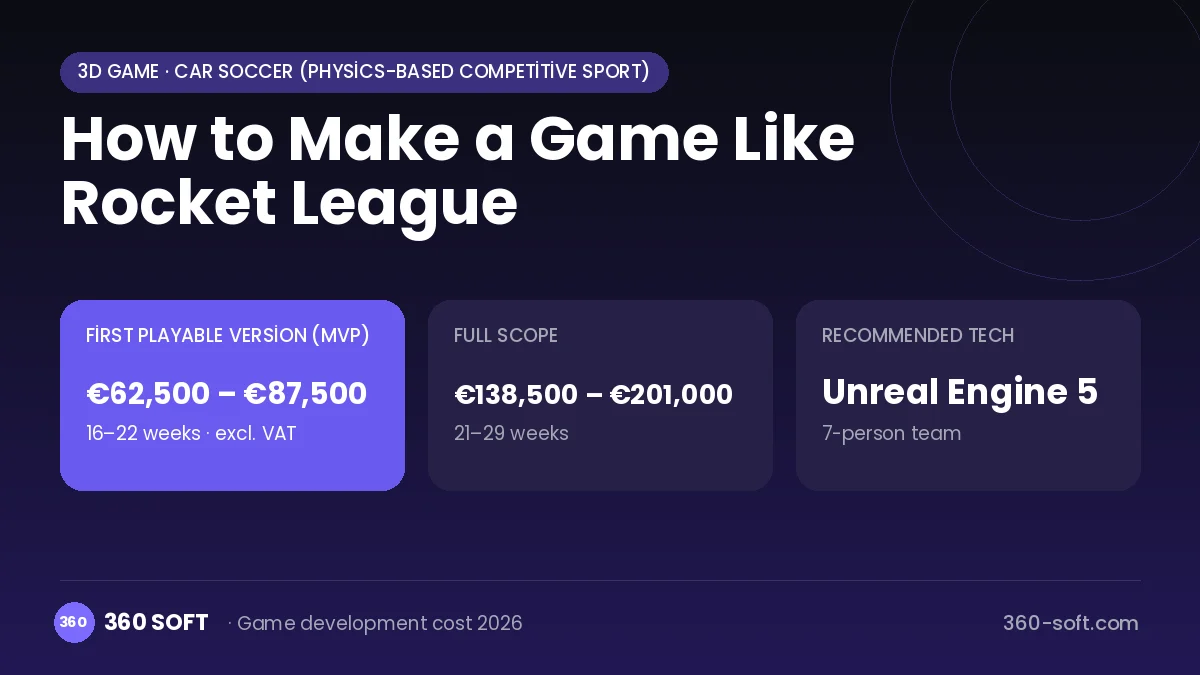
The estimate is based on the genre’s core systems, content volume, multiplayer and live-ops needs plus QA and project management: about 533 person-days for the full scope and 240 person-days for the first version. Cutting scope (fewer levels, one map, fewer characters) lowers the budget directly. Store accounts, servers, audio licences and user-acquisition budget are separate items. We send a fixed written price within 24 hours after the game design document.
Monetisation
Any sale that affects gameplay breaks a competitive community, so revenue is entirely cosmetic. Car bodies, boost trails, goal effects and a seasonal battle pass are the main items. A free-to-play model grows the player pool, while esports and community tournaments increase the visibility and value of cosmetics.
Estimate your game budget and get a fixed quote
Let us scope it together and send a fixed written quote within 24 hours. NDA on request; you own the source code.
Calculated instantly from your choices, excl. VAT. A fixed written quote follows a free scoping call within 24 hours.
Choosing a game development company for a game like Rocket League
Most people searching “make a game like rocket league” are really looking for a reliable game development company. When comparing quotes, check four things:
- Can you play their released 3D games on your own phone?
- Are the source code, art files and store accounts transferred to you by contract?
- Do they build a playable prototype first and show a demo every two weeks?
- Are multiplayer servers, anti-cheat and scaling costs written into the quote?
Copyright and originality
Game mechanics on their own are generally not protected, but names, logos, characters, art, audio and level designs are. That is why we build a game “like Rocket League” with your own name, art and world. This is not legal advice; we recommend a trademark search before launch.
Frequently asked questions
How long does it take to make a game like Rocket League?
A playable physics and network prototype with a single stadium can be built in a few months, but nailing the feel and reaching a fair online experience takes a long testing phase. Moving forward through a closed beta while collecting player data is the healthiest approach.
Will there be copyright issues?
The idea of playing football with cars and the general mechanics are generally not protected. However, the game name, logo, car designs, arena visuals and sounds cannot be copied; you should develop original cars and an original style. This is not legal advice.
Can a small team build it?
The core game can be built by a small team, but at least one engineer experienced in netcode and server infrastructure is a must. Since content volume is low, the real workload lies in technical quality and testing.
What should I look for when choosing a studio to build a game like Rocket League?
Look for a team that has shipped a real-time multiplayer game and has experience with server-authoritative physics and matchmaking. Being able to present a test plan under high ping and a server cost estimate is a strong indicator.