3D gameFirst-person factory building and automationOriginal by Coffee Stain Studios
Satisfactory takes the factory automation genre into a huge 3D world from a first-person view. On an alien planet the player mines resources, links machines with conveyor belts and unlocks new technology tiers by producing ever more complex parts. Walking through the massive production plant you built yourself and watching belts and trains flow are among the most satisfying moments, and co-op play with friends multiplies the fun.
A similar game needs a production chain and logistics simulation (miners, machines, belts, pipes, trains), a power grid and first-person building tools. Exploration across a large map, resource nodes and creatures form the second layer. Keeping thousands of machines and belt items running smoothly, plus multiplayer synchronisation, are the most critical technical topics.
Why Satisfactory works: the core loop
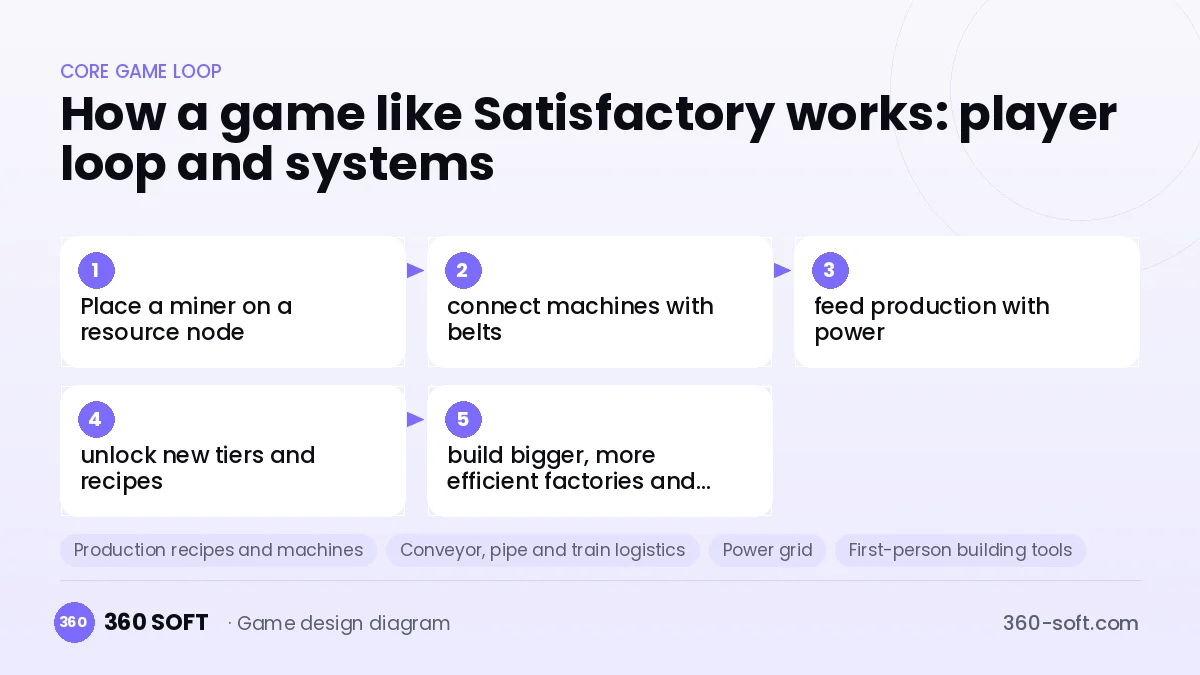
Systems you need to build a game like Satisfactory
Production recipes and machines
Recipes running from raw materials to complex parts, alternate recipes and ratio calculations. They are the foundation of factory planning.
Conveyor, pipe and train logistics
Belts, splitters, mergers, fluid pipes and rail lines. As the logistics network grows, new solutions are needed.
Power grid
Generators running on different fuels, power lines and overloads. As production grows, power demand becomes a new puzzle.
First-person building tools
Building foundations, walls, ramps and floors with grid snapping, mass placement and blueprint saving.
Exploration and open world
Different biomes, resource nodes, collectibles and dangerous creatures. Pushing deeper into the map keeps motivation alive.
Tier and milestone system
Technology tiers unlocked by delivering specific parts, plus long-term main goals.
What goes into the first version, what comes later
First version (soft launch)
- A mid-sized single-biome map and 3 technology tiers
- 15–20 machines and 40–50 recipes
- Conveyors, splitters/mergers and a power grid
- First-person building tools and basic exploration
- 2–4 player co-op
Later updates
- New biomes and advanced technology tiers
- Fluid pipes, trains and drone logistics
- Blueprint editor and mod support
- Console port and dedicated server support
The hard parts of this genre
Simulating thousands of items
Every item on the belts and every machine's output is calculated at the same time. Visuals and simulation must be decoupled, and distant factories calculated in aggregate.
Multiplayer sync
Consistent sync in a world where players build simultaneously and belts flow constantly requires smart limits on network traffic.
Progression and recipe balance
Recipes and tiers should encourage players to redesign without overwhelming them. Ratio calculations need intensive testing.
Team, timeline and budget
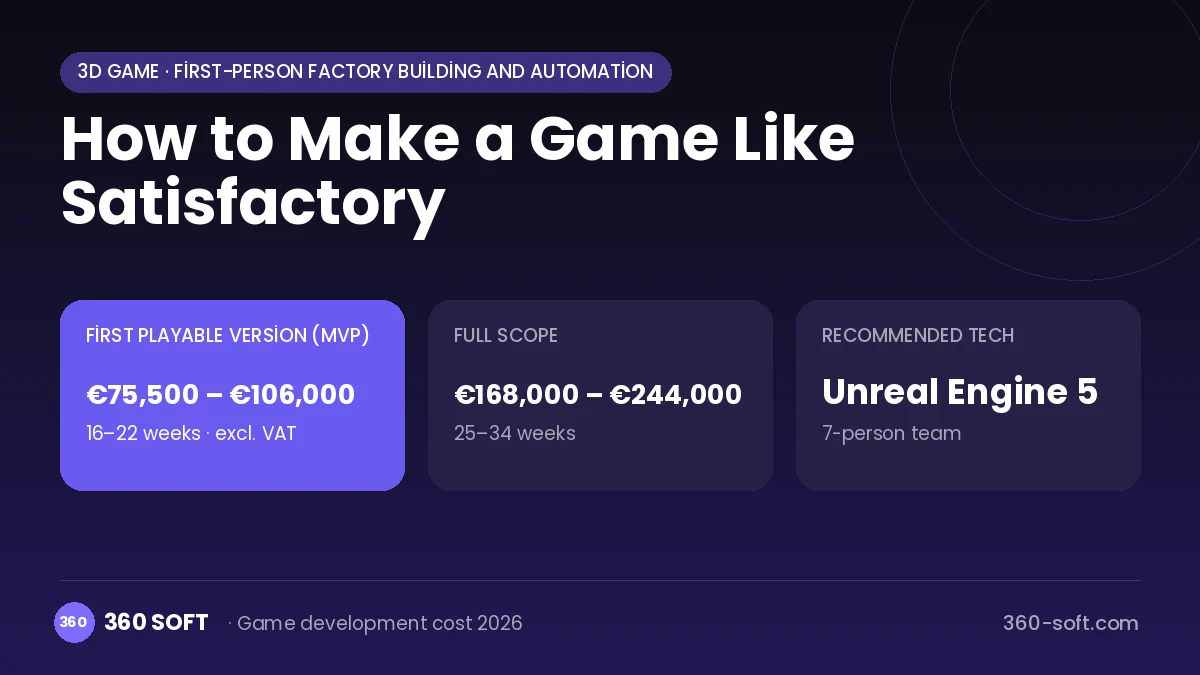
The estimate is based on the genre’s core systems, content volume, multiplayer and live-ops needs plus QA and project management: about 645 person-days for the full scope and 290 person-days for the first version. Cutting scope (fewer levels, one map, fewer characters) lowers the budget directly. Store accounts, servers, audio licences and user-acquisition budget are separate items. We send a fixed written price within 24 hours after the game design document.
Monetisation
Factory games earn through premium sales on PC; early access is common in the genre and lets content grow with community feedback. Afterwards, cosmetic packs, new biome or mechanic expansions and console versions create extra revenue. Big free updates keep sales alive for years.
Estimate your game budget and get a fixed quote
Let us scope it together and send a fixed written quote within 24 hours. NDA on request; you own the source code.
Calculated instantly from your choices, excl. VAT. A fixed written quote follows a free scoping call within 24 hours.
Choosing a game development company for a game like Satisfactory
Most people searching “make a game like satisfactory” are really looking for a reliable game development company. When comparing quotes, check four things:
- Can you play their released 3D games on your own phone?
- Are the source code, art files and store accounts transferred to you by contract?
- Do they build a playable prototype first and show a demo every two weeks?
- Are multiplayer servers, anti-cheat and scaling costs written into the quote?
Copyright and originality
Game mechanics on their own are generally not protected, but names, logos, characters, art, audio and level designs are. That is why we build a game “like Satisfactory” with your own name, art and world. This is not legal advice; we recommend a trademark search before launch.
Frequently asked questions
How long does it take to make a game like Satisfactory?
Once the production simulation and building tools are in place, most of the time goes into content, the map and optimisation. Starting with a single-biome early access version is a realistic path.
Will there be copyright issues?
Factory automation and conveyor mechanics are common in the genre and generally free to use. The Satisfactory name, original concepts such as FICSIT, characters and artwork cannot be copied. This is not legal advice.
Should I go 2D like Factorio or 3D like Satisfactory?
2D is more achievable for small teams and easier on performance. 3D boosts visual impact but significantly raises the cost of building tools, the map and optimisation.
What should I look for when choosing a game development studio?
Ask about experience with large-scale simulation, Unreal Engine optimisation and multiplayer sync. Asking for a performance prototype with thousands of items is a good test.