3D gamePhysics-based rocketry and space programme simulationOriginal by Squad
Kerbal Space Program is a physics-based simulation in which players design their own rockets from parts and try to send the lovable Kerbal astronauts into space. A badly balanced rocket exploding on the pad becomes a laugh, while the first stable orbit feels like a real achievement. By teaching a tough subject like orbital mechanics through trial and error, the game has won over both players and educators.
A similar game needs a part-based vehicle editor, centre-of-mass and thrust calculations, aerodynamics, joint physics between parts and planet-scale orbital mechanics. Manoeuvre nodes, time warp, docking and landing are the systems that add depth. Career mode brings science points, budgets and contracts, while on the technical side floating-point precision over huge distances is the most critical issue.
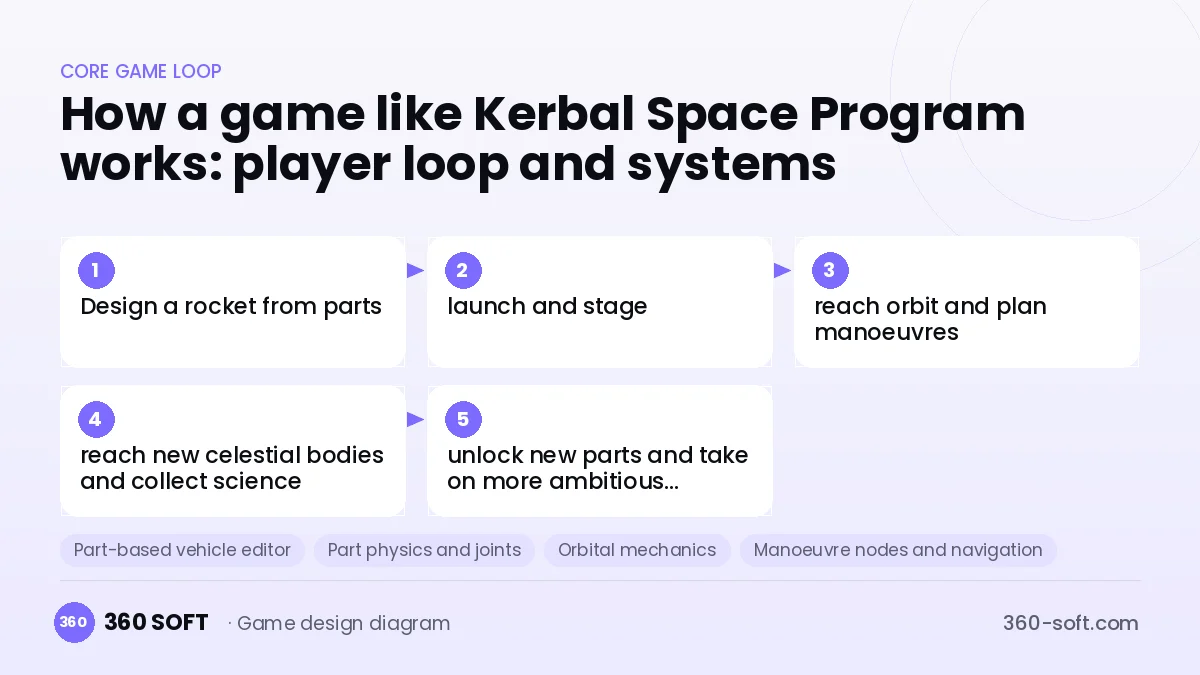
Why Kerbal Space Program works: the core loop
Systems you need to build a game like Kerbal Space Program
Part-based vehicle editor
Free-form design with engines, fuel tanks, wings, capsules and connectors, plus centre-of-mass and centre-of-thrust indicators.
Part physics and joints
Parts simulated as connected rigid bodies, with staging and structural failures.
Orbital mechanics
Spheres of influence, orbit prediction and on-rails calculation during time warp. It is the heart of the simulation.
Manoeuvre nodes and navigation
Nodes showing planned burns, a preview of orbit changes and rendezvous and docking aids.
Aerodynamics and landing
Drag, heating, parachutes and landing legs on planets with an atmosphere; powered landings on airless surfaces.
Career and science mode
Science experiments, a tech tree, budgets and contracts, plus astronauts gaining experience.
What goes into the first version, what comes later
First version (soft launch)
- A 30–40 part rocket editor and staging system
- A system made up of one planet and its moon
- Orbital mechanics, manoeuvre nodes and time warp
- Atmosphere, parachutes and landing
- Sandbox mode and tutorial missions
Later updates
- A multi-planet solar system
- Career mode, science and contracts
- Docking, space stations and colony systems
- Mod support and multiplayer experiments
The hard parts of this genre
Floating-point precision
At planetary distances, single-precision numbers cause jitter and errors. A floating origin and double-precision maths must be planned from the start.
Stable part physics
Getting vehicles with hundreds of parts to run in a physics engine without wobbling or spontaneously falling apart is hard. Joint-stiffening techniques are needed.
Making a hard subject fun to learn
Orbital mechanics can scare new players off. Visual aids, gradual missions and a humorous tone soften the learning curve.
Team, timeline and budget
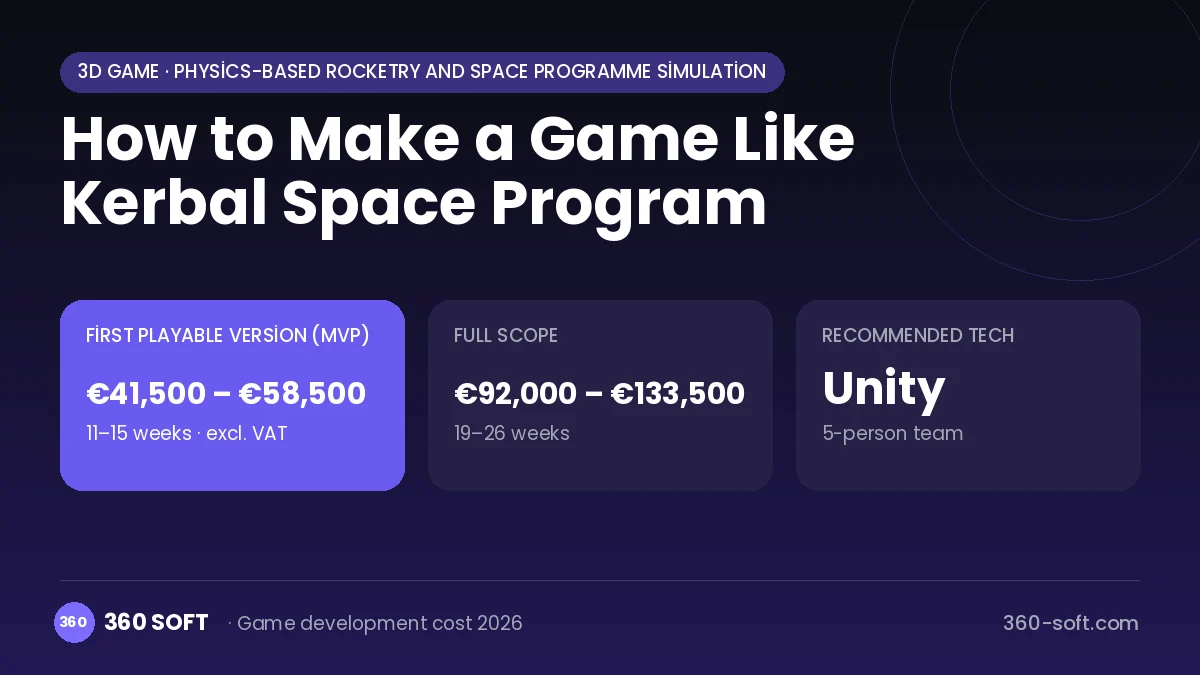
The estimate is based on the genre’s core systems, content volume, multiplayer and live-ops needs plus QA and project management: about 353 person-days for the full scope and 159 person-days for the first version. Cutting scope (fewer levels, one map, fewer characters) lowers the budget directly. Store accounts, servers, audio licences and user-acquisition budget are separate items. We send a fixed written price within 24 hours after the game design document.
Monetisation
Simulations like this sell as premium titles on PC; early access suits funding development through community feedback. New planetary systems, part sets and mission packs can be sold as DLC. Special editions for schools and universities can be a separate revenue channel. Players sharing their vehicle designs also provides free marketing.
Estimate your game budget and get a fixed quote
Let us scope it together and send a fixed written quote within 24 hours. NDA on request; you own the source code.
Calculated instantly from your choices, excl. VAT. A fixed written quote follows a free scoping call within 24 hours.
Choosing a game development company for a game like Kerbal Space Program
Most people searching “make a game like kerbal space program” are really looking for a reliable game development company. When comparing quotes, check four things:
- Can you play their released 3D games on your own phone?
- Are the source code, art files and store accounts transferred to you by contract?
- Do they build a playable prototype first and show a demo every two weeks?
- Are ads, in-app purchases and analytics set up as part of the quote?
Copyright and originality
Game mechanics on their own are generally not protected, but names, logos, characters, art, audio and level designs are. That is why we build a game “like Kerbal Space Program” with your own name, art and world. This is not legal advice; we recommend a trademark search before launch.
Frequently asked questions
How long does it take to make a game like Kerbal Space Program?
A single-planet, sandbox-focused version can be built in a fairly reasonable time, but physics stability and precision issues need serious testing. A multi-planet system and career mode extend the timeline.
Will there be copyright issues?
Part-based rocket building and orbital simulation mechanics are generally free to use. The Kerbal Space Program name, Kerbal characters, planet names and artwork cannot be copied. This is not legal advice.
Can we build a space simulation for education?
Yes, a simulation like this is a powerful tool for teaching physics and astronomy. Adding curriculum-aligned missions and a teacher dashboard creates an attractive product for schools.
Which game engine is suitable?
Both Unity and Unreal can be used; Unreal Engine 5's large world coordinates support is an advantage. Whichever engine you choose, you will need to write a custom orbital calculation layer.