Mobile appE-commerce & marketplacesOriginal by DeFacto
DeFacto, a Turkish fast-fashion retailer, offers affordable, youth-oriented clothing through frequently refreshed collections. The app's success comes from getting new products into the storefront quickly, delivering campaigns to users instantly and, thanks to a large store network, offering practical options such as click-and-collect. Users can discover an item in the app first and try it on in store, or the other way round.
A similar app needs a collection-focused catalogue, click-and-collect and store stock integration, a coupon and campaign engine and personalised notifications. Behind the scenes, a backbone that handles retail ERP, warehouse and store orders, season- and collection-based content management and infrastructure that scales during heavy sales periods complete the system.
How DeFacto works: the core user flow

How many apps and dashboards do you need?
Customer app
Young shoppers discover new collections, build a favourites list, use coupons and choose a delivery method.
Store app
Store staff prepare click-and-collect orders, hand them over to customers and handle returns.
Admin panel
The marketing and e-commerce team manages collection storefronts, coupons, notification campaigns and orders.
Critical features of a product like DeFacto
Collection storefronts
Seasonal and themed collections are built in the content management panel without code and published at a set time.
Click-and-collect
The customer orders and picks up at the chosen store within a set period; a notification is sent when the order is ready.
Favourites and price-drop alerts
When a favourite item drops in price or a size comes back in stock, the user receives a push notification.
Coupon and campaign engine
Coupons and multi-buy deals are defined by rules based on basket value, category and customer segment.
Segment-based notifications
Users are segmented by behaviour, and each segment receives different campaigns and recommendations.
Outfit suggestions
The product page shows pieces that can be worn together and adds them to the cart with a single tap.
What goes into the first version, what comes later
First version (MVP)
- Collection storefront, categories, search and filters
- Cart, coupons and checkout
- Courier delivery and order tracking
- Favourites and push notifications
- Product, price and stock integration with the ERP
Later releases
- Click-and-collect and store stock visibility
- Segment-based personal campaigns
- Outfit suggestions and a style feed
- Loyalty programme and points system
Modules and how the budget is calculated
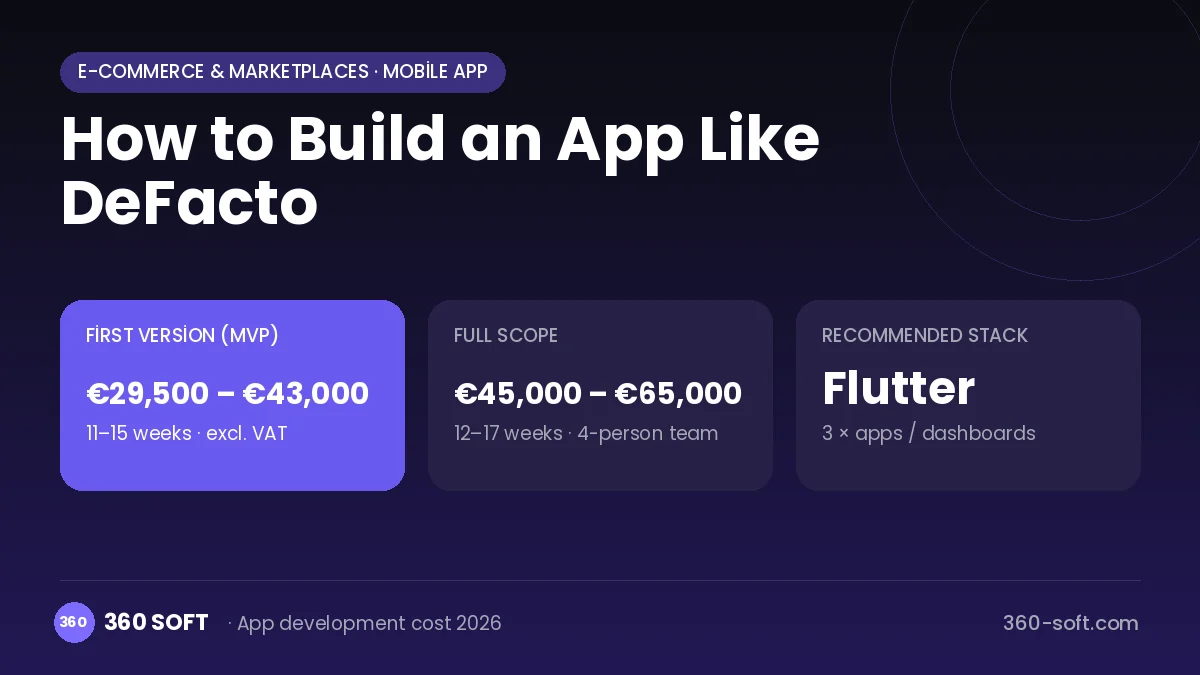
The budget is calculated with 360 SOFT’s pricing model from the modules below, about 28 screens and the project’s complexity: roughly 172 person-days for the full scope and 113 person-days for the first version. Every module you drop lowers the budget directly.
| Module | Phase |
|---|---|
| Sign-up, login, social login | First version |
| User profile and settings | First version |
| Roles and permissions | First version |
| Admin dashboard | First version |
| Online payments (Stripe / PSP) | First version |
| Product / content catalogue | First version |
| Cart and checkout | First version |
| Advanced search and filters | First version |
| Push notifications | First version |
| Email / SMS notifications | First version |
| Maps, location, routing | First version |
| Content management / blog | First version |
| Reporting and analytics | Later release |
| ERP / accounting integration | Later release |
Hosting, SMS, map APIs, app store accounts and payment-provider fees are separate items. Maintenance and improvements (optional): €600 / month. We send a fixed written price within 24 hours after a free discovery call.
The hard parts
Fast collection turnover
Products sell out and are replaced quickly, so catalogue, image and stock data must flow automatically and without errors.
Getting the notification balance right
Too many campaign notifications drive users away; frequency caps and segment-focused targeting are essential.
Store and online sync
A click-and-collect order being genuinely ready in store depends on store stock being accurate in real time.
Business model
The app is a direct sales channel for the brand's own products, and revenue comes from product margin. Coupons and campaigns are used to grow basket size, and a free shipping threshold raises the average order value. Click-and-collect lowers shipping costs while bringing customers into stores, creating upsell opportunities. Loyalty points support repeat purchases.
Get a free quote for your project
Let us scope it together and send a fixed written quote within 24 hours. NDA on request; you own the source code.
Choosing a company to build an app like DeFacto
Most people searching “build an app like defacto” are really looking for a reliable app development company. When comparing quotes, check four things:
- Can you try similar products they have shipped, in the stores or live?
- Are the source code, design files, servers and store accounts transferred to you by contract?
- Do they show a working demo every two weeks, with written scope and acceptance criteria?
- Are maintenance, scaling and GDPR/security costs written into the quote?
Copyright and trademarks
A business model and features are generally not protected on their own, but the DeFacto name, logo, interface design, content and source code are. That is why we build a product with similar functionality but your own brand, design and code. This is not legal advice; we recommend a trademark search before launch.
Frequently asked questions
How long does it take to build an app like DeFacto?
A fashion app with a catalogue, coupons, checkout and ERP integration can go live within a few months. Features such as click-and-collect and personal campaigns are added in later releases.
Do I need an app if I already have a website?
An app makes repeat purchases easier thanks to push notifications and saved sessions. For fashion brands with a loyal customer base, a mobile app alongside the website is usually a strong channel.
Off-the-shelf platform or custom software?
For a small brand, an off-the-shelf e-commerce platform with a mobile app plugin may be enough. For a retailer with a store network and ERP integration, custom software is more flexible and sustainable.
What should I look for in a company that builds an app like DeFacto?
Choose a team with experience in fashion retail catalogues, campaigns and ERP integration. App performance and post-launch analytics support should also be among your evaluation criteria.