Mobile appE-commerce & marketplacesOriginal by Amazon
Amazon's success is explained by an obsessive focus on customer experience: a vast catalogue, trustworthy reviews, one-click buying and delivery on the promised date. Its membership programme turns frequent shopping into a habit, while the recommendation engine grows the basket with customers-who-bought-this-also-bought logic. Combining third-party sellers with its own logistics network creates a scale advantage that competitors find hard to copy.
Building something similar means creating an ecosystem rather than just an app: a customer app, a seller central, a warehouse management system and platform administration. The backend needs a catalogue service that handles hundreds of thousands of products, a recommendation engine driven by behavioural data, a logistics layer that calculates delivery dates and a trust system that filters out fake reviews. The realistic strategy is to build this model in a narrow niche first.
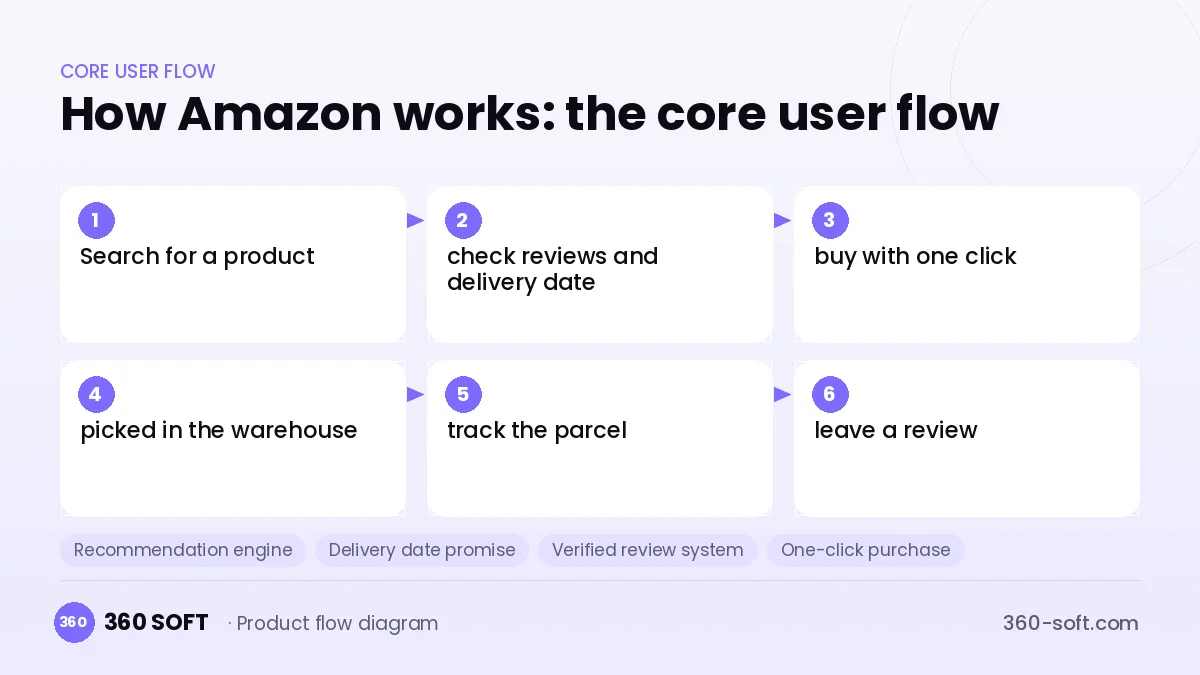
How Amazon works: the core user flow
How many apps and dashboards do you need?
Customer app
Users search for products, read reviews, buy with one click, use membership perks and manage their orders.
Seller central
Third-party sellers list products, manage prices and stock, launch ad campaigns and monitor sales reports.
Warehouse management system
Warehouse teams handle goods receipt, bin locations, picking and packing with barcodes.
Admin panel
The platform team manages catalogue quality, seller policies, review moderation and customer support.
Critical features of a product like Amazon
Recommendation engine
Recommendations on product pages and in the cart are generated from frequently-bought-together items, browsing history and similar user behaviour.
Delivery date promise
A firm delivery date is calculated on the product page from stock location, cut-off time and carrier capacity.
Verified review system
A review infrastructure where only buyers can leave reviews and suspicious patterns are detected automatically.
One-click purchase
Payment is reduced to a single step with a saved address and tokenised card; a cancellation window prevents accidental orders.
Platform fulfilment
Sellers send stock to the platform warehouse; picking, packing, shipping and returns are handled by the platform.
Membership programme
A paid subscription bundles fast and free shipping, exclusive deals and digital content perks.
What goes into the first version, what comes later
First version (MVP)
- Catalogue, search and product detail screens in a chosen niche
- Cart, fast checkout with saved cards and order tracking
- Purchase-verified reviews and ratings
- Seller central: product listings and order management
- A simple frequently-bought-together recommendation row
Later releases
- Platform warehouse and fulfilment service for sellers
- Paid membership programme
- Pay-per-click advertising platform for sellers
- Multi-country selling with currency and language support
Modules and how the budget is calculated
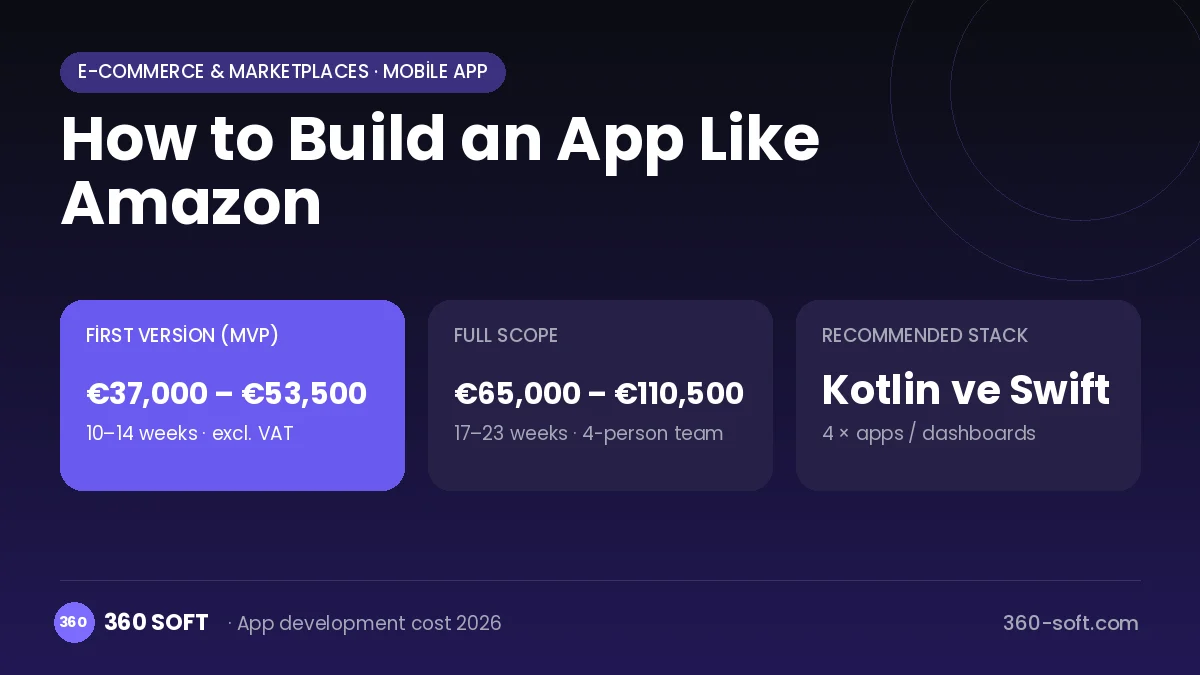
The budget is calculated with 360 SOFT’s pricing model from the modules below, about 40 screens and the project’s complexity: roughly 250 person-days for the full scope and 141 person-days for the first version. Every module you drop lowers the budget directly.
| Module | Phase |
|---|---|
| Sign-up, login, social login | First version |
| User profile and settings | First version |
| Roles and permissions | First version |
| Admin dashboard | First version |
| Online payments (Stripe / PSP) | First version |
| Subscriptions and recurring billing | First version |
| Product / content catalogue | First version |
| Cart and checkout | First version |
| Advanced search and filters | First version |
| Push notifications | First version |
| Ratings and reviews | First version |
| Reporting and analytics | Later release |
| Marketplace integration (Amazon, etc.) | Later release |
| AI features (LLM, RAG, recommendations) | Later release |
| Barcode / RFID / handheld | First version |
Hosting, SMS, map APIs, app store accounts and payment-provider fees are separate items. Maintenance and improvements (optional): €850 / month. We send a fixed written price within 24 hours after a free discovery call.
The hard parts
Catalogue scale
Storing millions of variants with consistent attributes and searching them quickly requires a well-designed product data model and search infrastructure.
Delivery date accuracy
Keeping the promised date depends on combining stock, warehouse capacity and carrier data in real time; broken promises destroy trust fast.
Fake reviews and seller manipulation
Incentivised reviews and attempts to smear competitors keep evolving; machine-learning detection and human moderation must work together.
Business model
The revenue model is layered: margin on first-party sales, sales commission from third-party sellers, storage and fulfilment fees, sponsored product ads and paid membership subscriptions. For a new venture it is best to start with commission and advertising and to introduce capital-intensive items such as logistics and membership once volume has built up.
Get a free quote for your project
Let us scope it together and send a fixed written quote within 24 hours. NDA on request; you own the source code.
Choosing a company to build an app like Amazon
Most people searching “build an app like amazon” are really looking for a reliable app development company. When comparing quotes, check four things:
- Can you try similar products they have shipped, in the stores or live?
- Are the source code, design files, servers and store accounts transferred to you by contract?
- Do they show a working demo every two weeks, with written scope and acceptance criteria?
- Are maintenance, scaling and GDPR/security costs written into the quote?
Copyright and trademarks
A business model and features are generally not protected on their own, but the Amazon name, logo, interface design, content and source code are. That is why we build a product with similar functionality but your own brand, design and code. This is not legal advice; we recommend a trademark search before launch.
Frequently asked questions
How long does it take to build an app like Amazon?
An Amazon-scale ecosystem takes years to build. However, a first version in a narrow category with a catalogue, payments, reviews and seller central can go live within a few months and be extended step by step.
Is AI essential for the recommendation engine?
At the start, frequently-bought-together and popularity rules deliver good results. As data accumulates, machine-learning personalisation can be added to lift conversion rates.
Do I need to set up my own warehouse?
Not in the first phase; sellers can ship their own orders or you can work with third-party logistics providers. A warehouse management system is added once volume and speed become a competitive factor.
Are there copyright or trademark issues?
Business models such as a marketplace and membership are free to use, but the Amazon name, logo, interface design, content and code cannot be copied. This information is not legal advice.