3D gameHyper-casual collect-and-build racing gameOriginal by Supersonic Studios
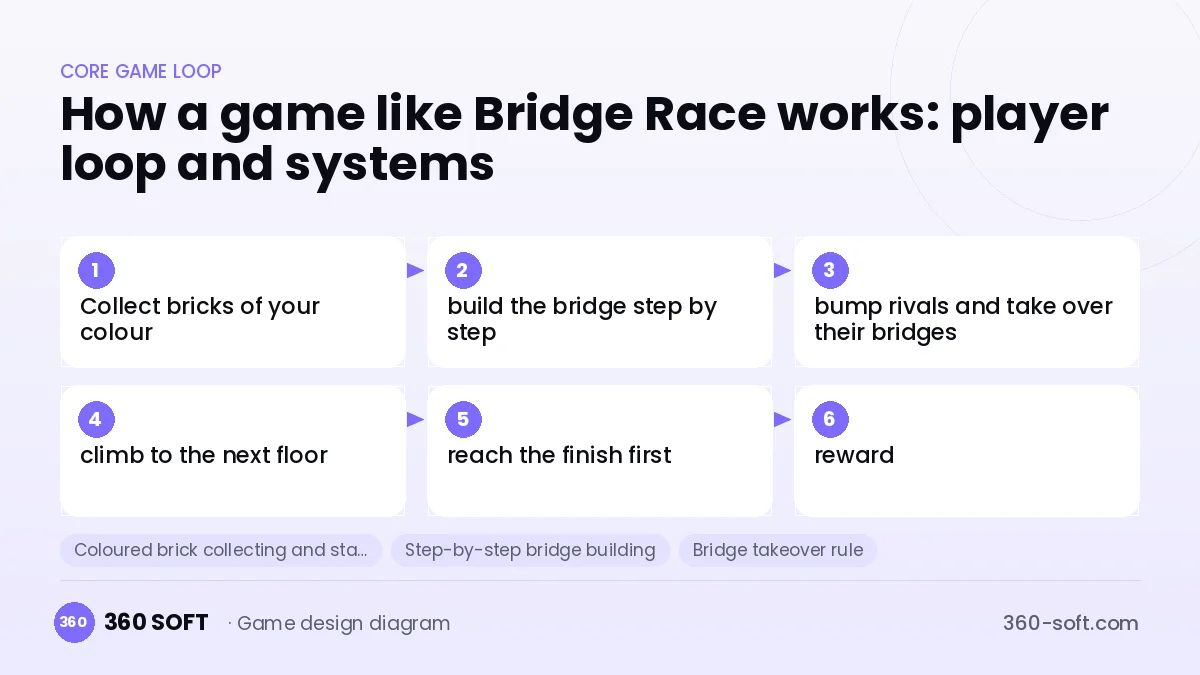
Bridge Race combines racing with resource gathering: you collect bricks of your colour from the floor and stack them on your back, then use them to build a staircase to the next floor, step by step. Rivals try to use the same bridges; knocking someone over to scatter their stack, or painting their half-built bridge in your colour, adds a small but effective layer of competition. The stack of bricks growing on your back is the most tangible sign of progress.
A similar game needs a colour-matched collecting system, a stack visual that stays balanced on the back, step-by-step bridge logic and AI that decides which bridge rival bots will pick. Floor transitions, knocking bricks loose on collision, a finish podium and cosmetic characters are also needed. For level design, a simple editor that sets bridge counts and brick distribution speeds up the work a lot.
Why Bridge Race works: the core loop
Systems you need to build a game like Bridge Race
Coloured brick collecting and stacking
Players collect only bricks of their own colour, which show as a vertical stack on their back. Stack height works as both a resource and a visual indicator.
Step-by-step bridge building
Each step onto the bridge uses one brick and paints the step in the player's colour. Out of bricks, the character cannot go further.
Bridge takeover rule
Spending bricks to turn steps of another colour into your own so you can pass. Direct competition with rivals comes from this rule.
Collisions and dropping bricks
A character with a taller stack scatters the bricks of the rival they bump. Scattered bricks fall to the floor uncoloured and anyone can collect them.
Bot AI
Bots with brick-collecting routes, bridge choices and aggression profiles. They should challenge the player without feeling unfair.
Level editor and ads
Setting floor count, bridge length and brick distribution, plus rewarded ads, interstitials and Remote Config.
What goes into the first version, what comes later
First version (soft launch)
- Coloured brick collecting and the back-stack visual
- Bridge building, floor transitions and the takeover rule
- Knocking bricks loose on collision
- Races against three rival bots and a finish podium
- Ad integration, analytics and a first level set
Later updates
- New map layouts and moving obstacles
- Character and brick cosmetics
- Trial asynchronous or real-time multiplayer
- Event levels and daily missions
The hard parts of this genre
Bot route choice
Bots always running for the shortest bridge become predictable, while random behaviour looks dumb. Target selection should use weighted rules.
Stack visual and camera
A tall brick stack can hide the character and the path ahead. Camera angle and stack caps must be tuned to protect readability.
Round length balance
If collecting bricks takes too long the game drags; too short and bridge decisions stop mattering. Brick density needs frequent testing.
Team, timeline and budget
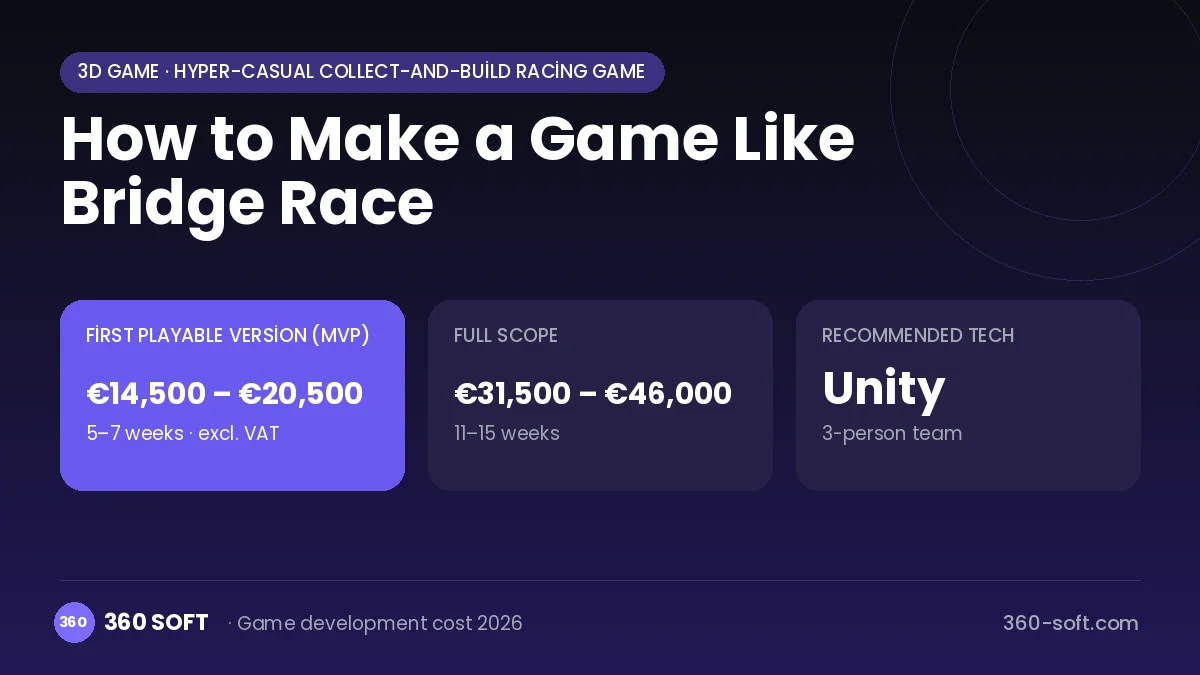
The estimate is based on the genre’s core systems, content volume, multiplayer and live-ops needs plus QA and project management: about 120 person-days for the full scope and 54 person-days for the first version. Cutting scope (fewer levels, one map, fewer characters) lowers the budget directly. Store accounts, servers, audio licences and user-acquisition budget are separate items. We send a fixed written price within 24 hours after the game design document.
Monetisation
The revenue model is ad-led: interstitials at level end, rewarded ads to multiply rewards and ad views that speed up new character unlocks. Cosmetic character packs and a no-ads purchase form the IAP side. Because rounds are short, the ad interval should be found through segment-based experiments.
Estimate your game budget and get a fixed quote
Let us scope it together and send a fixed written quote within 24 hours. NDA on request; you own the source code.
Calculated instantly from your choices, excl. VAT. A fixed written quote follows a free scoping call within 24 hours.
Choosing a game development company for a game like Bridge Race
Most people searching “make a game like bridge race” are really looking for a reliable game development company. When comparing quotes, check four things:
- Can you play their released 3D games on your own phone?
- Are the source code, art files and store accounts transferred to you by contract?
- Do they build a playable prototype first and show a demo every two weeks?
- Are ads, in-app purchases and analytics set up as part of the quote?
Copyright and originality
Game mechanics on their own are generally not protected, but names, logos, characters, art, audio and level designs are. That is why we build a game “like Bridge Race” with your own name, art and world. This is not legal advice; we recommend a trademark search before launch.
Frequently asked questions
How long does it take to make a game like Bridge Race?
A prototype of the collecting and bridge mechanics comes out quickly. Bot behaviour, level variety and ad integration determine how long a launch-ready version takes.
Will there be copyright issues?
The mechanic of collecting bricks to build bridges is generally free to use. The game's name, logo, character design and exact map layouts must not be copied. This is not legal advice.
Should rivals be bots or real players?
Using bots in the first release lowers costs and removes matchmaking waits. Once the game gains traction, a real-time mode can be evaluated as a separate investment.
What should I look for when choosing a hyper-casual game studio?
Look for rapid prototyping, CPI testing and bot AI experience. Teams that propose measuring the idea in the market quickly and making a go or no-go decision based on the results are more reliable.