3D gameHyper-casual shortcut racing runnerOriginal by Voodoo
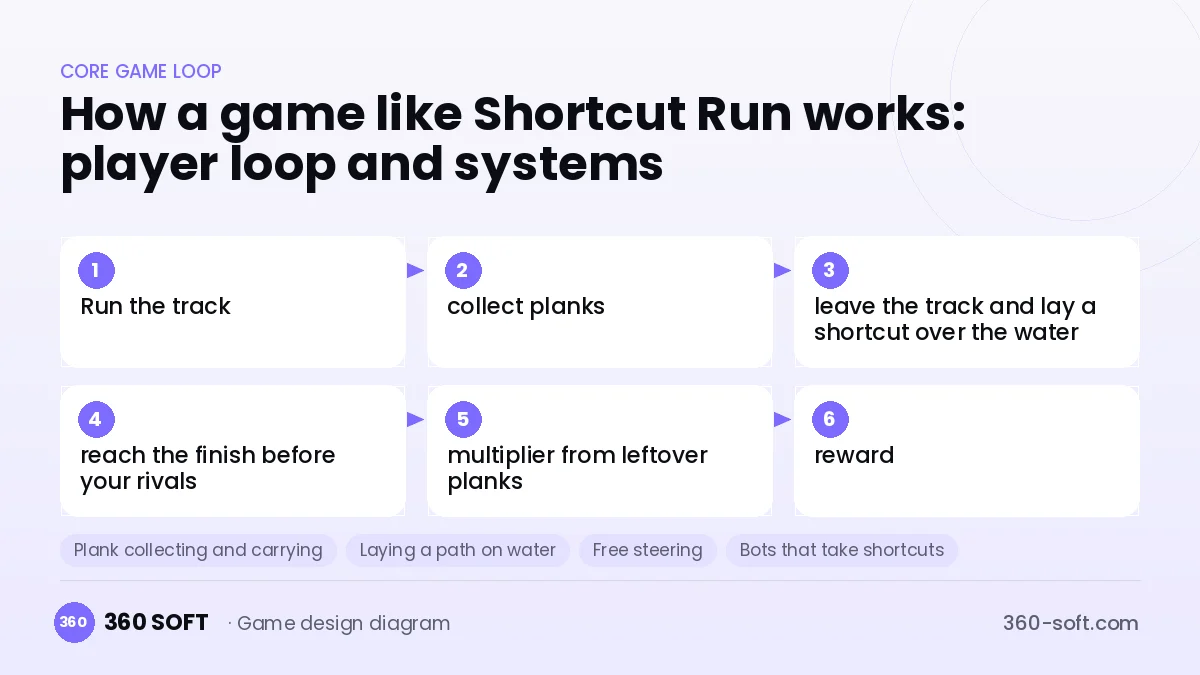
Shortcut Run sets its race track over water and gives players an off-the-rules option: you collect planks on the track and carry them on your back, then leave the track and lay your own shortcut across the water with them. Run out of planks and you fall in. Working out how much risk to take, when to leave the track and how far your planks will get you turns every round into a little strategy moment.
A similar game needs a plank collecting and path-laying system, free movement off the track, falling-in-the-water checks and bots that use shortcuts cleverly. Track generation, winding courses, a finish area that gives a score multiplier based on leftover planks, and cosmetics must be added too. It may look technically simple, but making the shortcut feel fair takes intensive tuning.
Why Shortcut Run works: the core loop
Systems you need to build a game like Shortcut Run
Plank collecting and carrying
Planks on the track are collected and stacked on the back. Stack height directly shows shortcut range.
Laying a path on water
When the character leaves the track, a plank is placed with every step; out of planks, they fall in. This simple resource spend is the heart of the mechanic.
Free steering
Running freely in the direction of the swipe, with consistent control off the track too. Sensitivity and turn speed are tuned through feel tests.
Bots that take shortcuts
Bots that decide on shortcuts based on the planks they have collected. Sometimes falling in with too few planks gives players a natural sense of superiority.
Finish area and multiplier
After the finish, moving along a long ramp or score line with the remaining planks. Leftover resources turn directly into rewards.
Track generation and ads
Modular winding tracks, plank distribution and difficulty settings, plus rewarded ads, interstitials and analytics.
What goes into the first version, what comes later
First version (soft launch)
- Plank collecting, carrying and laying paths on water
- Free steering and falling in the water
- Bot rivals that decide on shortcuts
- Finish area and score multiplier
- Ad integration, analytics and a first track set
Later updates
- New surface types and obstacles
- Character and plank cosmetics
- Event tracks and special maps
- Leaderboards and daily challenges
The hard parts of this genre
Shortcut balance
If the shortcut always wins, the track becomes pointless. Plank density and track geometry must keep shortcuts risky but tempting.
Believable bot decisions
When bots leave the track decides whether players feel they are real rivals. Perfect bots are frustrating.
Producing new content
In games built on a single mechanic, track layouts and twists must be added regularly to break the sense of repetition.
Team, timeline and budget
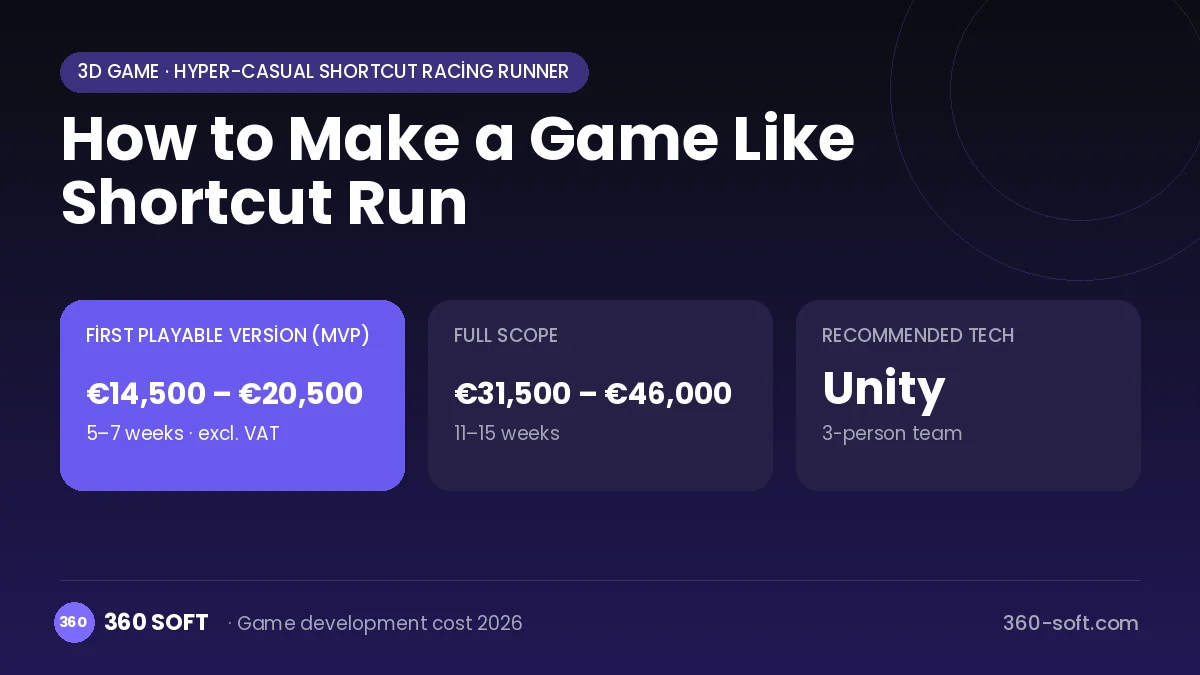
The estimate is based on the genre’s core systems, content volume, multiplayer and live-ops needs plus QA and project management: about 120 person-days for the full scope and 54 person-days for the first version. Cutting scope (fewer levels, one map, fewer characters) lowers the budget directly. Store accounts, servers, audio licences and user-acquisition budget are separate items. We send a fixed written price within 24 hours after the game design document.
Monetisation
Level-end interstitials, rewarded ads to boost the finish multiplier and speeding up new character unlocks are the main revenue sources. Cosmetic characters and a no-ads pack bring a small IAP income. Success depends on retaining players in the first days at a low user acquisition cost, so the ad interval and track difficulty should be tested together.
Estimate your game budget and get a fixed quote
Let us scope it together and send a fixed written quote within 24 hours. NDA on request; you own the source code.
Calculated instantly from your choices, excl. VAT. A fixed written quote follows a free scoping call within 24 hours.
Choosing a game development company for a game like Shortcut Run
Most people searching “make a game like shortcut run” are really looking for a reliable game development company. When comparing quotes, check four things:
- Can you play their released 3D games on your own phone?
- Are the source code, art files and store accounts transferred to you by contract?
- Do they build a playable prototype first and show a demo every two weeks?
- Are ads, in-app purchases and analytics set up as part of the quote?
Copyright and originality
Game mechanics on their own are generally not protected, but names, logos, characters, art, audio and level designs are. That is why we build a game “like Shortcut Run” with your own name, art and world. This is not legal advice; we recommend a trademark search before launch.
Frequently asked questions
How long does it take to make a game like Shortcut Run?
The core collecting and path-laying mechanic is quick to prototype. Tuning bot behaviour, track variety and shortcut balance takes time for a launch-ready version.
Will there be copyright issues?
The mechanic of collecting resources to build a shortcut is generally free to use. The game's name, logo, character designs and exact track layouts must not be copied. This is not legal advice.
How is it similar to Bridge Race?
Both are about carrying resources on your back and building a path. Shortcut Run turns this into free-form shortcuts, while Bridge Race uses fixed bridges and taking over rivals' bridges. Even small differences like these can create separate games in the hyper-casual market.
Which engine do you recommend?
Unity is the most common choice thanks to ready-made ad SDK support and fast prototyping. Godot 4 is possible too, but ad and analytics integrations need more manual work.