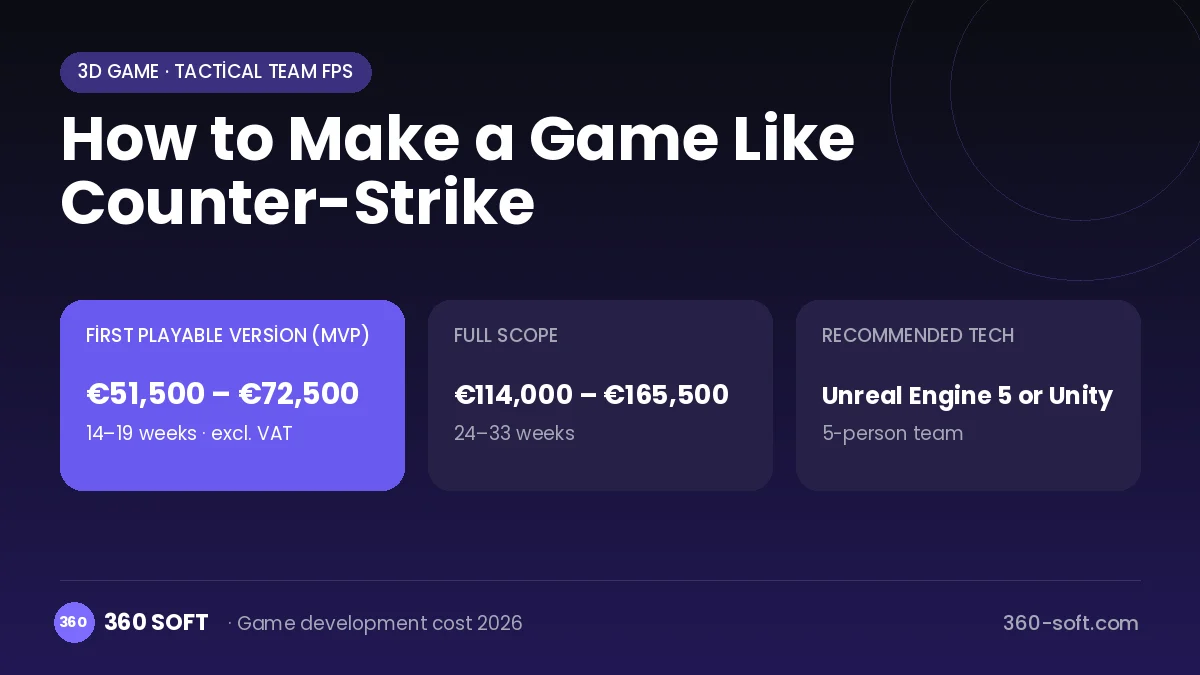
3D gameTactical team FPSOriginal by Valve
Counter-Strike is one of the best examples of simple rules creating endless depth. Two teams, a bomb to plant or defuse, buying weapons with money at the start of each round and recoil control that takes mastery. There are no abilities or superpowers; only aim, positional knowledge, sound cues and team communication decide who wins. That purity lets players keep improving on the same maps for years.
A similar game needs consistent, repeatable gunplay, a sound system that conveys information through footsteps, balanced map design and high tick-rate servers. Tools such as community servers, a map editor and demo recording give the genre its long life. Content may look small, but every map has to be tested for months on angles and rotation times; that is where the real work lies.
Why Counter-Strike works: the core loop
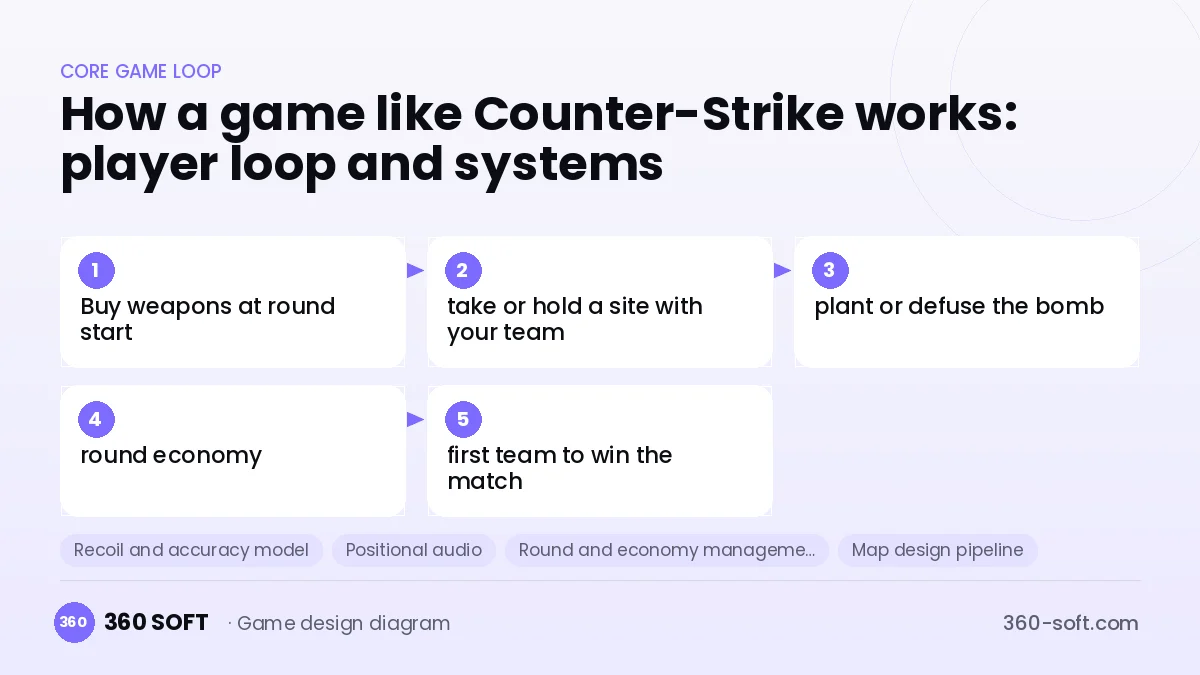
Systems you need to build a game like Counter-Strike
Recoil and accuracy model
Fixed, learnable spray patterns, movement-dependent accuracy and first-shot accuracy.
Positional audio
Footsteps, reloads and bomb sounds heard with correct direction and distance; the main source of tactical information.
Round and economy management
Income based on win/loss streaks, a buy menu and buying weapons for teammates.
Map design pipeline
Blockout stage, rotation-time measurement, angle balance and testing of grenade lineups.
Dedicated and community servers
Official matchmaking servers alongside player-hosted servers and mods.
Demo recording and spectator mode
A recording system for match replays, an observer camera and cheat review.
What goes into the first version, what comes later
First version (soft launch)
- One or two bomb defusal maps
- Basic set of rifles, pistols, snipers and grenades
- Round economy and team-balanced matchmaking
- Positional audio and server-authoritative netcode
- Basic anti-cheat and player reporting
Later updates
- Ranked system and skill groups
- Community servers and map editor
- Weapon skin economy and player-to-player trading
- Extra modes such as hostage rescue, demo/spectator tools
The hard parts of this genre
Movement and shooting feel
Players in this genre notice the smallest difference; acceleration, stopping and aim response must be tuned again and again.
Map balance
A map favouring one side breaks the whole competition; it takes long testing and data analysis.
Cheats and server security
Wallhacks and aimbots are common; server-side visibility culling and constant monitoring are required.
Team, timeline and budget
The estimate is based on the genre’s core systems, content volume, multiplayer and live-ops needs plus QA and project management: about 438 person-days for the full scope and 197 person-days for the first version. Cutting scope (fewer levels, one map, fewer characters) lowers the budget directly. Store accounts, servers, audio licences and user-acquisition budget are separate items. We send a fixed written price within 24 hours after the game design document.
Monetisation
In this genre the game itself can be a one-off purchase or free to play; sustainable revenue comes from the cosmetics economy. Weapon skins, collection cases, stickers and seasonal operation passes are common. Case systems can fall under gambling regulations in some countries, so a legal review is essential.
Estimate your game budget and get a fixed quote
Let us scope it together and send a fixed written quote within 24 hours. NDA on request; you own the source code.
Calculated instantly from your choices, excl. VAT. A fixed written quote follows a free scoping call within 24 hours.
Choosing a game development company for a game like Counter-Strike
Most people searching “make a game like counter-strike” are really looking for a reliable game development company. When comparing quotes, check four things:
- Can you play their released 3D games on your own phone?
- Are the source code, art files and store accounts transferred to you by contract?
- Do they build a playable prototype first and show a demo every two weeks?
- Are multiplayer servers, anti-cheat and scaling costs written into the quote?
Copyright and originality
Game mechanics on their own are generally not protected, but names, logos, characters, art, audio and level designs are. That is why we build a game “like Counter-Strike” with your own name, art and world. This is not legal advice; we recommend a trademark search before launch.
Frequently asked questions
How long does it take to make a game like Counter-Strike?
Content volume is relatively small, so a two-map MVP can be built in somewhere between a few months and a year. The testing time spent on gunplay feel and map balance is the most critical part.
What should I watch for on copyright?
Mechanics such as plant/defuse and the round economy are generally free to use, but the name, map layouts, weapon models, UI and sounds cannot be copied. This is general information, not legal advice.
Which engine should I choose?
Unreal Engine 5 is a strong option for a PC-focused tactical FPS; Unity also delivers good results with a custom character controller. More important than the engine is the quality of the network and movement code.
What should I look for in a studio that builds tactical FPS games?
Look at their competitive game experience, map design process and anti-cheat plan. Ask for an early playable prototype and a closed beta plan.