3D gameTactical team hero shooterOriginal by Riot Games
Valorant combines the precise, one-tap gunplay of a classic tactical shooter with agents' special abilities. The plant/defuse structure, an economy decision at the start of every round and team-planned ability combos turn the game into a chess match. A competitive ranked system and a high skill ceiling give players the feeling that they improve every match.
Most of a similar game is invisible engineering: high tick-rate servers, lag compensation, strong anti-cheat and millimetre-precise map design. An agent roster and map pool as large as the original is not realistic for a small team; the first release should prove the core feel with a few agents and a single competitive map. The economy system, round management and matchmaking must be built from the start too.
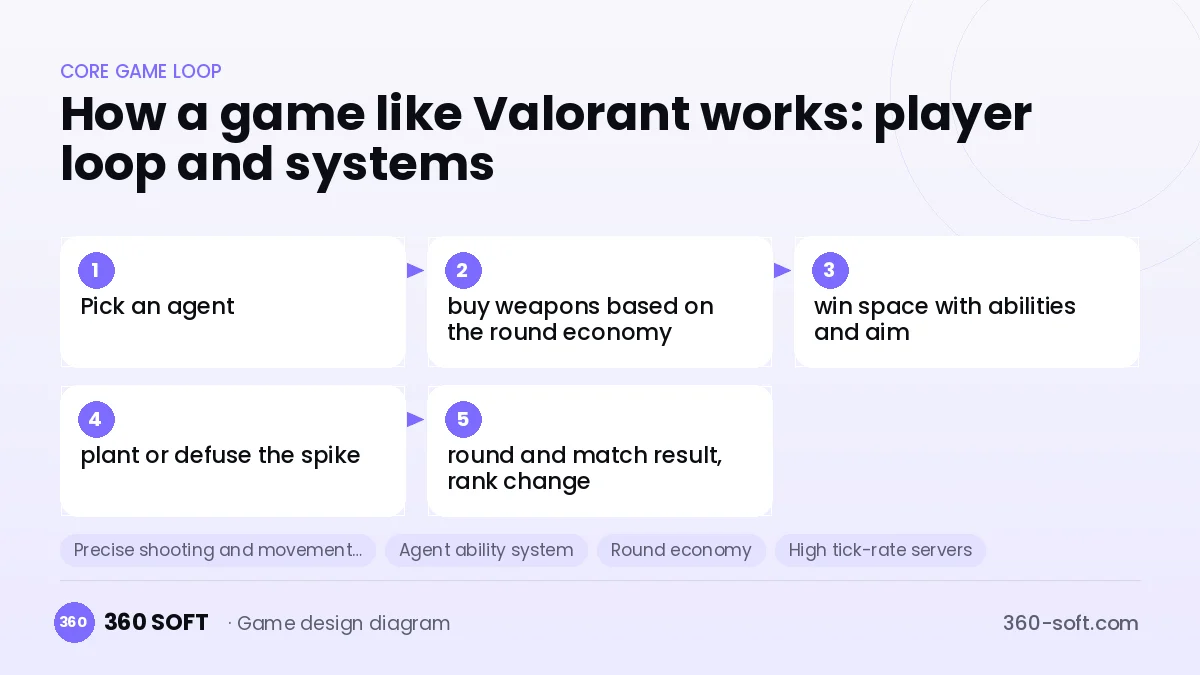
Why Valorant works: the core loop
Systems you need to build a game like Valorant
Precise shooting and movement model
Accuracy loss while moving, first-shot accuracy, recoil patterns and headshots; the heart of the game's feel.
Agent ability system
Abilities split into roles such as smokes, flashes, recon and area control, with limited charges and costs.
Round economy
Win/loss income, buying weapons and shields, dropping guns for teammates; the source of strategic depth.
High tick-rate servers
Many updates per second, rewind-based hit validation and visibility-based data sending (fog of war).
Competitive matchmaking and ranks
Skill rating, rank tiers, team balance and penalties for leaving matches.
Anti-cheat
Server-side validation, never sending unseen enemy positions to the client and client integrity checks.
What goes into the first version, what comes later
First version (soft launch)
- One competitive map (two spike sites)
- A few agents from different roles
- Round economy and basic weapon set
- Unrated (casual) matchmaking
- Server-authoritative netcode and basic anti-cheat
Later updates
- Ranked system and tiers
- New agents and maps
- Short/fun modes and a practice range
- Bigger cosmetics store, seasonal pass and tournament support
The hard parts of this genre
Netcode quality
Milliseconds decide tactical shooters; tick rate, lag compensation and server locations directly shape player perception.
Anti-cheat
Competitive PC shooters are cheaters' first target; you must keep out-of-sight data off the client and run continuous detection.
Ability and weapon balance
Abilities must not overshadow gunplay; every new agent risks breaking the existing balance.
Team, timeline and budget
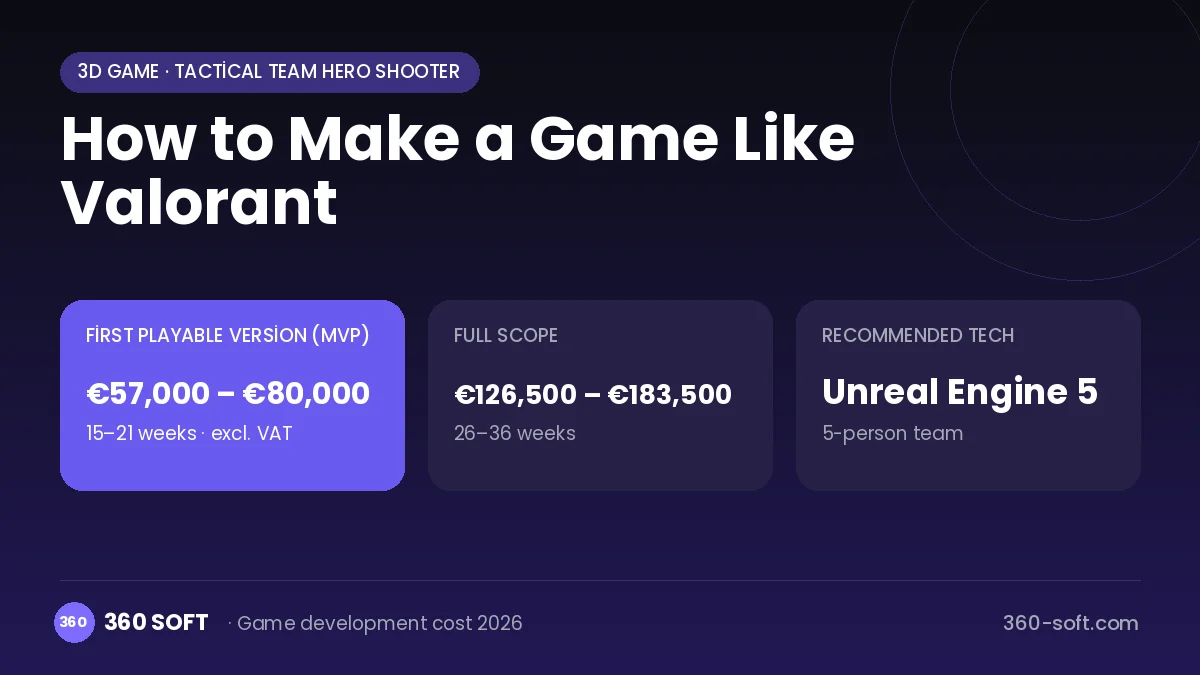
The estimate is based on the genre’s core systems, content volume, multiplayer and live-ops needs plus QA and project management: about 486 person-days for the full scope and 219 person-days for the first version. Cutting scope (fewer levels, one map, fewer characters) lowers the budget directly. Store accounts, servers, audio licences and user-acquisition budget are separate items. We send a fixed written price within 24 hours after the game design document.
Monetisation
In a competitive tactical shooter, revenue should come from cosmetics only: weapon skin bundles, a seasonal pass, rewards unlocked through agent contracts and collection sets. Agents being unlockable through play is critical for fairness. Esports and tournament partnerships only become an extra revenue channel once the community has grown; early on, fewer but high-quality cosmetics work better.
Estimate your game budget and get a fixed quote
Let us scope it together and send a fixed written quote within 24 hours. NDA on request; you own the source code.
Calculated instantly from your choices, excl. VAT. A fixed written quote follows a free scoping call within 24 hours.
Choosing a game development company for a game like Valorant
Most people searching “make a game like valorant” are really looking for a reliable game development company. When comparing quotes, check four things:
- Can you play their released 3D games on your own phone?
- Are the source code, art files and store accounts transferred to you by contract?
- Do they build a playable prototype first and show a demo every two weeks?
- Are multiplayer servers, anti-cheat and scaling costs written into the quote?
Copyright and originality
Game mechanics on their own are generally not protected, but names, logos, characters, art, audio and level designs are. That is why we build a game “like Valorant” with your own name, art and world. This is not legal advice; we recommend a trademark search before launch.
Frequently asked questions
How long does it take to make a game like Valorant?
A tactical shooter at the original scale is years of work for a large team. An MVP with one map and a few agents can reach a testable state in roughly a year with an experienced team.
Are there copyright issues?
The plant/defuse structure and the idea of characters with abilities are generally free to use. Agent names and designs, map layouts, UI and sounds cannot be copied. This is general information, not legal advice.
Can a small team make a tactical FPS?
It can, but success rarely comes from content volume; gunplay feel and netcode must be excellent. The team must include an experienced network programmer.
What should I look for in a studio that builds games like Valorant?
Look at their competitive multiplayer experience, netcode approach and anti-cheat plan. Ask for an early prototype that has been load-tested and run through latency simulation.