2D gameMatch-3 with decoration (story-driven meta game)Original by Playrix
Gardenscapes turns match-3 levels into fuel for a story and decoration game. Players earn stars by beating levels, use them to restore a corner of the garden and choose between two or three designs with every task. The dialogue of Austin the butler and the characters around him adds an emotional bond to an ordinary puzzle, along with curiosity about how the garden will turn out.
A similar game means building two products in one: a solid match-3 engine and a scene-based decoration meta game. The decoration side demands lots of artwork, selectable object variants, character animations and dialogue tools. On top of that you need a LiveOps pipeline that can continuously produce content for events, mini-games and team features.
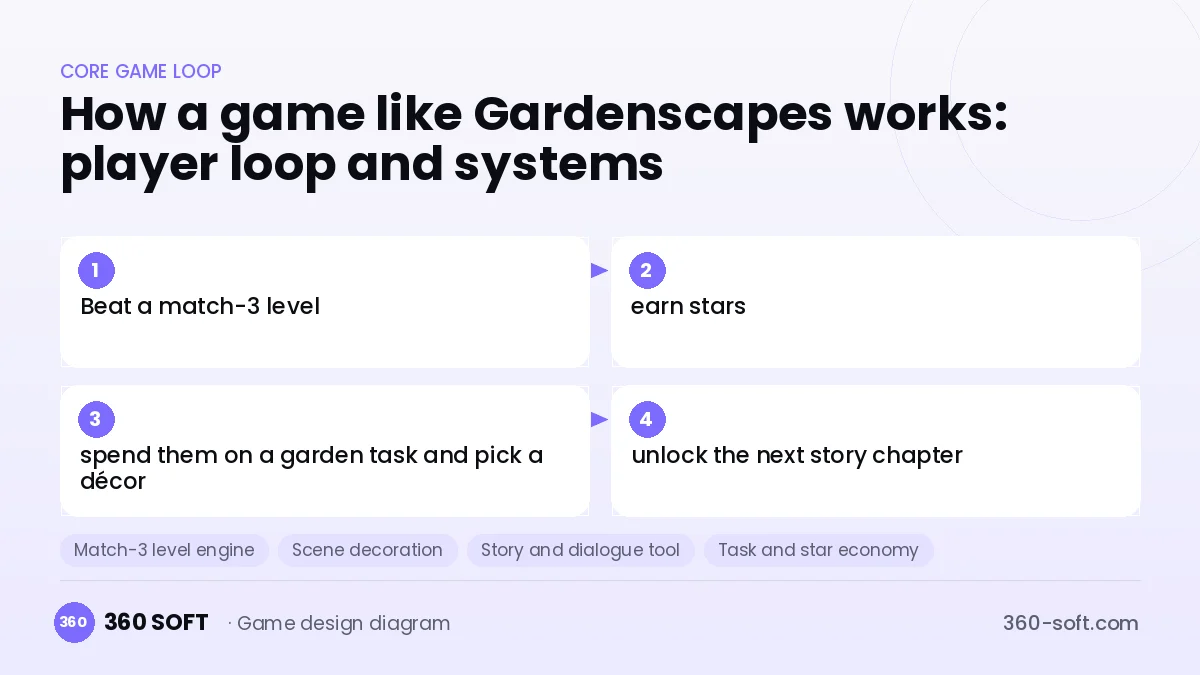
Why Gardenscapes works: the core loop
Systems you need to build a game like Gardenscapes
Match-3 level engine
Rich matching gameplay with boosters, blockers and goal types, fed by a level editor.
Scene decoration
A system that opens garden areas as tasks, offers several design options per object and shows changes with animation.
Story and dialogue tool
Narrative tooling that lets designers edit character dialogue, cutscenes and task text without code.
Task and star economy
The core resource balance in which stars from levels are spent on tasks, setting the pace of progression.
Events and mini-games
A modular structure for limited-time collection events and small game modes that differ from the main game.
Pets and secondary meta
Additional engagement systems, such as a pet the player looks after, that increase how often players return.
What goes into the first version, what comes later
First version (soft launch)
- A match-3 engine with core boosters and blockers
- The first garden area and tasks with décor choices
- A short story arc with character dialogue
- Lives, a store and an extra-moves offer
- Analytics, cloud save and Remote Config
Later updates
- New garden areas and story chapters
- Limited-time events and mini-games
- Teams and team races
- Pets, collections and a seasonal reward track
The hard parts of this genre
Art volume
Every garden area and every object variant needs its own artwork; art production makes up a large share of the budget.
Balancing two economies
If star earning and decoration tasks are out of balance, the story either crawls or content runs out too quickly.
Content flow
In story-driven games players are always waiting for new areas; regular levels, scenes and events require a strong production pipeline.
Team, timeline and budget
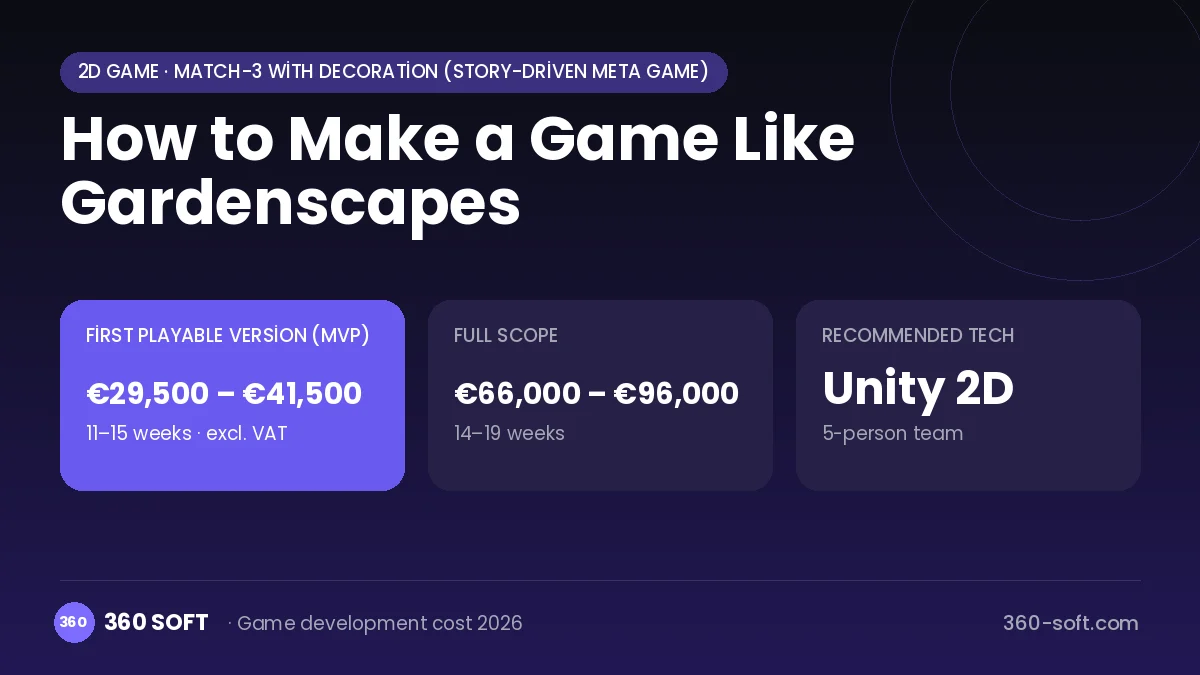
The estimate is based on the genre’s core systems, content volume, multiplayer and live-ops needs plus QA and project management: about 252 person-days for the full scope and 113 person-days for the first version. Cutting scope (fewer levels, one map, fewer characters) lowers the budget directly. Store accounts, servers, audio licences and user-acquisition budget are separate items. We send a fixed written price within 24 hours after the game design document.
Monetisation
The revenue model rests on the same foundations as match-3: extra moves, lives and booster bundles. The decoration meta strengthens the motivation to spend because players want to see the story unfold. Event reward tracks, bundles with exclusive décor and season passes are additional revenue lines; rewarded ads should stay opt-in.
Estimate your game budget and get a fixed quote
Let us scope it together and send a fixed written quote within 24 hours. NDA on request; you own the source code.
Calculated instantly from your choices, excl. VAT. A fixed written quote follows a free scoping call within 24 hours.
Choosing a game development company for a game like Gardenscapes
Most people searching “make a game like gardenscapes” are really looking for a reliable game development company. When comparing quotes, check four things:
- Can you play their released 2D games on your own phone?
- Are the source code, art files and store accounts transferred to you by contract?
- Do they build a playable prototype first and show a demo every two weeks?
- Are multiplayer servers, anti-cheat and scaling costs written into the quote?
Copyright and originality
Game mechanics on their own are generally not protected, but names, logos, characters, art, audio and level designs are. That is why we build a game “like Gardenscapes” with your own name, art and world. This is not legal advice; we recommend a trademark search before launch.
Frequently asked questions
How long does it take to make a game like Gardenscapes?
A prototype with the match-3 core and a single garden area comes together relatively quickly. Preparing for soft launch with story, scene art and enough levels takes months, and content production continues after launch.
Is making a game similar to Gardenscapes a copyright problem?
Combining match-3 with decoration is a general design approach. Characters, story, name, visual style and scenes must be original. This is not legal advice.
Can it be made without the decoration part?
It can, but the meta game is one of the main things that keeps players engaged long term. If budget is tight, starting with fewer object variants and smaller areas is a sensible middle ground.
What should we look for when choosing a studio to build a game like Gardenscapes?
Evaluate the studio’s 2D art production capacity, narrative tooling and match-3 experience together. Be sure to ask how they plan content and event production after launch.