2D gameFast-paced collectible card gameOriginal by Second Dinner / Nuverse
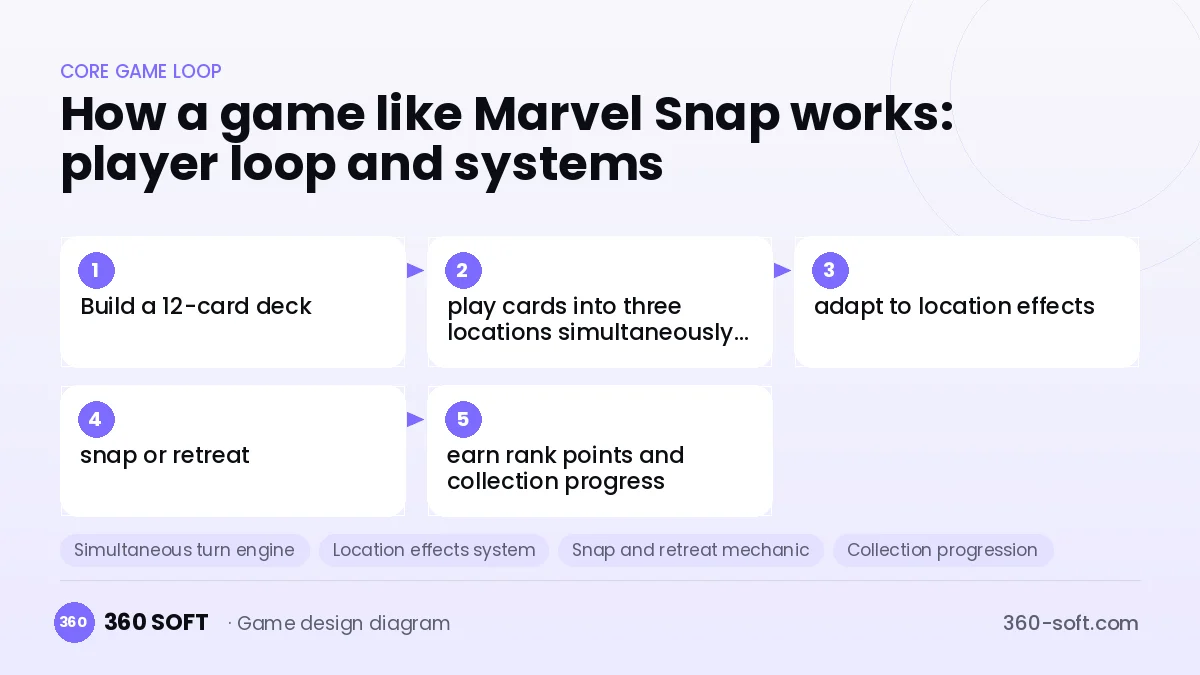
Marvel Snap compresses the collectible card game into simultaneous six-turn matches that last just a few minutes. Both players play their cards at the same time into three locations, and whoever wins the majority of locations takes the match. Location effects that change every game create surprises, while doubling the stakes with a 'snap' or retreating in time adds a poker-like layer of bluffing to the card game.
A similar game needs a simultaneous turn resolution engine, data-defined card and location effects, a fair way to decide reveal order and server-side validation. You also build collection-level progression that unlocks cards, card cosmetic upgrades, ranking and the doubling mechanic, a season pass and a steady flow of new cards and locations. Without a Marvel license, an original universe and character roster are essential.
Why Marvel Snap works: the core loop
Systems you need to build a game like Marvel Snap
Simultaneous turn engine
The core that collects both players' hidden moves and resolves them deterministically according to reveal order.
Location effects system
Defining and balancing, through data, the rule-changing locations revealed at random each match.
Snap and retreat mechanic
Snapping to raise the stakes mid-match, retreating to cap losses, and the rank point calculation behind them.
Collection progression
A progression-based rather than pack-based structure in which new cards unlock as you upgrade card cosmetics.
Card cosmetic upgrades
Cosmetic progression through card variants with frames, 3D effects and animations.
Matchmaking and seasons
Rank-based matchmaking, season resets and season pass rewards.
What goes into the first version, what comes later
First version (soft launch)
- 80–100 cards and 30+ locations in an original universe
- Simultaneous turn engine and server validation
- Snap/retreat and ranking system
- Collection progression and cosmetic upgrades
- AI opponent, analytics and remote balance tuning
Later updates
- Friendly matches and special event modes
- Season pass and themed seasons
- Clubs/guilds and chat
- Tournaments and spectator mode
The hard parts of this genre
Licensing and an original universe
Marvel characters are licensed; to be appealing, you need strong original character and world design.
Location-card interaction balance
Every location can interact with every card; the combinatorial explosion makes automated simulation and data monitoring essential.
Economy and fair progression
Progression-based card unlocks must be balanced so purchases feel meaningful without alienating free players.
Team, timeline and budget
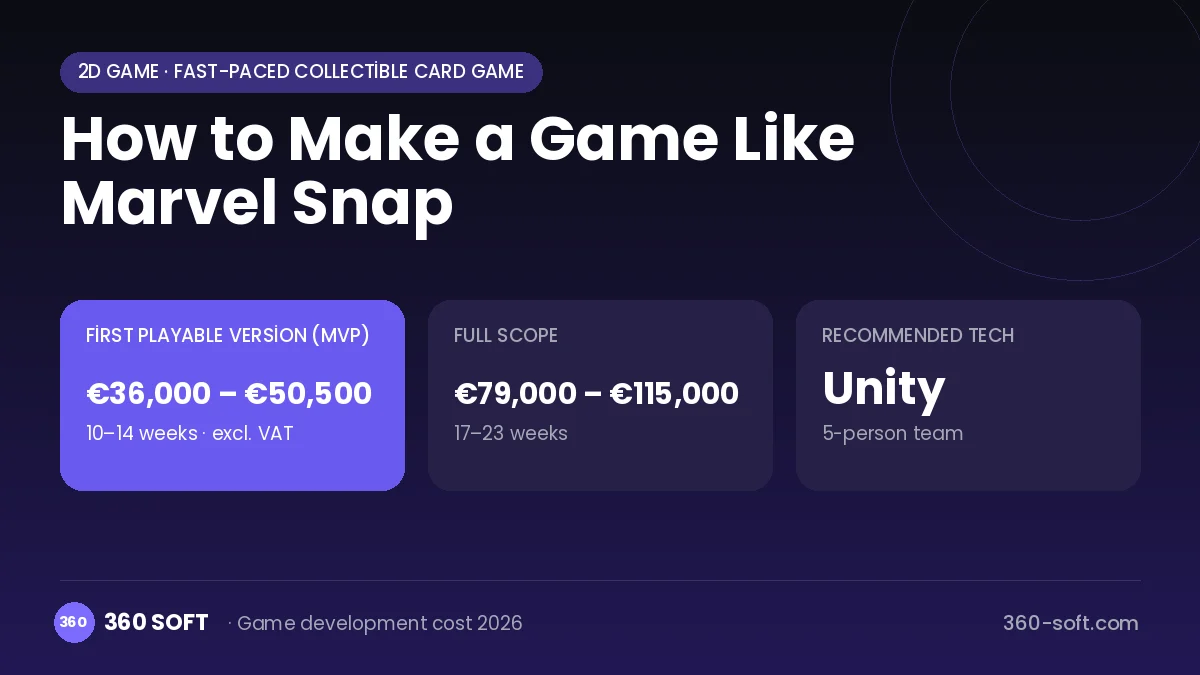
The estimate is based on the genre’s core systems, content volume, multiplayer and live-ops needs plus QA and project management: about 304 person-days for the full scope and 137 person-days for the first version. Cutting scope (fewer levels, one map, fewer characters) lowers the budget directly. Store accounts, servers, audio licences and user-acquisition budget are separate items. We send a fixed written price within 24 hours after the game design document.
Monetisation
Revenue in this genre comes from the season pass, card cosmetics and variants, cosmetic bundles and resource packs that speed up progression. Rotating limited-time store offers and themed seasons keep spending active. Avoiding direct power sales protects competitive trust.
Estimate your game budget and get a fixed quote
Let us scope it together and send a fixed written quote within 24 hours. NDA on request; you own the source code.
Calculated instantly from your choices, excl. VAT. A fixed written quote follows a free scoping call within 24 hours.
Choosing a game development company for a game like Marvel Snap
Most people searching “make a game like marvel snap” are really looking for a reliable game development company. When comparing quotes, check four things:
- Can you play their released 2D games on your own phone?
- Are the source code, art files and store accounts transferred to you by contract?
- Do they build a playable prototype first and show a demo every two weeks?
- Are multiplayer servers, anti-cheat and scaling costs written into the quote?
Copyright and originality
Game mechanics on their own are generally not protected, but names, logos, characters, art, audio and level designs are. That is why we build a game “like Marvel Snap” with your own name, art and world. This is not legal advice; we recommend a trademark search before launch.
Frequently asked questions
How long does it take to make a game like Marvel Snap?
A simultaneous turn engine prototype comes together relatively quickly; most of the time goes into card and location content, art, balance and the economy. The number of cards and the live content plan drive the schedule.
Can I use Marvel characters?
No, not without a license. Simultaneous turn and location mechanics are generally free to use, but characters, names and artwork must be original. This is not legal advice.
Why choose a card game with short matches?
Mobile players want short sessions; matches lasting a few minutes increase daily play. That strengthens retention and revenue opportunities.
Which engine is a good fit?
Unity is a common choice for this genre thanks to card effects, mobile performance and a broad plugin ecosystem. On the server side, deterministic turn resolution logic is essential.