2D gameHyper-casual protect-the-balloon reflex gameOriginal by Serkan Özyılmaz
Rise Up asks the player to protect something other than themselves: you clear the way for a fragile, slowly rising balloon using a small shield you move with your finger. Blocks, bars and spinning structures can be knocked around by physics and fall towards the balloon, so you have to push them aside, open a path and react to sudden threats. Guarding a passive target creates a tense sense of responsibility that sets it apart from classic reflex games.
The cornerstones of a similar game are shield control that follows the finger directly and physics-based obstacle setups. Obstacles need to be designed as handcrafted chunks combined into an endless stream, difficulty must rise with height, and collision checks on the balloon have to be very precise. Scoring, balloon and shield cosmetics, ad placement and analytics make up the rest of the game.
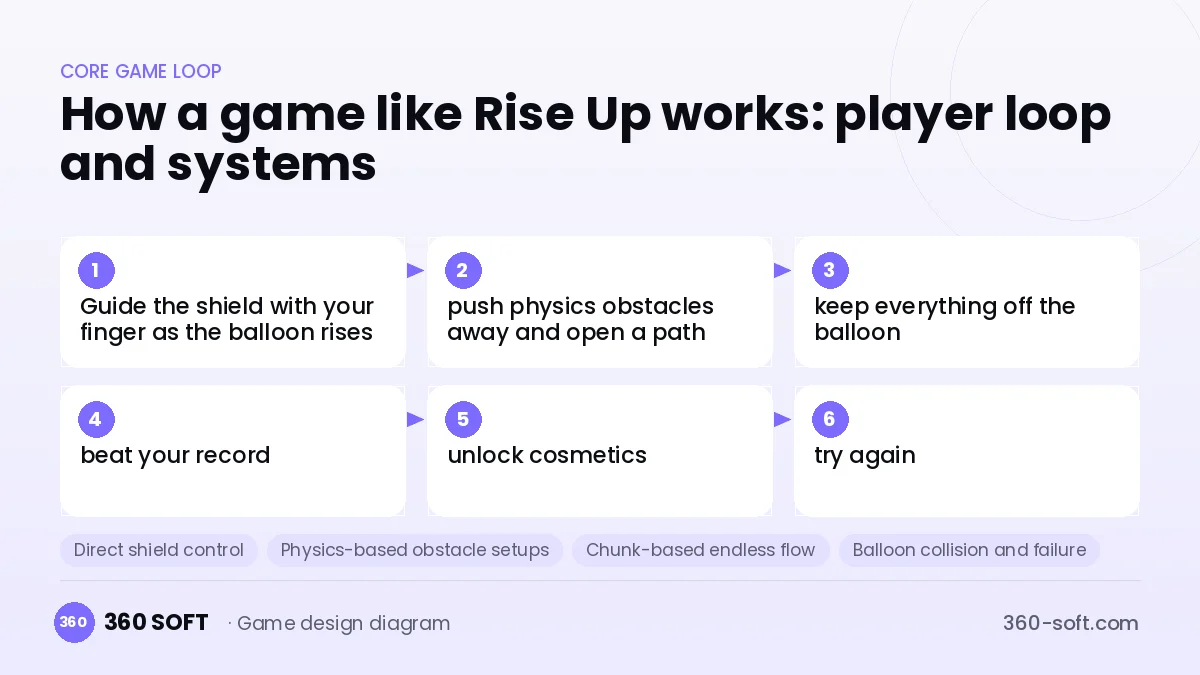
Why Rise Up works: the core loop
Systems you need to build a game like Rise Up
Direct shield control
The shield follows the finger relatively, so the finger never covers the balloon. Lag-free, precise control is the foundation of the game.
Physics-based obstacle setups
Blocks, chains, spinning bars and collapsing structures. When pushed by the shield they should react realistically but predictably.
Chunk-based endless flow
Handcrafted obstacle chunks stitched together in order of difficulty. This delivers variety and a fair difficulty curve at the same time.
Balloon collision and failure
Any contact with the balloon ends the run, with a pop effect and an instant restart. The one-mistake rule keeps the tension alive.
Score and cosmetics
Height score, personal best, and balloon and shield skins. These provide the short-term goals.
Ads and analytics
Rewarded ads to continue, end-of-run interstitials and analytics that reveal drop-off points.
What goes into the first version, what comes later
First version (soft launch)
- Precise shield control and balloon collision
- Basic physics-based obstacle chunks
- Chunk-based endless flow and difficulty curve
- Score, personal best and a few cosmetics
- Rewarded continue, interstitials and analytics
Later updates
- New obstacle setups and themed zones
- Daily challenge and leaderboard
- Expanded cosmetic collection
- Ad-free pack
The hard parts of this genre
Predictable physics obstacles
If physics behaves chaotically, players blame losses on luck. Mass, friction and push forces must be tuned so obstacles stay readable.
The finger covering the screen
A finger can hide the shield and incoming obstacles; relative control and camera framing need to solve this.
Producing obstacle chunks
An endless stream that does not feel repetitive needs many well-designed chunks, and each one has to be difficulty-tested.
Team, timeline and budget
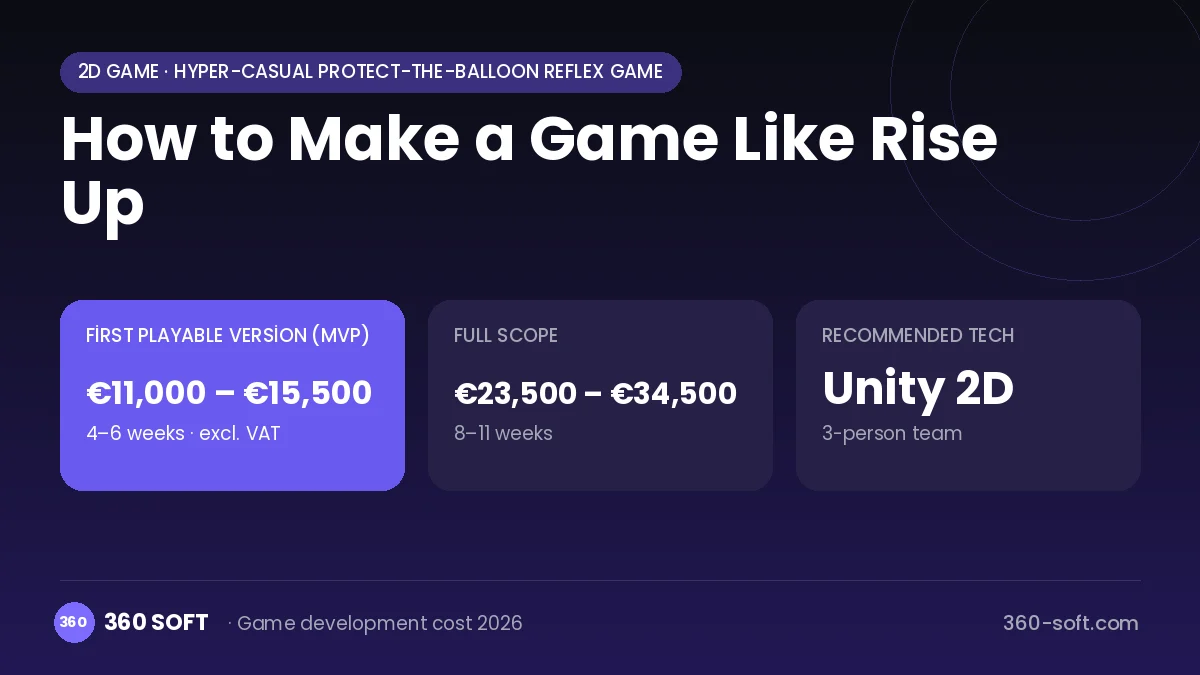
The estimate is based on the genre’s core systems, content volume, multiplayer and live-ops needs plus QA and project management: about 90 person-days for the full scope and 41 person-days for the first version. Cutting scope (fewer levels, one map, fewer characters) lowers the budget directly. Store accounts, servers, audio licences and user-acquisition budget are separate items. We send a fixed written price within 24 hours after the game design document.
Monetisation
Revenue comes mostly from ads: interstitials at the end of a run, rewarded ads to continue after the balloon pops, and banners. Cosmetic balloons and shields plus an ad-free pack provide modest IAP income. Because sessions are very short, ad frequency should be chosen so it never kills the urge to try again.
Estimate your game budget and get a fixed quote
Let us scope it together and send a fixed written quote within 24 hours. NDA on request; you own the source code.
Calculated instantly from your choices, excl. VAT. A fixed written quote follows a free scoping call within 24 hours.
Choosing a game development company for a game like Rise Up
Most people searching “make a game like rise up” are really looking for a reliable game development company. When comparing quotes, check four things:
- Can you play their released 2D games on your own phone?
- Are the source code, art files and store accounts transferred to you by contract?
- Do they build a playable prototype first and show a demo every two weeks?
- Are ads, in-app purchases and analytics set up as part of the quote?
Copyright and originality
Game mechanics on their own are generally not protected, but names, logos, characters, art, audio and level designs are. That is why we build a game “like Rise Up” with your own name, art and world. This is not legal advice; we recommend a trademark search before launch.
Frequently asked questions
How long does it take to make a game like Rise Up?
Shield control and basic physics obstacles can be prototyped quickly. Designing many obstacle chunks for the endless stream and tuning the difficulty curve is what takes the real time.
Will there be copyright issues?
The mechanic of protecting a rising object with a shield is generally free to use. Do not copy the game's name, logo, exact visual style or obstacle layouts. This is not legal advice.
Can I build it on my own?
Yes. Rise Up was made by an independent developer, which shows the genre is achievable with small teams. Marketing and ad optimisation, however, are a separate area of expertise.
What should I look for when choosing a hyper-casual game studio?
Look for experience tuning the feel of 2D physics-based games, a fast prototyping rhythm and solid ad/analytics integration know-how.