3D gameMultiplayer survival and base buildingOriginal by Facepunch Studios
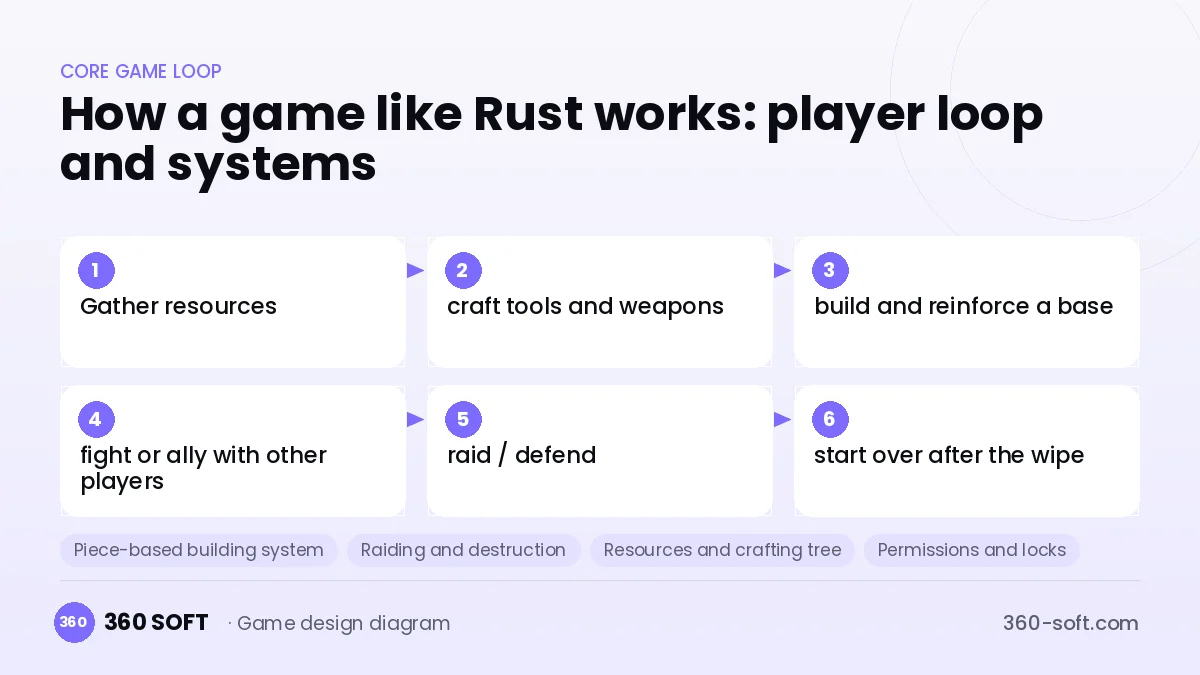
The strength of Rust is that it drops you naked with a rock in your hand and forces you to build everything in spite of other players. Gather resources, craft tools, build a base, lock the door; but someone may raid you while you sleep. Trust, betrayal, alliances and rivalry are written entirely by players. Periodic server wipes put everyone back on the same starting line and keep the "this time I will do better" urge alive.
At the heart of a similar game is a persistent, multiplayer, piece-based building system. The durability of building blocks such as walls, floors and doors, raid explosives, resource gathering, a crafting tree and a lock / permission system must all work together. A first release only needs a smaller map, low-population servers and limited crafting content, but server persistence, efficient world saving and anti-cheat must be built in from the start.
Why Rust works: the core loop
Systems you need to build a game like Rust
Piece-based building system
Foundations, walls, floors, stairs and doors; durability by material tier and structural support rules.
Raiding and destruction
Structure damage from explosives and tools; the cost balance between defence and attack defines the game's economy.
Resources and crafting tree
Gathering wood, stone and metal; unlocking blueprints through research and a crafting queue.
Permissions and locks
Code locks, a tool cupboard and clan membership; rules for who can do what inside a base area.
Persistent world and wipes
Persistent server storage of structures and inventories, periodic resets and map generation.
Survival meters
Hunger, thirst, temperature and radiation; the basic pressures that keep players moving.
What goes into the first version, what comes later
First version (soft launch)
- One small procedural or hand-crafted map
- Low-population persistent servers
- Basic building pieces and 2–3 material tiers
- A limited crafting tree, a few weapons and explosives
- Code locks, a tool cupboard and manual wipes
Later updates
- Vehicles, electricity and automation systems
- NPC-guarded danger zones (monuments)
- Community servers and mod support
- Clan system and server scaling
The hard parts of this genre
Synchronising thousands of structures
The many pieces built by players are a heavy load on server memory and network traffic; regional data streaming is essential.
Toxic play and new players
Fully open PvP can scare off new players; starter zones and server rules are needed.
Cheats and exploits
Exploits such as seeing through walls or clipping into bases break the raid economy; server-side validation is critical.
Team, timeline and budget
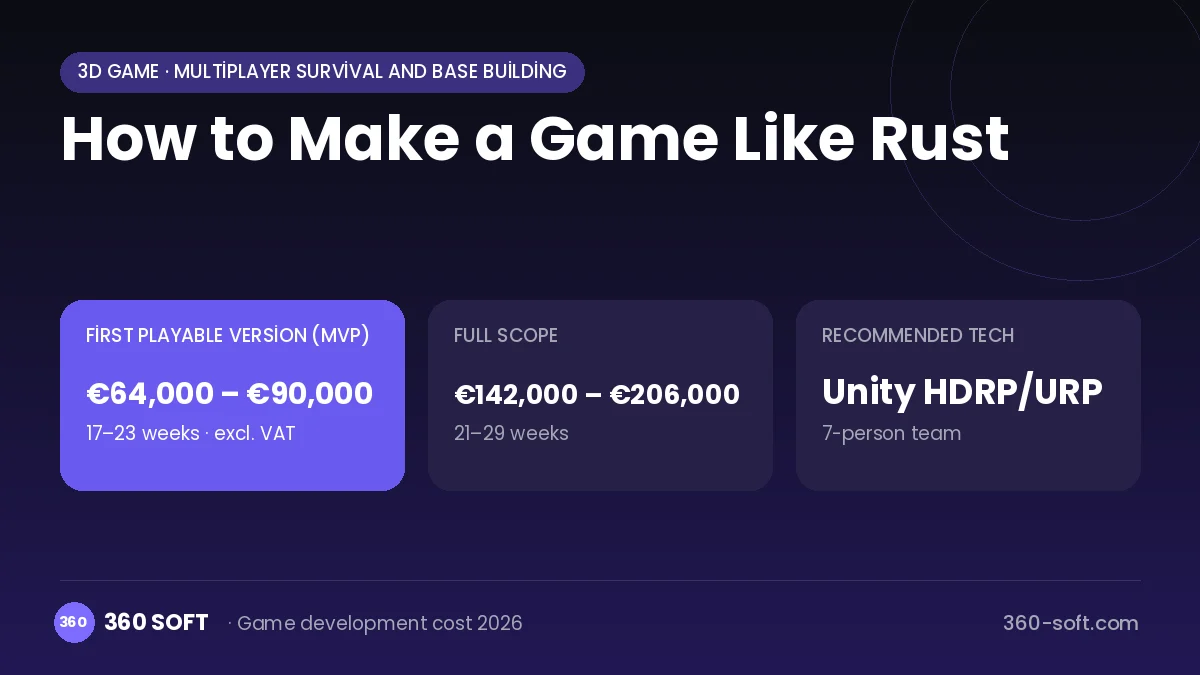
The estimate is based on the genre’s core systems, content volume, multiplayer and live-ops needs plus QA and project management: about 546 person-days for the full scope and 246 person-days for the first version. Cutting scope (fewer levels, one map, fewer characters) lowers the budget directly. Store accounts, servers, audio licences and user-acquisition budget are separate items. We send a fixed written price within 24 hours after the game design document.
Monetisation
This genre usually runs on premium sales, with a cosmetic store offering weapon, clothing and building skins on top. DLC packs and hosting services for community servers can also generate revenue. Selling power in the game instantly breaks the persistent PvP balance.
Estimate your game budget and get a fixed quote
Let us scope it together and send a fixed written quote within 24 hours. NDA on request; you own the source code.
Calculated instantly from your choices, excl. VAT. A fixed written quote follows a free scoping call within 24 hours.
Choosing a game development company for a game like Rust
Most people searching “make a game like rust” are really looking for a reliable game development company. When comparing quotes, check four things:
- Can you play their released 3D games on your own phone?
- Are the source code, art files and store accounts transferred to you by contract?
- Do they build a playable prototype first and show a demo every two weeks?
- Are multiplayer servers, anti-cheat and scaling costs written into the quote?
Copyright and originality
Game mechanics on their own are generally not protected, but names, logos, characters, art, audio and level designs are. That is why we build a game “like Rust” with your own name, art and world. This is not legal advice; we recommend a trademark search before launch.
Frequently asked questions
How long does it take to make a game like Rust?
An MVP with basic building, crafting and persistent servers can be built by an experienced team in around a year. Growing through Early Access with community feedback is common in this genre.
Will there be copyright issues?
Survival, base building, raiding and wipe mechanics are generally free to use. The game name, map, models, visuals and sounds cannot be copied. This is general information, not legal advice.
Which engine should I choose?
Unity is flexible for procedural terrain and moddability. Unreal Engine 5 offers high visual quality and built-in dedicated server support; the team's experience should be the deciding factor.
What should I look for in a company that makes games like Rust?
Look at the company's experience with persistent worlds and multiplayer servers, and how it synchronises large numbers of objects. Ask for a load-tested building prototype.