3D gameUnderwater exploration and survivalOriginal by Unknown Worlds Entertainment
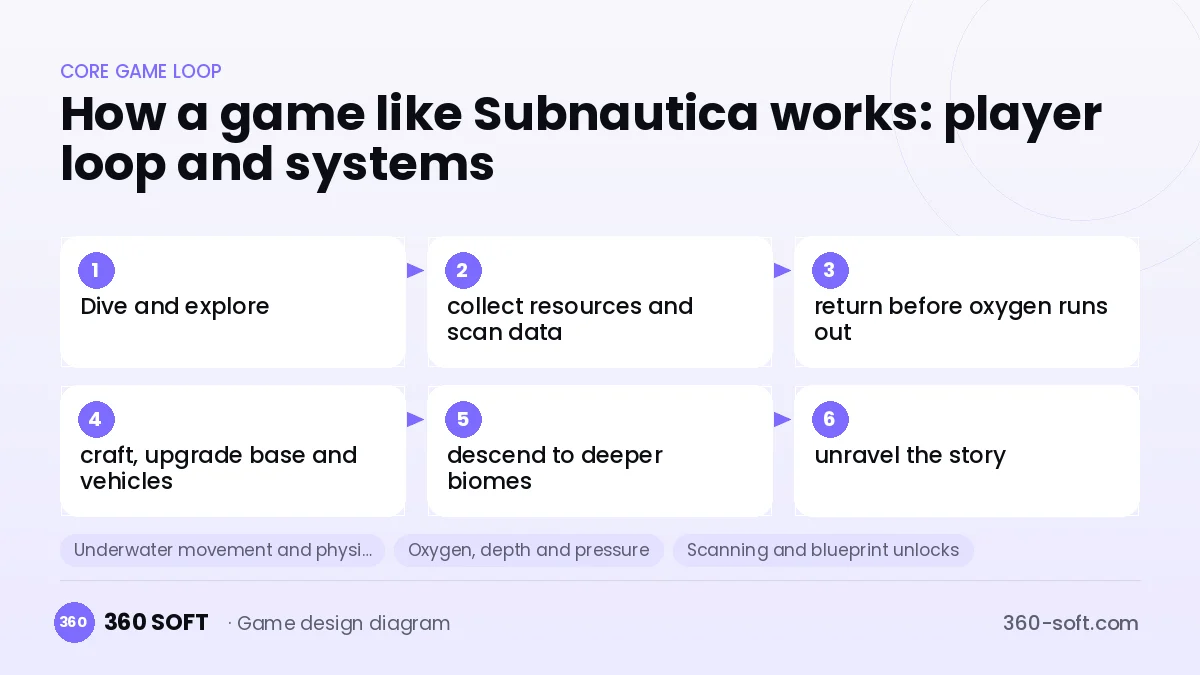
Subnautica builds survival on the curiosity of exploration and the fear of the deep. Stranded in the ocean of an alien planet, every new depth is both fascinating and threatening. The oxygen limit turns each dive into a small mission, and blueprints learned with the scanner unlock new tools and deeper dives. A strong story told in fragments makes players ask "what is down there?" and steers progress naturally.
A similar game needs a hand-crafted, layered world design; procedural generation usually falls short here, because progression is built around depth and biome order. Underwater movement and physics, oxygen and pressure systems, unlocking blueprints by scanning, modular base building, vehicles and sea creature AI form the core. A first release only needs a few biomes, a single vehicle and the first chapter of the story.
Why Subnautica works: the core loop
Systems you need to build a game like Subnautica
Underwater movement and physics
Three-dimensional swimming, currents, buoyancy and vehicle handling; UI cues that prevent disorientation.
Oxygen, depth and pressure
Oxygen that sets dive time, depth limits and vehicle hull strength.
Scanning and blueprint unlocks
Blueprints learned by scanning fragments; the system that ties exploration directly to progression.
Modular base building
Underwater corridors, rooms and observation domes; power and hull integrity management.
Sea life ecosystem
Layered AI from harmless fish to giant predators; threats that change with depth.
Environmental storytelling
Audio logs, wrecks, radio signals and key locations; a narrative that guides the player to new areas.
What goes into the first version, what comes later
First version (soft launch)
- 3–4 hand-crafted shallow and mid-depth biomes
- Oxygen, scanning and basic crafting
- A simple modular base and one small vehicle
- 10–15 sea creature species and one large predator
- The first story chapter and single-player mode
Later updates
- Deep biomes and a large submarine
- The rest of the story and a final area
- Land areas and weather
- Console version and VR support
The hard parts of this genre
Underwater visuals and performance
Light refraction, fog and particles create the atmosphere but strain performance; quality tiers are required.
Navigation
Players get lost easily in a 3D underwater space; markers, sonar and careful level design are essential.
Content and story cost
Hand-crafted biomes, creatures and narrative require heavy art and design effort; the content pipeline must be planned early.
Team, timeline and budget
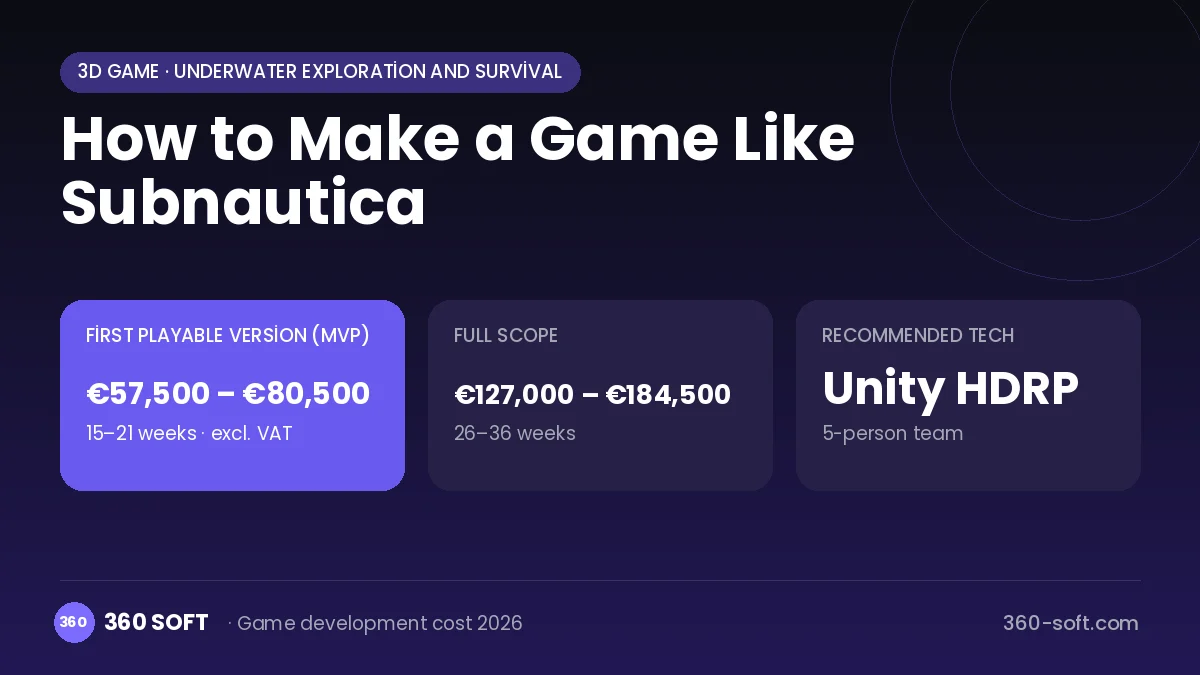
The estimate is based on the genre’s core systems, content volume, multiplayer and live-ops needs plus QA and project management: about 488 person-days for the full scope and 219 person-days for the first version. Cutting scope (fewer levels, one map, fewer characters) lowers the budget directly. Store accounts, servers, audio licences and user-acquisition budget are separate items. We send a fixed written price within 24 hours after the game design document.
Monetisation
Premium sales are the best fit; Early Access lets you develop the world with community feedback. A sequel or standalone expansion is an efficient way to sell new content on the same technology. Ads and microtransactions do not suit a single-player, atmosphere-driven experience like this.
Estimate your game budget and get a fixed quote
Let us scope it together and send a fixed written quote within 24 hours. NDA on request; you own the source code.
Calculated instantly from your choices, excl. VAT. A fixed written quote follows a free scoping call within 24 hours.
Choosing a game development company for a game like Subnautica
Most people searching “make a game like subnautica” are really looking for a reliable game development company. When comparing quotes, check four things:
- Can you play their released 3D games on your own phone?
- Are the source code, art files and store accounts transferred to you by contract?
- Do they build a playable prototype first and show a demo every two weeks?
- Are ads, in-app purchases and analytics set up as part of the quote?
Copyright and originality
Game mechanics on their own are generally not protected, but names, logos, characters, art, audio and level designs are. That is why we build a game “like Subnautica” with your own name, art and world. This is not legal advice; we recommend a trademark search before launch.
Frequently asked questions
How long does it take to make a game like Subnautica?
An Early Access-ready version with a few biomes and the first story chapter can ship with an experienced small team in about a year or a little more. Hand-crafted content is the biggest factor in the timeline.
Will there be copyright issues?
Mechanics such as underwater survival, oxygen and scanning to unlock blueprints are generally free to use. The game name, planet and creature designs, story, visuals and sounds cannot be copied. This is general information, not legal advice.
Does it need multiplayer?
It is not required; the genre's strength is the feeling of isolation and discovery. Co-op can be added later, but retrofitting it is expensive if it is not planned from the start.
What should I look for in a company that makes games like Subnautica?
Look at the company's portfolio in atmosphere, lighting / shaders and level design. Ask for a vertical slice of one biome that captures the underwater feel.