3D gameFirst-person supermarket management simOriginal by Nokta Games
Supermarket Simulator is one of the best-known examples of the "job simulator" wave that turns everyday chores into tactile satisfaction. Opening boxes and stacking shelves, setting price tags, scanning barcodes and giving change at the till, then reinvesting profits to grow the shop: each creates a small but tangible sense of progress. Watching an empty shop turn into a busy, fully stocked supermarket keeps players hooked for hours.
Success in a game like this lies in how the interactions feel: grab-and-place physics, shelving rules, the checkout interface and customer reactions. Underneath sits an economy with a product catalogue, wholesale orders, demand and price elasticity, plus customer AI that walks around with shopping lists, store expansion and staff automation. Content volume is moderate, making it an achievable project for a small team.
Why Supermarket Simulator works: the core loop
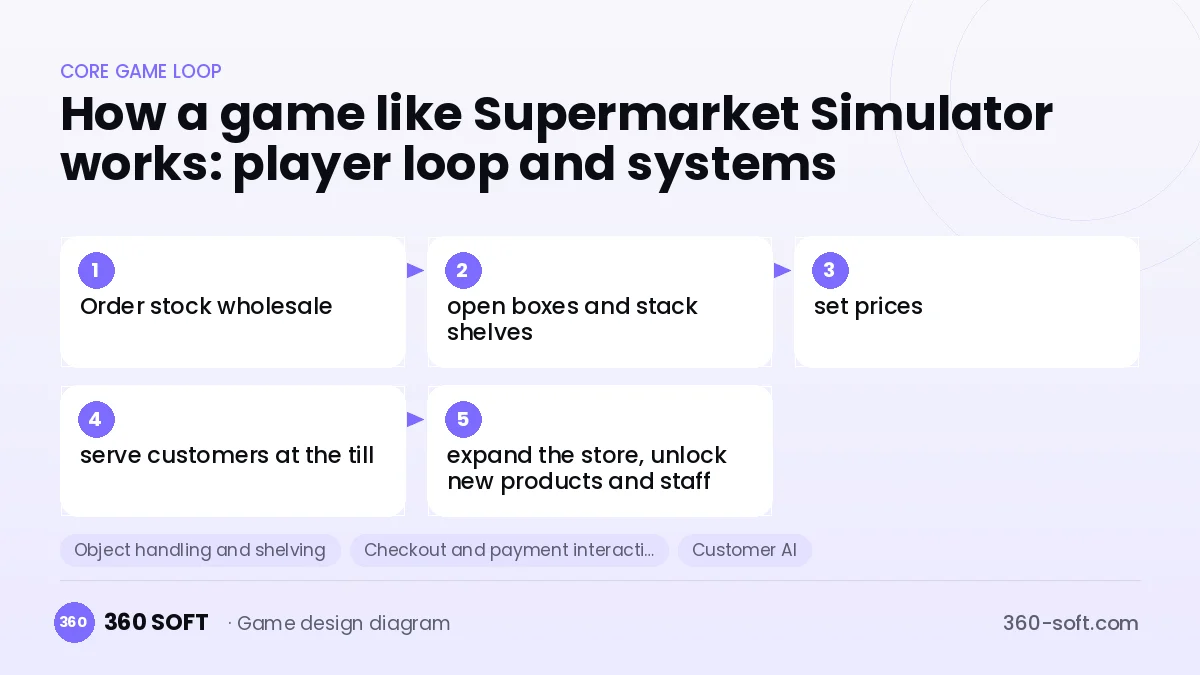
Systems you need to build a game like Supermarket Simulator
Object handling and shelving
Carrying and opening boxes, stocking shelves item by item or in bulk, and placement rules per shelf type. Every hands-on task has to feel satisfying.
Checkout and payment interaction
Barcode scanning, calculating cash change, card payments and queue management. The chance of mistakes adds a small skill layer.
Customer AI
Customers who arrive with shopping lists, search for products, walk away if prices are too high and get annoyed by long queues. Crowd simulation must be optimised.
Product catalogue and pricing economy
The relationship between wholesale cost, market price, the player's price and demand; product groups unlocked via licences. Its balance sets the game's pace.
Store expansion and decor
Knocking down walls, new sections, a storeroom, buying shelves and decor; the player plans the store layout.
Staff and automation
Hiring cashiers and shelf stackers, wages and efficiency. In later stages it shifts the game from manual work to management.
What goes into the first version, what comes later
First version (soft launch)
- One store with 2–3 expandable sections
- A 60–100 item catalogue and wholesale ordering
- Shelf stocking, price labelling and checkout interaction
- Customer AI and a satisfaction system
- Day cycle, save system and basic staff
Later updates
- New product categories (fresh produce, bakery, electronics)
- Shoplifting, cleaning and random events
- Co-op (run the store with a friend)
- Console and mobile ports, mod support
The hard parts of this genre
Repetition turning into boredom
Stocking shelves and working the till are fun at first but become monotonous after hours. Automation, new products and events must kick in at the right time.
Crowd performance
Dozens of customers pathfinding and interacting with shelves in a big store strain the CPU. NavMesh optimisation and a simplified simulation are required.
Economy balance
If the price-demand relationship is too easy to exploit, the game loses meaning; if it is too punishing, it frustrates. It needs continuous tuning with player data.
Team, timeline and budget
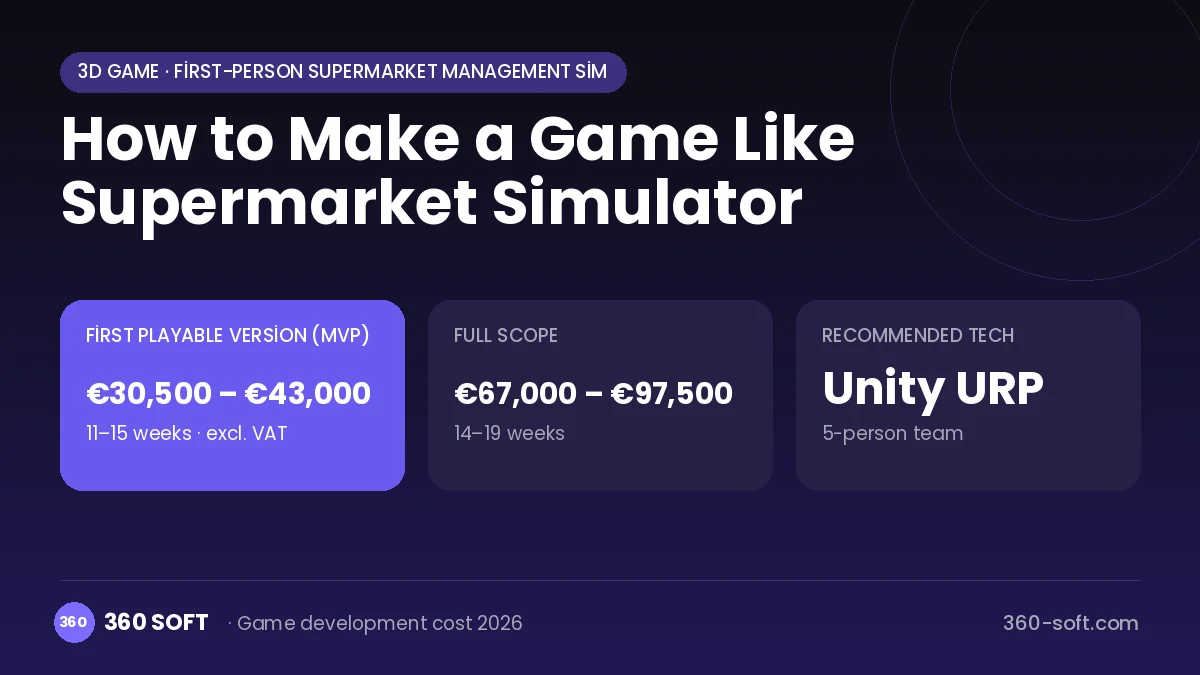
The estimate is based on the genre’s core systems, content volume, multiplayer and live-ops needs plus QA and project management: about 257 person-days for the full scope and 116 person-days for the first version. Cutting scope (fewer levels, one map, fewer characters) lowers the budget directly. Store accounts, servers, audio licences and user-acquisition budget are separate items. We send a fixed written price within 24 hours after the game design document.
Monetisation
On PC this genre usually follows a one-off paid purchase and a Steam Early Access model, with later updates and DLC (new product categories, decor packs) adding revenue. For a mobile port, free download plus rewarded ads (speed-ups, extra cash) and a no-ads pack fit well. Content creators and streamers are the strongest marketing channel for this genre.
Estimate your game budget and get a fixed quote
Let us scope it together and send a fixed written quote within 24 hours. NDA on request; you own the source code.
Calculated instantly from your choices, excl. VAT. A fixed written quote follows a free scoping call within 24 hours.
Choosing a game development company for a game like Supermarket Simulator
Most people searching “make a game like supermarket simulator” are really looking for a reliable game development company. When comparing quotes, check four things:
- Can you play their released 3D games on your own phone?
- Are the source code, art files and store accounts transferred to you by contract?
- Do they build a playable prototype first and show a demo every two weeks?
- Are ads, in-app purchases and analytics set up as part of the quote?
Copyright and originality
Game mechanics on their own are generally not protected, but names, logos, characters, art, audio and level designs are. That is why we build a game “like Supermarket Simulator” with your own name, art and world. This is not legal advice; we recommend a trademark search before launch.
Frequently asked questions
How long does it take to make a game like Supermarket Simulator?
An Early Access version with one store and a basic economy can ship with a small team in a reasonable time. It then grows through updates with new products, events and co-op.
Can I use real product brands?
Real brands and logos require permission because of trademark rights. Fictional brands are both safe and a great opportunity for humour; this is not legal advice.
PC or mobile?
The genre grew on PC through Steam and creator videos. A mobile version reaches a wider audience, but the control scheme and revenue model need to be redesigned.
What should I look for in a simulation game development company?
Look at their experience with first-person interaction, crowd AI and in-game economy balancing. A team that knows Steam publishing and Early Access management is an advantage.