3D gameTruck and logistics driving simulator
The appeal of games like Euro Truck Simulator and Truck Simulator Ultimate is a calm yet immersive sense of the journey. Players pick up cargo, drive long intercity roads while obeying traffic rules, watch the sunset and enjoy the satisfaction of an on-time delivery. Using earnings to buy new trucks, open garages and hire drivers to grow your own logistics company adds a long-term goal to the driving.
The biggest cost in this kind of game is the map: a road network representing thousands of kilometres, junctions, city entrances and scenery. A small first release should limit the map to a few cities and the motorways that connect them. Alongside that you need truck-and-trailer physics, AI traffic, fuel, fatigue and damage systems, an economy and a company management layer.
Why Truck Simulator works: the core loop
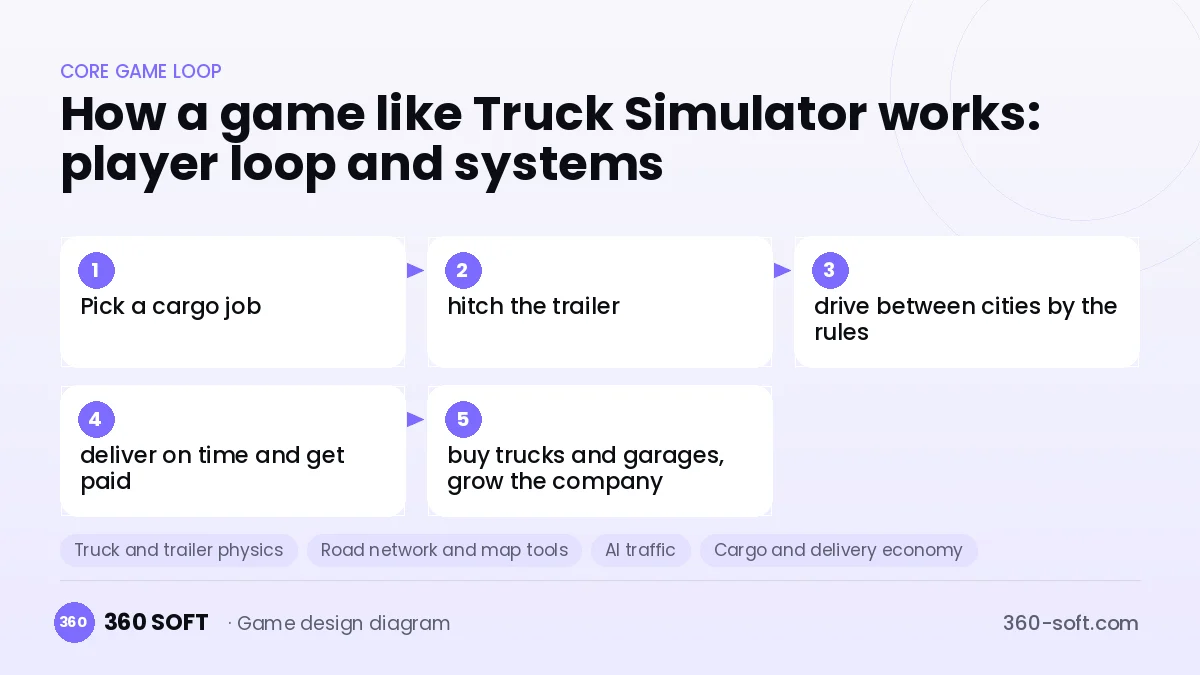
Systems you need to build a game like Truck Simulator
Truck and trailer physics
Heavy mass, multi-axle trailer coupling, engine brake, gearbox and reversing manoeuvres. Parking with a trailer is the skill peak of the genre.
Road network and map tools
A spline-based road editor, junction generation, motorway on- and off-ramps and procedural roadside scenery. Modelling every kilometre by hand is not sustainable.
AI traffic
Lane-following vehicles that obey traffic lights and overtake, plus a speed camera and fine system that reacts to player violations.
Cargo and delivery economy
Cargo types, pay by distance and time, damage deductions, fuel and toll costs. The income and expense balance sets progression speed.
Company and garage management
Buying garages, hiring drivers, adding trucks to the fleet and passive income. The management layer that carries the mid and late game.
Cab, tuning and atmosphere
A detailed interior cab, mirrors, gauges and radio; a day-night cycle and weather. Truck tuning (paint, lights, horn) builds cosmetic attachment.
What goes into the first version, what comes later
First version (soft launch)
- 3–5 cities and the motorway network connecting them
- 3–4 truck models and a few trailer types with solid driving physics
- Basic AI traffic with speeding and red-light fines
- Cargo jobs, fuel and damage economy
- Day-night cycle, simple weather and cloud save
Later updates
- New countries/regions and map expansions
- Company management, driver hiring and fleet
- Convoy (multiplayer driving together) mode
- Steering wheel support and advanced cab tuning
The hard parts of this genre
Map scale and content production
A sense of long distance needs a large area, but every kilometre is production cost. Procedural tools and a scaled map (a shrunk version of reality) are critical decisions.
Streaming and floating point in a big world
On very large maps, world chunk loading and the jitter that appears far from the origin (floating origin) must be solved.
Balancing boredom and realism
Long drives are relaxing for some players and boring for others. Time-skip options, scenery variety and random events strike the balance.
Team, timeline and budget
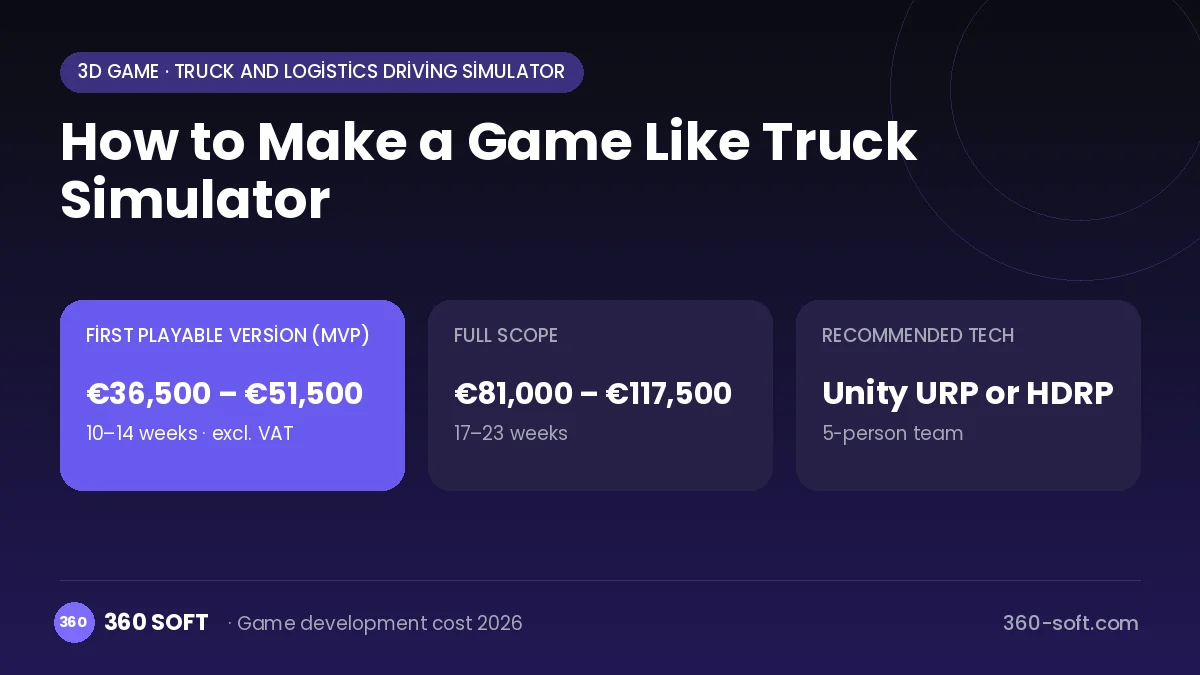
The estimate is based on the genre’s core systems, content volume, multiplayer and live-ops needs plus QA and project management: about 310 person-days for the full scope and 140 person-days for the first version. Cutting scope (fewer levels, one map, fewer characters) lowers the budget directly. Store accounts, servers, audio licences and user-acquisition budget are separate items. We send a fixed written price within 24 hours after the game design document.
Monetisation
On mobile, free download plus rewarded ads (doubling delivery rewards) and in-app purchases (premium trucks, currency packs, ad-free version) are common. On PC, one-off sales and map/region expansion DLCs dominate. Cosmetic truck packs bring regular revenue on both platforms.
Estimate your game budget and get a fixed quote
Let us scope it together and send a fixed written quote within 24 hours. NDA on request; you own the source code.
Calculated instantly from your choices, excl. VAT. A fixed written quote follows a free scoping call within 24 hours.
Choosing a game development company for a game like Truck Simulator
Most people searching “make a game like truck simulator” are really looking for a reliable game development company. When comparing quotes, check four things:
- Can you play their released 3D games on your own phone?
- Are the source code, art files and store accounts transferred to you by contract?
- Do they build a playable prototype first and show a demo every two weeks?
- Are ads, in-app purchases and analytics set up as part of the quote?
Copyright and originality
Game mechanics on their own are generally not protected, but names, logos, characters, art, audio and level designs are. That is why we build a game “like Truck Simulator” with your own name, art and world. This is not legal advice; we recommend a trademark search before launch.
Frequently asked questions
How long does it take to make a game like Truck Simulator?
A first release with a map of a few cities and a basic economy can be built in a reasonable timeframe. What really drives the schedule is how large and detailed the map will be.
Can I use real cities and truck brands?
Real city names are usually fine, but truck brands, logos and some recognisable buildings may require licences. Original vehicle designs are the safest route; this is not legal advice.
Should I build for mobile or PC?
Mobile reaches a wider audience but limits map size and visual detail. PC players expect steering wheel support and deep simulation; decide based on your target audience.
What should I look for in a studio that builds simulation games?
Look at their experience with vehicle physics, large-map streaming and AI traffic. A team that sizes the map realistically and proposes procedural tools protects your budget.