3D gameLife simulationOriginal by Maxis / Electronic Arts
The Sims hands the player the role of director of a life: you create characters, build a home, form relationships, pick careers and watch the funny or dramatic moments little people create through their own choices. The magic lies in emergent stories; characters driven by needs such as hunger, sleep and fun produce moments the player never planned. Build mode is a creative game in its own right.
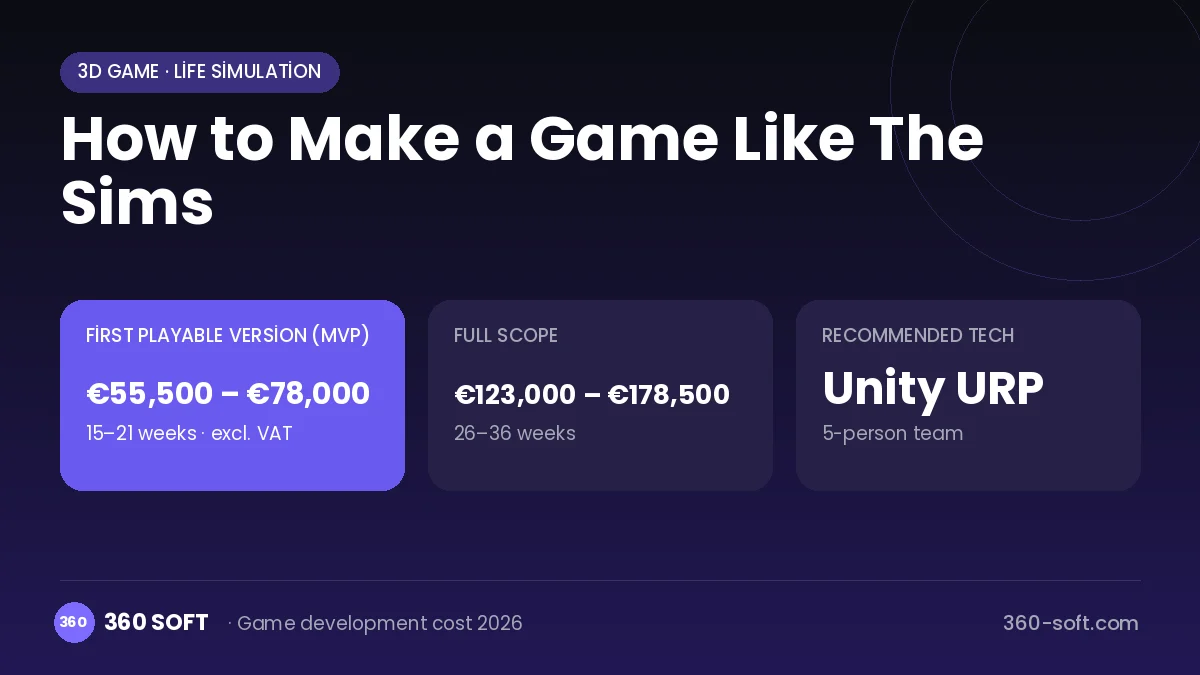
To be honest, this series has a huge content library built up over many years, so a small first release has to cut scope significantly. A realistic MVP: one neighbourhood with a few lots, limited character creation options, grid-based house building, 6–8 needs with basic social interactions, and a few careers. This requires needs-based AI (utility AI), an object-interaction system, modular characters and an extensive UI.
Why The Sims works: the core loop
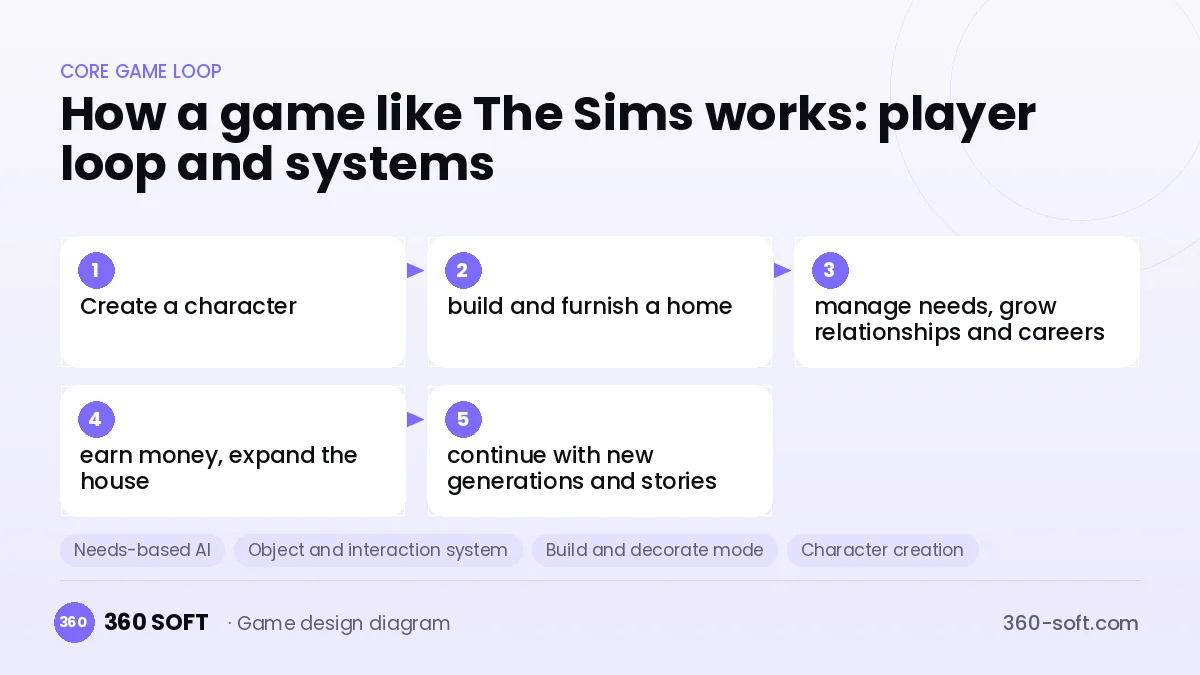
Systems you need to build a game like The Sims
Needs-based AI
Utility AI built on needs such as hunger, energy, hygiene, social and fun, with objects "advertising" how well they satisfy them. It lets characters behave sensibly on their own.
Object and interaction system
A data-driven structure where every object carries its own interaction list, animations and need effects. It makes adding new content easy.
Build and decorate mode
Drawing walls, doors, windows, floors, roofs and storeys; grid-based object placement and colour variations.
Character creation
Face and body sliders, hair, outfits and personality traits. A customisation pipeline based on modular meshes and blend shapes.
Relationship and social system
Friendship and romance values, a social interaction menu, and the effect of mood and traits on interaction success.
Careers, time and life stages
Jobs, promotions, skills, money and bills; time speed-up, ageing and generations. Together they form the long-term story frame.
What goes into the first version, what comes later
First version (soft launch)
- One neighbourhood, 3–5 lots and a grid-based build mode
- Limited but flexible character creation
- 6–8 needs with autonomous behaviour via utility AI
- 100–150 objects and basic social interactions
- 3–4 careers, a money / bills system and saving
Later updates
- Life stages, families and generations
- New neighbourhoods, community lots and holiday destinations
- Pets, hobbies and themed content packs
- Mod support and a user content sharing gallery
The hard parts of this genre
Believable autonomous behaviour
If characters act stupidly (starving, getting stuck in doorways) the game frustrates; if they act perfectly, the player has no role left. Tuning utility AI needs constant testing.
Huge content and animation load
Every object must work with proper animations for every character type. Object-animation combinations multiply content costs.
Complex UI
Build mode, character creation, the needs panel and interaction menus add up to a dense interface. Keeping it intuitive on gamepad and touch is especially hard.
Team, timeline and budget
The estimate is based on the genre’s core systems, content volume, multiplayer and live-ops needs plus QA and project management: about 473 person-days for the full scope and 213 person-days for the first version. Cutting scope (fewer levels, one map, fewer characters) lowers the budget directly. Store accounts, servers, audio licences and user-acquisition budget are separate items. We send a fixed written price within 24 hours after the game design document.
Monetisation
The common life sim model is selling the base game or offering it free, then selling themed expansion and item packs. Cosmetic outfit and furniture sets, seasonal content and, on mobile, speed-ups with premium currency are good fits. The modding community and content creators are the most valuable assets for extending the life of this genre.
Estimate your game budget and get a fixed quote
Let us scope it together and send a fixed written quote within 24 hours. NDA on request; you own the source code.
Calculated instantly from your choices, excl. VAT. A fixed written quote follows a free scoping call within 24 hours.
Choosing a game development company for a game like The Sims
Most people searching “make a game like the sims” are really looking for a reliable game development company. When comparing quotes, check four things:
- Can you play their released 3D games on your own phone?
- Are the source code, art files and store accounts transferred to you by contract?
- Do they build a playable prototype first and show a demo every two weeks?
- Are ads, in-app purchases and analytics set up as part of the quote?
Copyright and originality
Game mechanics on their own are generally not protected, but names, logos, characters, art, audio and level designs are. That is why we build a game “like The Sims” with your own name, art and world. This is not legal advice; we recommend a trademark search before launch.
Frequently asked questions
How long does it take to make a game like The Sims?
Content at the level of the series requires large teams and many years. An Early Access version with one neighbourhood and limited objects and careers is a far more achievable goal and can grow with community feedback.
Will there be copyright issues?
Mechanics such as life simulation, need systems and house building are generally free to use. The name, UI design, character language, logo and visuals cannot be copied. This is not legal advice.
Can it be made for mobile?
Yes, but build mode and character creation must be redesigned for touch. Mobile versions usually favour a leaner scope and session structure.
What should I look for in a life sim development company?
Look at their experience with AI systems, complex UI and modular character pipelines. A team that splits scope into phases and proposes an Early Access strategy reduces risk.