2D gameColour sorting puzzle
Water Sort Puzzle is built on the idea of pouring mixed-colour liquids between tubes until each tube holds a single colour. The rule takes seconds to learn but demands thinking a few moves ahead, which gives the game a calm yet cerebral character. The liquid pouring animation and the sound of a tube filling up amplify the satisfaction of creating order. A limited number of undos pushes players to be careful.
The most critical part of a similar game is solvable level generation: each of thousands of levels must be verified by a solver algorithm and have its difficulty measured. Alongside that you build a fluid-looking pour animation, undo and extra tube mechanics, tube and background cosmetics, progress saving and ad infrastructure. Variations such as ball sort can be offered as extra modes on the same engine.
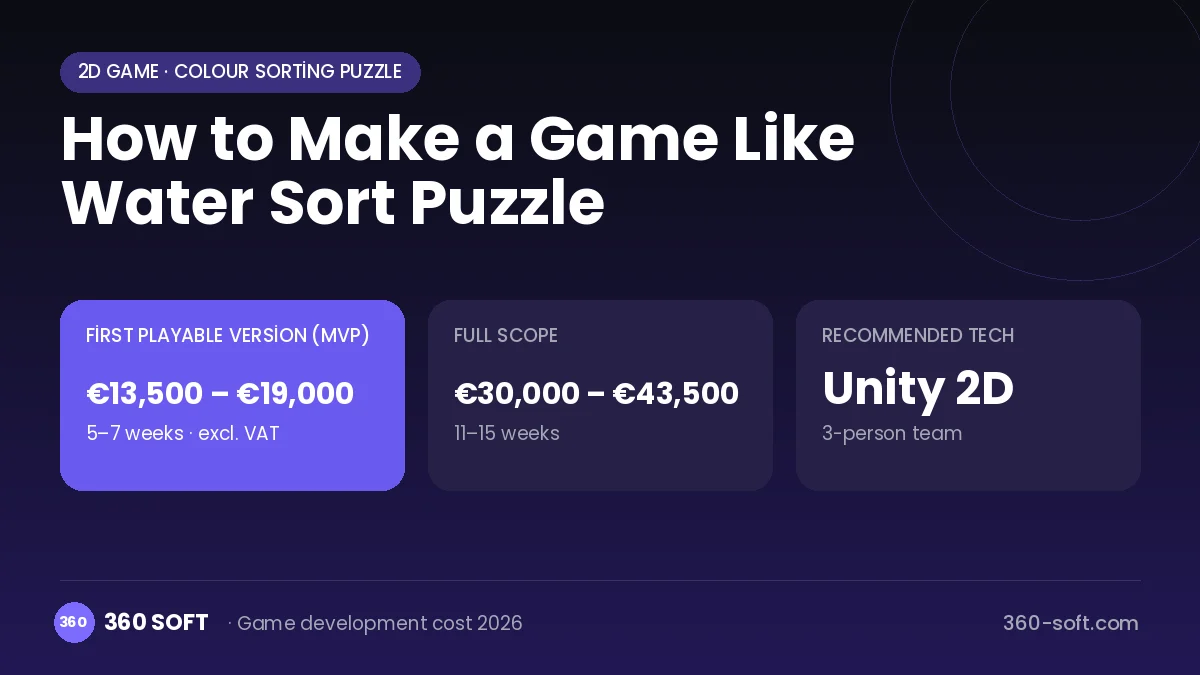
Why Water Sort Puzzle works: the core loop
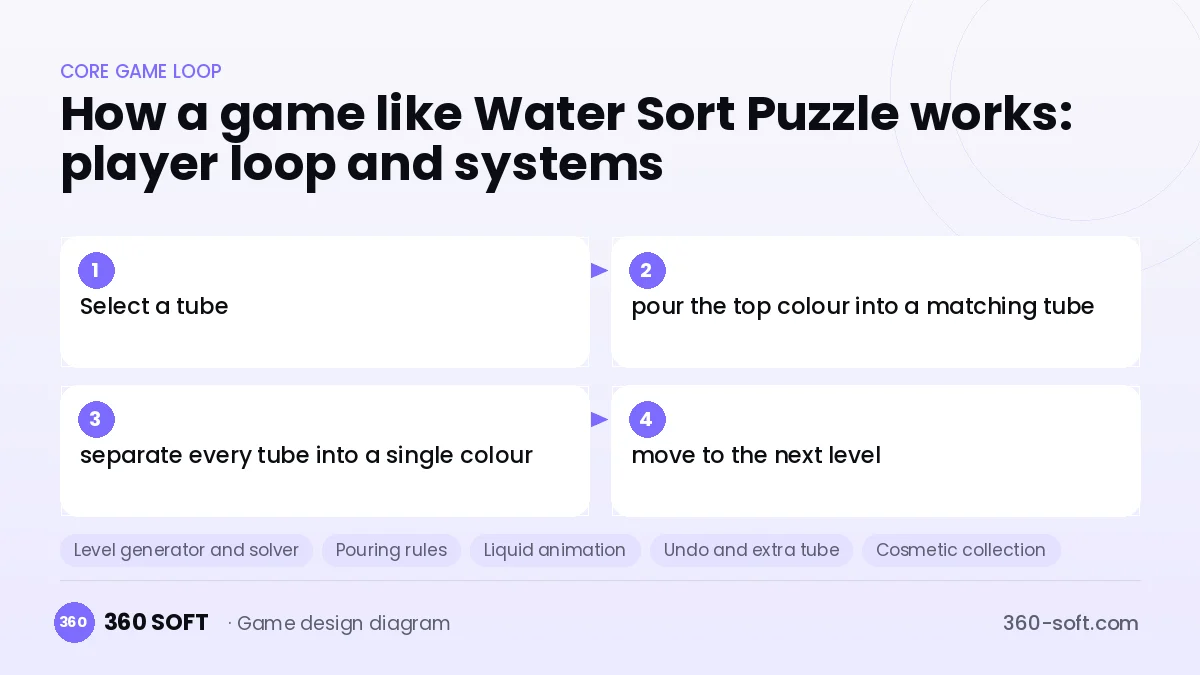
Systems you need to build a game like Water Sort Puzzle
Level generator and solver
Tool that generates random mixes, verifies solvability with a search algorithm and scores difficulty by the minimum number of moves.
Pouring rules
Rule engine that consistently handles pouring only onto the same colour or an empty tube, capacity checks and multi-layer transfers.
Liquid animation
Visual system that convincingly shows the tube tilting, the pour stream and the level rising using shaders or masks.
Undo and extra tube
Helpers tied to rewarded ads that rescue players with limited undos and an empty tube that can be added when stuck.
Cosmetic collection
Collection screen where tube shapes, liquid colour palettes and backgrounds unlock as players progress.
Level progress and saving
Save that stores level number, earned rewards and unlocked cosmetics and survives device changes.
What goes into the first version, what comes later
First version (soft launch)
- Core game with finished pouring rules and liquid animation
- Large starter level set verified by the solver
- Undo and extra tube helpers
- Rewarded and interstitial ads
- Basic cosmetics and progress saving
Later updates
- Alternative sorting modes such as balls, screws or sand
- New mechanics such as hidden colours and locked tubes
- Daily challenges and badges
- Ad-free pack and cosmetics shop
The hard parts of this genre
Measuring difficulty
A level's difficulty is not determined by the number of colours alone; solution depth and trap moves must be analysed with the solver.
Believable liquid
Real fluid simulation is heavy on mobile; you need a cheap but convincing fake effect.
Repetition
Because the mechanic is uniform, players get bored over time unless new obstacles and modes are added.
Team, timeline and budget
The estimate is based on the genre’s core systems, content volume, multiplayer and live-ops needs plus QA and project management: about 114 person-days for the full scope and 51 person-days for the first version. Cutting scope (fewer levels, one map, fewer characters) lowers the budget directly. Store accounts, servers, audio licences and user-acquisition budget are separate items. We send a fixed written price within 24 hours after the game design document.
Monetisation
Water sort games earn most of their revenue from ads: interstitials at the end of levels and rewarded ads for an extra tube or undo. An ad-free version and cosmetic packs add revenue from players willing to pay. Ad frequency per level should be tuned with Remote Config based on retention data.
Estimate your game budget and get a fixed quote
Let us scope it together and send a fixed written quote within 24 hours. NDA on request; you own the source code.
Calculated instantly from your choices, excl. VAT. A fixed written quote follows a free scoping call within 24 hours.
Choosing a game development company for a game like Water Sort Puzzle
Most people searching “make a game like water sort puzzle” are really looking for a reliable game development company. When comparing quotes, check four things:
- Can you play their released 2D games on your own phone?
- Are the source code, art files and store accounts transferred to you by contract?
- Do they build a playable prototype first and show a demo every two weeks?
- Are ads, in-app purchases and analytics set up as part of the quote?
Copyright and originality
Game mechanics on their own are generally not protected, but names, logos, characters, art, audio and level designs are. That is why we build a game “like Water Sort Puzzle” with your own name, art and world. This is not legal advice; we recommend a trademark search before launch.
Frequently asked questions
How long does it take to make a game like Water Sort Puzzle?
The core pouring mechanic is quick to develop; with the level generator and solver, animation polish and ad integration, a release-ready version usually takes a few months.
Are the levels designed by hand?
Usually not; levels are generated by an algorithm, verified by a solver and sorted by difficulty. Designers hand-craft the tutorial levels and the ones that introduce new mechanics.
Will there be copyright problems?
Colour sorting mechanics are generally free to use. A specific game's name, icon, visuals and sounds cannot be copied; you should create your own visual language. This is not legal advice.
What should I look for when choosing a studio to make a game like Water Sort Puzzle?
Choose a studio with experience in procedural level generation and solver algorithms that also understands ad optimisation. Store ratings and update frequency of its previous puzzle games are good indicators too.