Mobile appE-commerce & marketplacesOriginal by SHEIN
What sets SHEIN apart is an on-demand production cycle that catches trends almost instantly. New styles debut in small batches, clicks and sales are monitored, and the winners are scaled up quickly. Hundreds of new products appear in the app every day; with photo reviews, fit feedback and a points system, users both discover and decide based on what the community says.
A similar app needs a fashion-focused catalogue, size and fit recommendations, photo reviews and an outfit feed in the customer app. Behind it sit a portal for supplier and production tracking, analytics that measure product performance and a multi-language, multi-currency setup for international sales. Because product images and variants change so fast, a content production pipeline is part of the system as well.
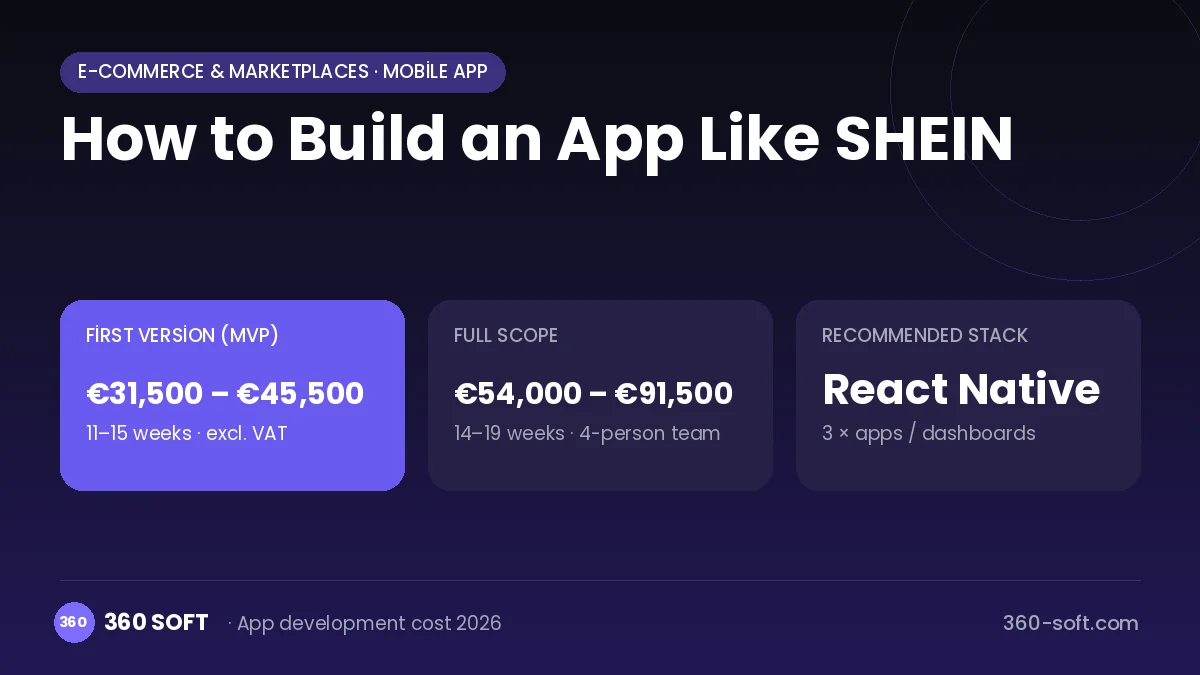
How SHEIN works: the core user flow
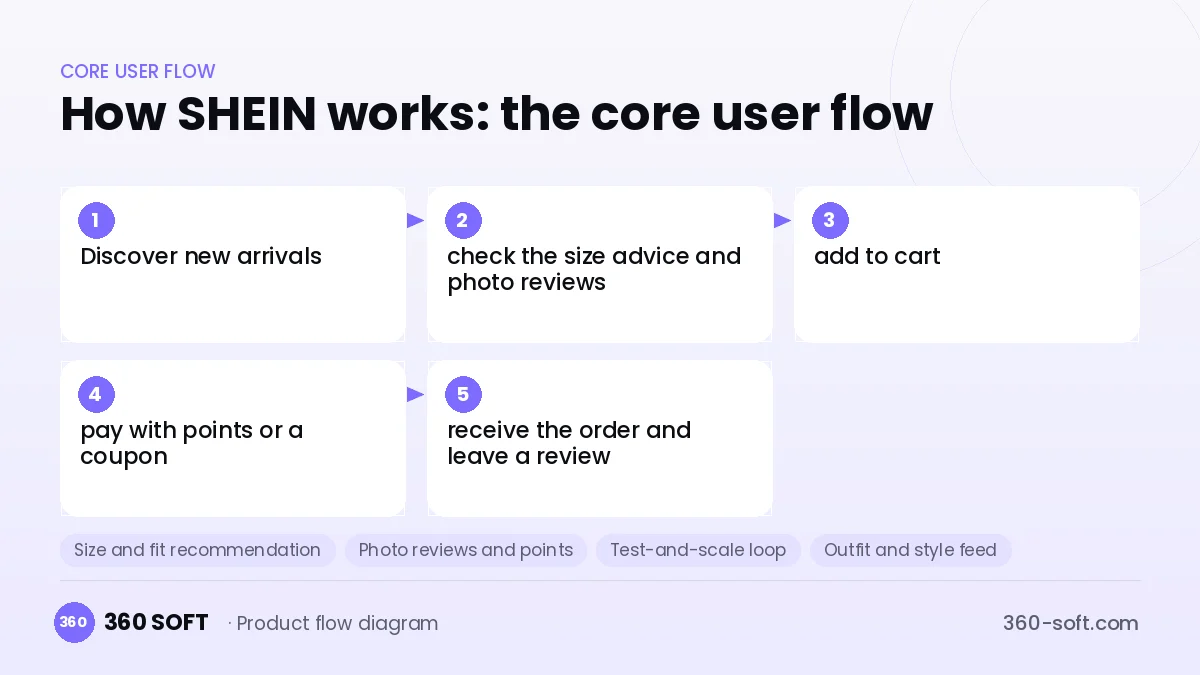
How many apps and dashboards do you need?
Customer app
Users discover new products, get size recommendations, browse photo reviews and shop while collecting points.
Supplier and production portal
Manufacturers track new style drafts, small-batch production orders and delivery dates.
Admin and merchandising panel
Category teams monitor product performance, plan campaigns and decide which styles to scale up.
Critical features of a product like SHEIN
Size and fit recommendation
Size advice combines the user's measurements, past returns and other buyers' runs-small feedback.
Photo reviews and points
Buyers leave reviews with photos of themselves wearing the item and their size details, earning points in return.
Test-and-scale loop
Clicks, add-to-cart events and sales for new products are tracked in real time; production orders are triggered for winning styles.
Outfit and style feed
Products are grouped into outfit suggestions, and the user can add every piece to the cart from a single screen.
Points and loyalty programme
Points earned from logging in, reviewing and buying turn into discounts on future orders.
Fast content pipeline
Product photos, colour variants and descriptions are produced in bulk from templates and pushed to the catalogue quickly.
What goes into the first version, what comes later
First version (MVP)
- Fashion catalogue, new arrivals feed and advanced filters
- Size chart and basic size recommendation
- Cart, checkout and order tracking
- Photo reviews and point rewards
- Admin panel with product performance reports
Later releases
- Supplier production portal and small-batch orders
- AI-driven personalised style recommendations
- Multi-country, multi-language and multi-currency support
- Live-stream selling and a community feed
Modules and how the budget is calculated
The budget is calculated with 360 SOFT’s pricing model from the modules below, about 32 screens and the project’s complexity: roughly 207 person-days for the full scope and 121 person-days for the first version. Every module you drop lowers the budget directly.
| Module | Phase |
|---|---|
| Sign-up, login, social login | First version |
| User profile and settings | First version |
| Admin dashboard | First version |
| Online payments (Stripe / PSP) | First version |
| Product / content catalogue | First version |
| Cart and checkout | First version |
| Advanced search and filters | First version |
| Push notifications | First version |
| File, photo, video upload | First version |
| Ratings and reviews | First version |
| Reporting and analytics | Later release |
| Multi-language | First version |
| AI features (LLM, RAG, recommendations) | Later release |
Hosting, SMS, map APIs, app store accounts and payment-provider fees are separate items. Maintenance and improvements (optional): €700 / month. We send a fixed written price within 24 hours after a free discovery call.
The hard parts
High return rates
In online fashion, poor fit drives returns; the accuracy of size recommendations directly determines profitability.
Catalogue speed
Images, variants and stock for large numbers of new products must be uploaded flawlessly every day; manual processes do not scale.
Data-driven decision infrastructure
Deciding which product to scale requires event data to be collected and analysed in real time.
Business model
Revenue comes directly from the margin on product sales; since this is a low-price, high-frequency model, purchase frequency is critical. A paid shipping threshold, express delivery fees and paid membership perks provide extra income. If the platform also opens up to third-party sellers, sales commissions and promotion fees can be added to the model.
Get a free quote for your project
Let us scope it together and send a fixed written quote within 24 hours. NDA on request; you own the source code.
Choosing a company to build an app like SHEIN
Most people searching “build an app like shein” are really looking for a reliable app development company. When comparing quotes, check four things:
- Can you try similar products they have shipped, in the stores or live?
- Are the source code, design files, servers and store accounts transferred to you by contract?
- Do they show a working demo every two weeks, with written scope and acceptance criteria?
- Are maintenance, scaling and GDPR/security costs written into the quote?
Copyright and trademarks
A business model and features are generally not protected on their own, but the SHEIN name, logo, interface design, content and source code are. That is why we build a product with similar functionality but your own brand, design and code. This is not legal advice; we recommend a trademark search before launch.
Frequently asked questions
How long does it take to build an app like SHEIN?
A fashion app with a catalogue, size chart, checkout and review system can go live within a few months. The production portal and AI recommendations are added in later phases.
How does size recommendation work?
At first, the product's measurement chart is matched with the user's height, weight and preferred fit. As data builds up, return reasons and buyer feedback improve the accuracy of the recommendations.
Is an off-the-shelf e-commerce platform enough?
For a fashion brand with a small range, an off-the-shelf platform will do. If you are aiming for a data-driven, multi-country model that constantly tests new products, a custom-built system is a better fit.
Are there copyright or trademark issues?
The fast-fashion business model and app features are free to use, but the brand name, logo, design, product photos and code cannot be copied. This information is not legal advice.