2D gameTower defence and character-collecting (gacha) strategyOriginal by Hypergryph
Arknights merges tower defence with character collecting and turns a familiar formula into a tactical puzzle. Instead of towers, you deploy operators split into classes: those who block enemies up front, those who shoot from behind, healers and special supports. Each operator has a deployment cost, a block count and skill timing; clearing a stage with minimal losses gives the player a real sense of victory. A dark sci-fi world and strong character design deepen engagement.
A similar game needs grid-based deployment and pathfinding, a class and skill system, a comprehensive stage editor and operator progression. Base management, daily routines and server-side gacha are added on top. For UK and EU markets, publishing drop rates and showing pity rules should be part of the design.
Why Arknights works: the core loop
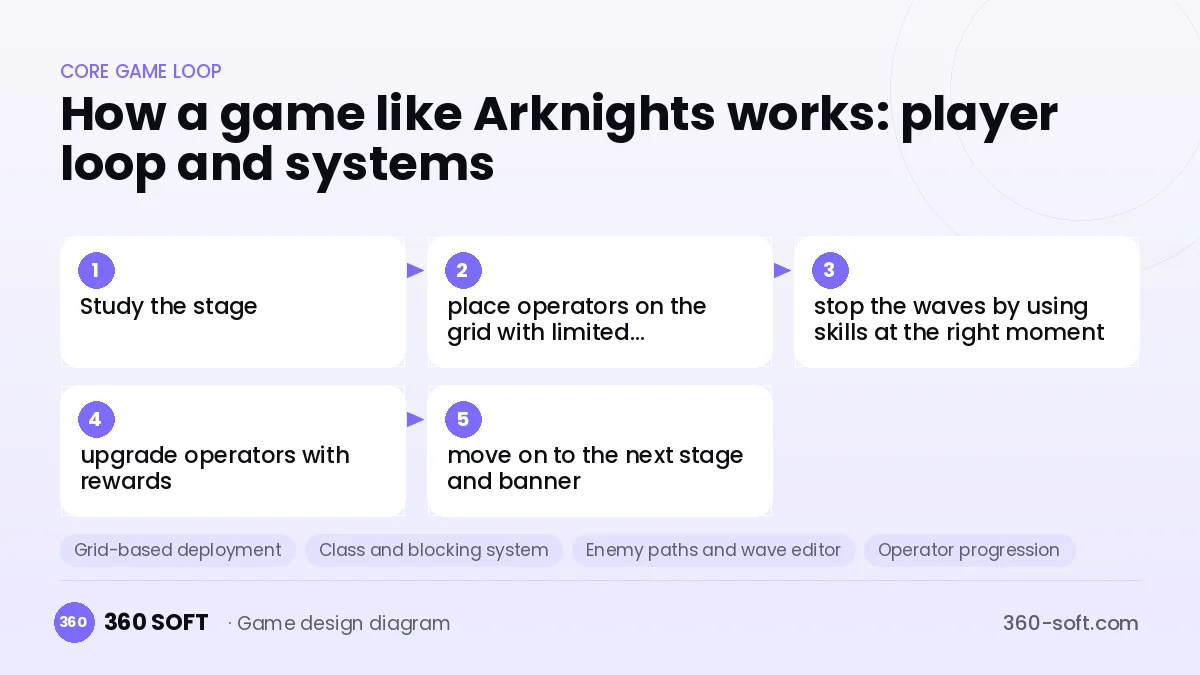
Systems you need to build a game like Arknights
Grid-based deployment
Ground and high tiles, facing direction, deployment points and retreat cost. Every stage is a small tactical puzzle.
Class and blocking system
Classes such as vanguard, defender, sniper and medic; how many enemies each operator can block and their attack range.
Enemy paths and wave editor
A designer tool for enemy routes, flying units, elite enemies with special mechanics and stage-specific rules.
Operator progression
Levels, promotion (elite), skill mastery and potential systems. Material needs create long-term goals.
Base management
Rooms that produce resources, operator assignments and morale management. Gives players a short, passive daily routine.
Gacha and odds transparency
Server-run pulls, pity counter, limited banners and drop rates shown in the game.
What goes into the first version, what comes later
First version (soft launch)
- A two-chapter main story with 20–25 stages
- 20–25 operators, 6–8 classes and basic skills
- Grid deployment, wave editor and auto-replay
- Standard banner, published drop rates and pity
- Simple base management and cloud saves
Later updates
- New story chapters and limited-time events
- A roguelike mode and challenge maps
- Operator skins and base decoration
- PC client and multi-language support
The hard parts of this genre
Stage design and difficulty curve
Each stage should be solvable with different operator combinations, but no single strong character should solve everything. This balance needs intensive testing.
Readability
Lots of enemies, attack ranges and skill effects can turn into chaos on a small mobile screen. Clear icons and colour coding are essential.
Gacha and regulation
Operator pulls bring revenue, but free players must still be able to progress. Odds disclosure and spending rules vary by market.
Team, timeline and budget
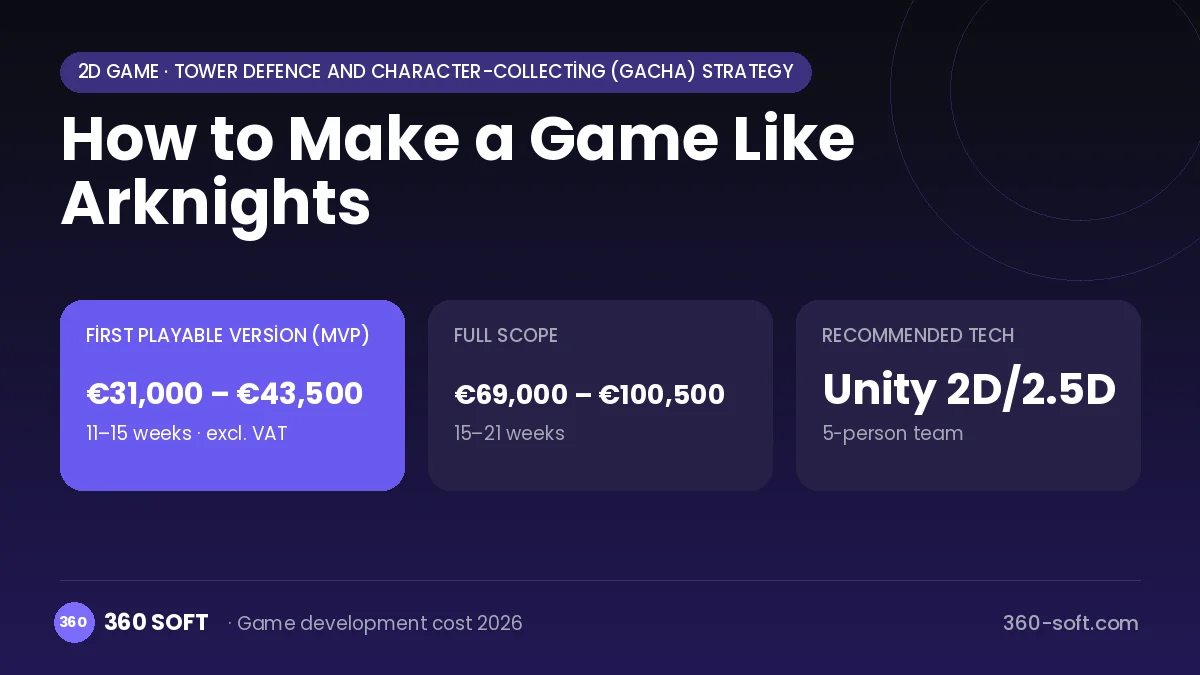
The estimate is based on the genre’s core systems, content volume, multiplayer and live-ops needs plus QA and project management: about 264 person-days for the full scope and 119 person-days for the first version. Cutting scope (fewer levels, one map, fewer characters) lowers the budget directly. Store accounts, servers, audio licences and user-acquisition budget are separate items. We send a fixed written price within 24 hours after the game design document.
Monetisation
Operator gacha is the foundation of revenue; drop rates and pity rules must be published clearly. A monthly card, cosmetic operator skins and base decoration are extra revenue sources. Communities in this genre value a fair, generous economy; letting free players clear the stages is the key to a long life. Event shops and free character giveaways reinforce that sense of generosity.
Estimate your game budget and get a fixed quote
Let us scope it together and send a fixed written quote within 24 hours. NDA on request; you own the source code.
Calculated instantly from your choices, excl. VAT. A fixed written quote follows a free scoping call within 24 hours.
Choosing a game development company for a game like Arknights
Most people searching “make a game like arknights” are really looking for a reliable game development company. When comparing quotes, check four things:
- Can you play their released 2D games on your own phone?
- Are the source code, art files and store accounts transferred to you by contract?
- Do they build a playable prototype first and show a demo every two weeks?
- Are multiplayer servers, anti-cheat and scaling costs written into the quote?
Copyright and originality
Game mechanics on their own are generally not protected, but names, logos, characters, art, audio and level designs are. That is why we build a game “like Arknights” with your own name, art and world. This is not legal advice; we recommend a trademark search before launch.
Frequently asked questions
How long does it take to make a game like Arknights?
The core tower defence system can be built relatively quickly; most of the time goes into operator art, animation and stage design. A soft launch with a small roster and a few chapters is a realistic route.
Will there be copyright issues?
Mechanics like operator-deployment tower defence and gacha are generally free to use. Characters, world, names, artwork and music cannot be copied. This is not legal advice.
Should I choose 2D or 3D?
A 2D/2.5D approach with skeletal animation makes character production cheaper and performs well on mobile. 3D gives freedom in camera and presentation but raises the cost per character.
What should I look for in a studio that builds tower defence games?
Look for a team with experience in stage editors, balancing tools and gacha economies. Choose a studio that plans odds transparency and the LiveOps calendar from the start.