3D gameTurn-based 4X strategyOriginal by Firaxis Games / 2K
The Civilization series is the best-known example of turn-based 4X strategy: explore, expand, exploit and exterminate. Starting with a single settler, players found cities, advance through technology and culture trees and make deals with or go to war against other leaders. The famous one-more-turn feeling comes from every turn offering a small reward and a new goal at the same time. Different victory types turn each game into its own story.
A similar game needs a procedural hex map, city and district management, technology and culture trees, diplomacy, units and, above all, rival leader AI. A realistic MVP has to narrow the scope: six to eight civilisations, a shortened range of eras, two victory types, basic diplomacy and single-player play. AI quality is the area early reviews criticise most in this genre.
Why Sid Meier's Civilization works: the core loop
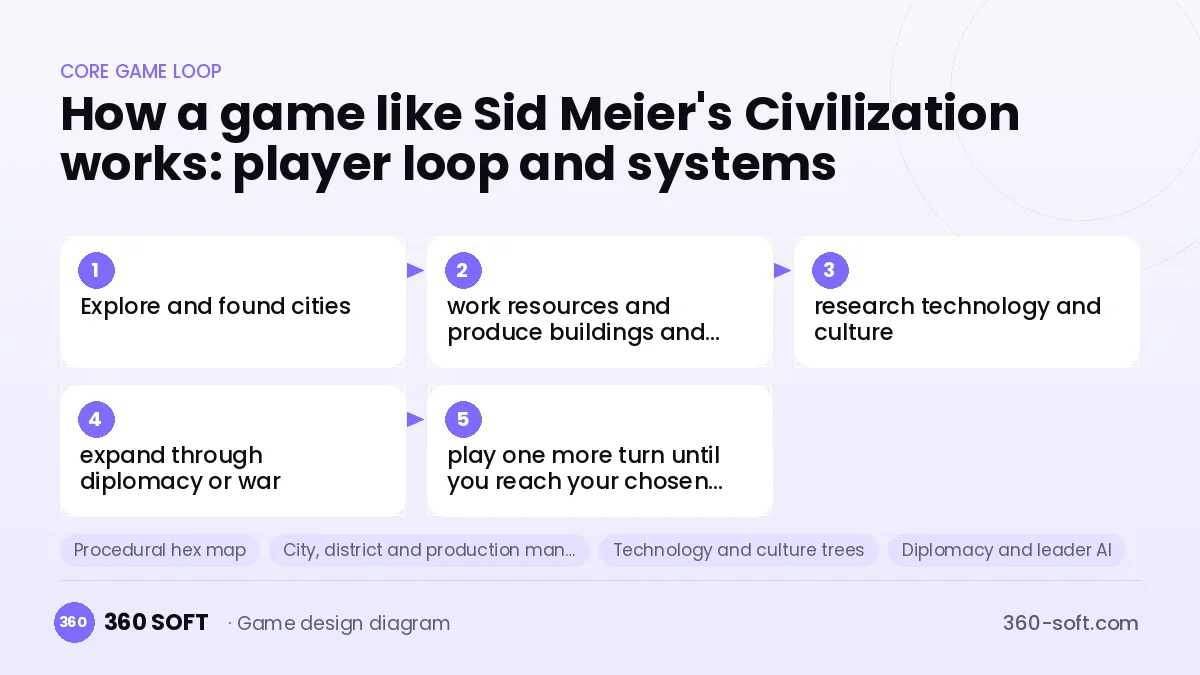
Systems you need to build a game like Sid Meier's Civilization
Procedural hex map
A map generator producing terrain types, resources, rivers, continents and balanced starting positions. Makes every game unique.
City, district and production management
Population, tile working, production queues, buildings and districts. The source of economic depth.
Technology and culture trees
Interconnected research, policy cards and era transitions. Offers long-term planning and strategic choice.
Diplomacy and leader AI
Rival leaders with personality, relationship scores, deals, alliances and declarations of war. Makes the game world feel alive.
Units, combat and fog
Tile-based movement, unit classes, sieges, fog of war and scouting. Builds military strategy.
Victory conditions and turn processing
Military, science, culture and diplomatic victories; turn processing speed and autosave. Defines the game’s goal structure.
What goes into the first version, what comes later
First version (soft launch)
- 6–8 civilisations with personality-driven leader AI
- Procedural hex map and 3–4 map types
- Shortened technology and culture trees
- City management, basic diplomacy and units
- 2 victory types and a complete single-player game
Later updates
- Online multiplayer and hot-seat play
- New civilisations, religion and espionage systems
- Scenario editor and mod support
- Mobile/tablet version and console controls
The hard parts of this genre
Rival leader AI
The AI must behave both sensibly and with personality, and remain a threat in the late game. This is the hardest and most criticised area of the genre.
Late-game pacing and turn times
As the map fills up, turn processing gets slower and players tire. AI calculations and management overhead must be designed efficiently.
Balance across systems
Technology, culture, economy and war all affect each other; one dominant strategy makes the game monotonous. Extensive playtesting is required.
Team, timeline and budget
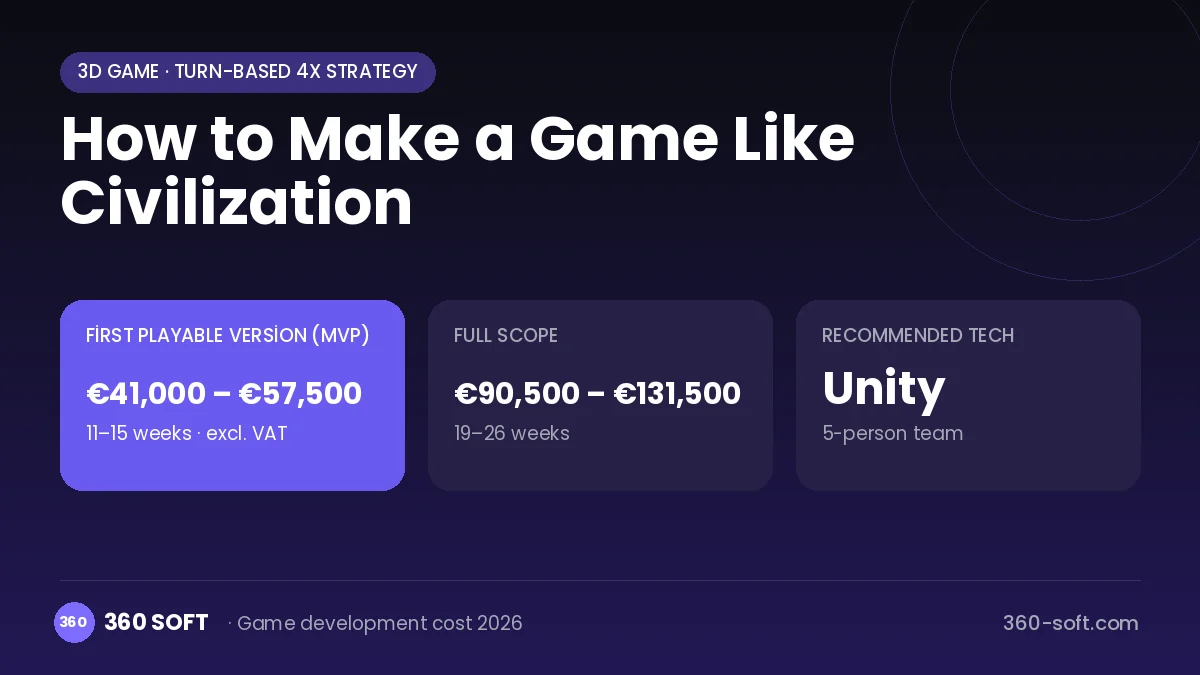
The estimate is based on the genre’s core systems, content volume, multiplayer and live-ops needs plus QA and project management: about 348 person-days for the full scope and 157 person-days for the first version. Cutting scope (fewer levels, one map, fewer characters) lowers the budget directly. Store accounts, servers, audio licences and user-acquisition budget are separate items. We send a fixed written price within 24 hours after the game design document.
Monetisation
A premium sale plus later civilisation, scenario and expansion packs is the standard here. Mod support extends the game’s life and indirectly boosts sales. On mobile, a free trial followed by a full-game unlock can work; microtransactions are weak in this genre.
Estimate your game budget and get a fixed quote
Let us scope it together and send a fixed written quote within 24 hours. NDA on request; you own the source code.
Calculated instantly from your choices, excl. VAT. A fixed written quote follows a free scoping call within 24 hours.
Choosing a game development company for a game like Sid Meier's Civilization
Most people searching “make a game like civilization” are really looking for a reliable game development company. When comparing quotes, check four things:
- Can you play their released 3D games on your own phone?
- Are the source code, art files and store accounts transferred to you by contract?
- Do they build a playable prototype first and show a demo every two weeks?
- Are multiplayer servers, anti-cheat and scaling costs written into the quote?
Copyright and originality
Game mechanics on their own are generally not protected, but names, logos, characters, art, audio and level designs are. That is why we build a game “like Sid Meier's Civilization” with your own name, art and world. This is not legal advice; we recommend a trademark search before launch.
Frequently asked questions
How long does it take to make a game like Civilization?
A single-player 4X with six to eight civilisations and shortened eras is a reachable goal for an experienced small-to-mid-sized team. AI and balance work take up most of the time.
Will I run into copyright issues?
Ideas such as 4X mechanics, hex maps and tech trees are generally free to use. The series name, leader portrayals, UI, text and art assets cannot be copied, and real historical figures should be depicted in your own original way. This is not legal advice.
Is multiplayer necessary in the first release?
The core of this genre is the single-player experience. It is safer to solidify the AI and single-player game first, then add online or asynchronous turn-based multiplayer.
What should I look for in a studio to build a 4X strategy game?
Look at experience with game AI, procedural map generation and systems design. A team that can explain how it will run balance testing and optimise turn times inspires confidence.