3D gameRoblox co-op horror experienceOriginal by LSPLASH
DOORS showed how powerful being scared together with friends can be on Roblox. Players push through a seemingly endless hotel, door by door; behind each one there might be a key, a locked cabinet or sudden danger. Every entity has its own rule: some require hiding, some staying still, some listening carefully. Learning the rules, dying and trying again turns fear into a sense of mastery.
A similar game needs procedural room generation and rule-based entity design built together. Room templates, door numbering, hiding spots and light and sound design form the foundation of the atmosphere. Each entity gets a warning sign, a reaction window and a fair way to escape. On Roblox, co-op server infrastructure is ready; in a standalone game, audio and lighting quality go up, but networking and matchmaking are your job.
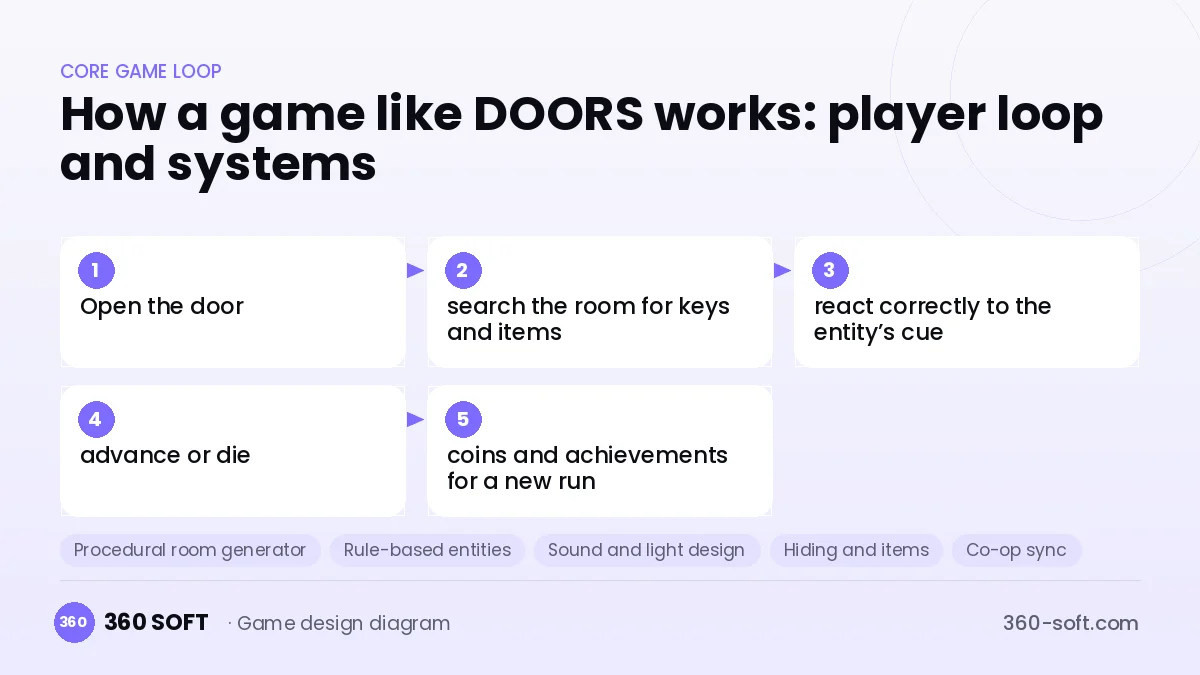
Why DOORS works: the core loop
Systems you need to build a game like DOORS
Procedural room generator
A system that combines room templates such as corridors, libraries and storerooms by rules and places locked doors and keys.
Rule-based entities
For each entity, a warning cue such as a sound or flickering light, the correct response (hide, freeze, run) and a fair reaction window.
Sound and light design
Positional audio, audio cues of approaching danger, flickering lights and dark sections; the true source of fear.
Hiding and items
Hiding spots like wardrobes and under beds, plus consumables such as a flashlight, lockpick and medicine.
Co-op sync
Making sure everyone on the team sees the same room and entity at the same time, with dead players switching to spectator mode.
Achievements and progression
Death and progress records, achievements, an in-between shop and modifiers that motivate replays.
What goes into the first version, what comes later
First version (soft launch)
- A first floor of fifty to sixty doors with room templates
- Four or five entities with distinct rules
- Hiding spots and basic items
- A co-op lobby for up to four players
- An in-between shop, achievements and a revive product
Later updates
- New floors and end-of-floor encounters
- Difficulty modifiers and special modes
- Seasonal and holiday-themed events
- A standalone PC horror version (if you go off-platform)
The hard parts of this genre
Fair fear
Deaths without warning are frustrating; every hazard needs a learnable cue and a reasonable reaction window.
Procedural, yet handcrafted-feeling
Random rooms can look repetitive; template variety, fixed narrative rooms and surprise moments must be balanced.
Synced scare moments over the network
An entity appearing late for one player ruins the shared experience; events must be triggered on the server and played in sync on every client.
Team, timeline and budget
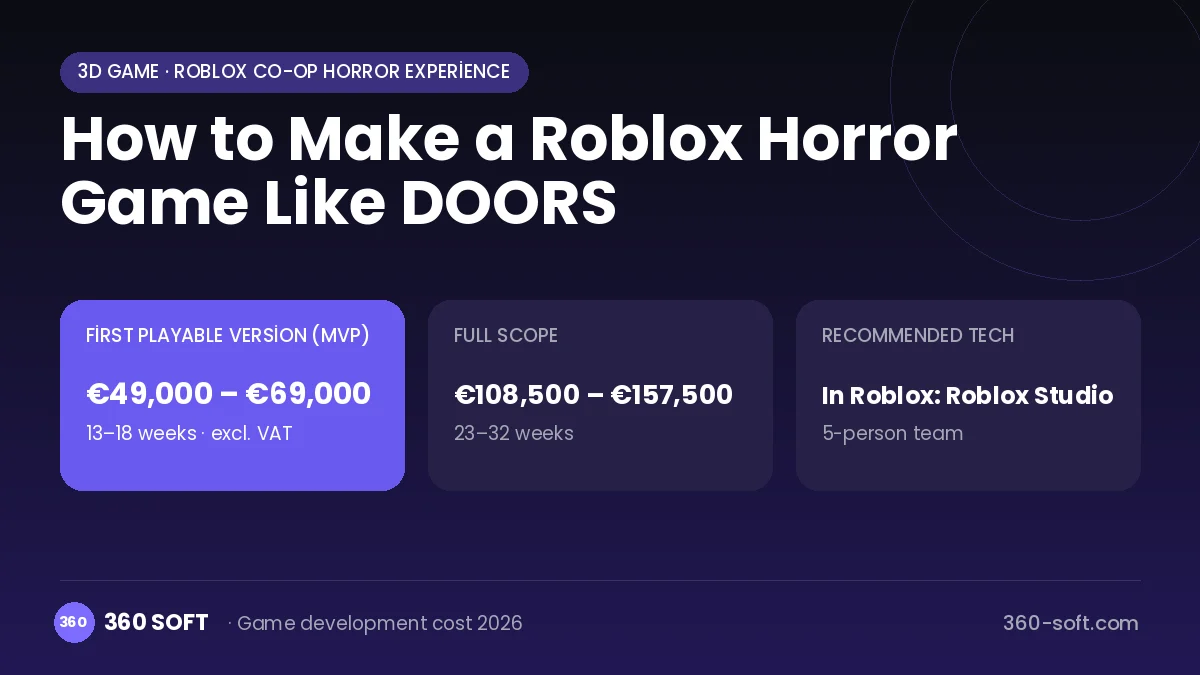
The estimate is based on the genre’s core systems, content volume, multiplayer and live-ops needs plus QA and project management: about 416 person-days for the full scope and 187 person-days for the first version. Cutting scope (fewer levels, one map, fewer characters) lowers the budget directly. Store accounts, servers, audio licences and user-acquisition budget are separate items. We send a fixed written price within 24 hours after the game design document.
Monetisation
On Roblox, revenue comes from one-off developer products like revives, Game Passes offering cosmetics and convenience, private servers and Premium Payouts. Robux earned can be converted into real money through the DevEx programme for creators who meet the eligibility requirements. In a standalone PC version, a one-off purchase followed by chapter packs works well in the horror genre.
Estimate your game budget and get a fixed quote
Let us scope it together and send a fixed written quote within 24 hours. NDA on request; you own the source code.
Calculated instantly from your choices, excl. VAT. A fixed written quote follows a free scoping call within 24 hours.
Choosing a game development company for a game like DOORS
Most people searching “make a game like doors” are really looking for a reliable game development company. When comparing quotes, check four things:
- Can you play their released 3D games on your own phone?
- Are the source code, art files and store accounts transferred to you by contract?
- Do they build a playable prototype first and show a demo every two weeks?
- Are multiplayer servers, anti-cheat and scaling costs written into the quote?
Copyright and originality
Game mechanics on their own are generally not protected, but names, logos, characters, art, audio and level designs are. That is why we build a game “like DOORS” with your own name, art and world. This is not legal advice; we recommend a trademark search before launch.
Frequently asked questions
How long does it take to make a Roblox horror game like DOORS?
A first floor with a limited set of room templates and a few entities can launch within a few months. Sound and lighting polish, playtesting and new floors determine the timeline.
Should I build on Roblox or as a standalone game?
Roblox is the better route for quickly reaching a young, social audience. If you are aiming for a more mature horror atmosphere and higher visual quality, a standalone PC game fits better, but you build the co-op infrastructure yourself.
Will there be copyright issues?
Procedural rooms and rule-based entity mechanics are free to use. The DOORS name, entity designs and names, hotel theme and sound effects cannot be copied, and Roblox platform rules also apply. This is not legal advice.
What should I look for when choosing a horror game developer?
Look at their sound and lighting design examples, entity AI experience and co-op sync solutions. Asking for a short playable horror scene quickly shows the team’s ability to build atmosphere.