3D gameOpen-world parkour and zombie survivalOriginal by Techland
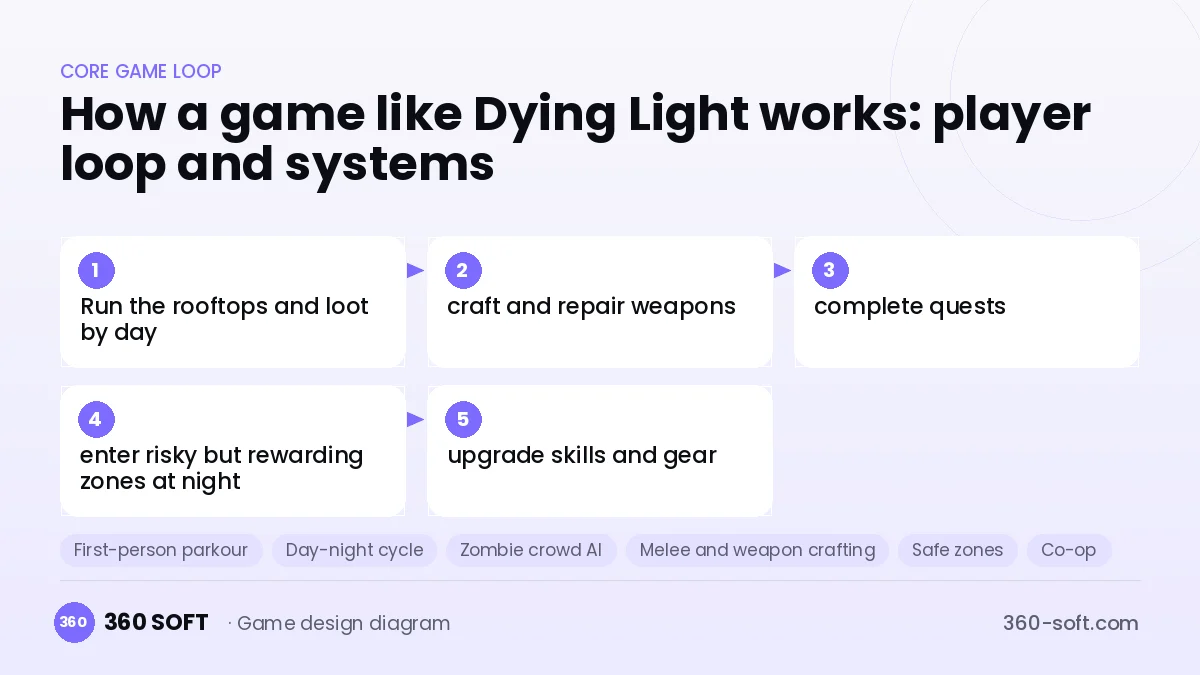
Dying Light gains its own identity by combining zombie survival with first-person parkour. By day you run across rooftops collecting loot and easily escape the slow zombies in the streets; when night falls, fast and dangerous creatures emerge and the hunter becomes the hunted. The risk balance created by the day-night cycle and the co-op mode played with friends are the game's greatest strengths.
For a similar game, you need to build fluid first-person parkour, melee combat, zombie crowd AI, a day-night cycle and weapon crafting. Co-op is a separate job in terms of network synchronisation. A realistic target for a small team is a first “Dying Light-style” release with one district, a few zombie types and a short story; co-op can be left for a second phase.
Why Dying Light works: the core loop
Systems you need to build a game like Dying Light
First-person parkour
Ledge grabs, climbing, sliding and rooftop jumps, with camera movement that does not cause motion sickness.
Day-night cycle
Safe exploration by day, dangerous but valuable opportunities at night, with enemies and rewards that change with the cycle.
Zombie crowd AI
Slow hordes, fast night hunters and special types, with large enemy counts balanced against performance.
Melee and weapon crafting
Weapons that wear out, repairs and elemental mods, with feedback for head and limb hits.
Safe zones
Places to shelter at night, save and re-equip, setting the rhythm of exploration.
Co-op
Doing quests with friends in the same world, with shared progression and loot.
What goes into the first version, what comes later
First version (soft launch)
- One district and rooftop routes
- Core parkour moves and melee combat
- 3–4 zombie types and a night hunter
- Day-night cycle and two or three safe zones
- A short story and simple weapon crafting, no co-op
Later updates
- 2–4 player co-op mode
- New regions and story chapters
- Advanced traversal tools such as a grappling hook and paraglider
- A deeper skill tree and vehicles
The hard parts of this genre
Parkour feel
First-person climbing and jumping can easily feel clumsy or nauseating; it needs long fine-tuning and playtesting.
Crowd performance
Large numbers of zombies and physics interactions strain the CPU; LODs, shared animation and smart respawning are essential.
Co-op synchronisation
Keeping parkour, physics and crowds of enemies in sync across several players is hard; the network architecture must be considered from the start.
Team, timeline and budget
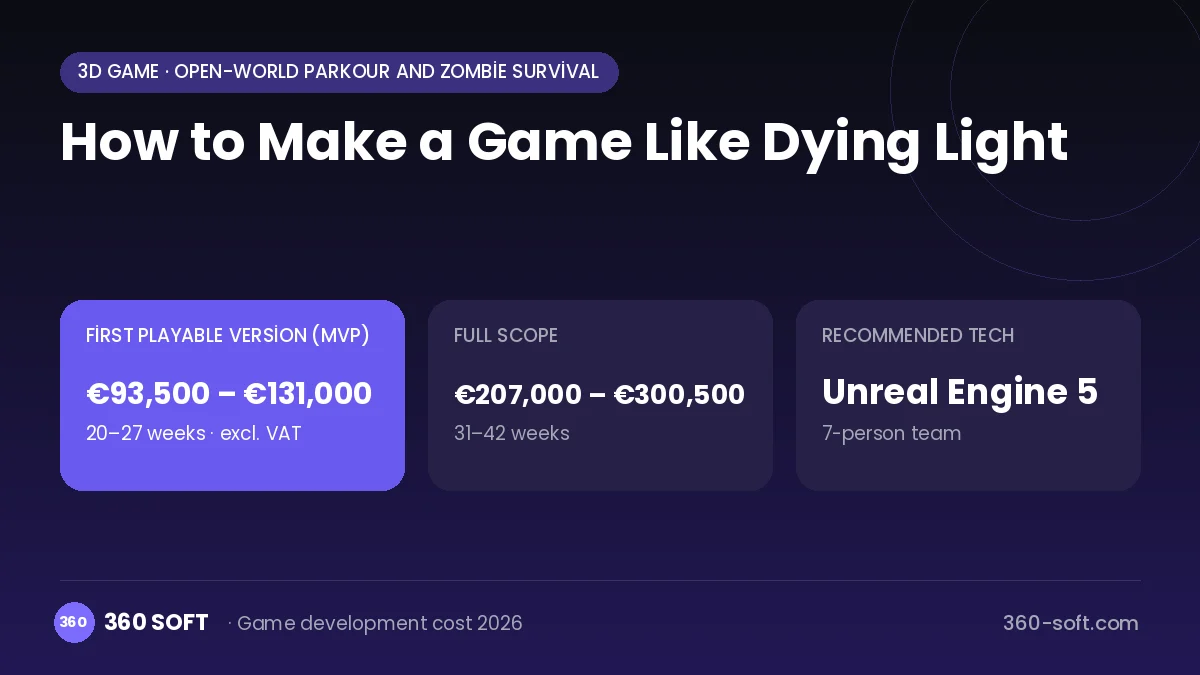
The estimate is based on the genre’s core systems, content volume, multiplayer and live-ops needs plus QA and project management: about 795 person-days for the full scope and 358 person-days for the first version. Cutting scope (fewer levels, one map, fewer characters) lowers the budget directly. Store accounts, servers, audio licences and user-acquisition budget are separate items. We send a fixed written price within 24 hours after the game design document.
Monetisation
Games like this sell as premium titles, and co-op supports sales through word of mouth. New region and story expansions plus weapon and outfit cosmetic packs bring extra revenue, while long-term free updates are an effective way to keep the community alive. Friend-pack discounts can also encourage groups to buy together.
Estimate your game budget and get a fixed quote
Let us scope it together and send a fixed written quote within 24 hours. NDA on request; you own the source code.
Calculated instantly from your choices, excl. VAT. A fixed written quote follows a free scoping call within 24 hours.
Choosing a game development company for a game like Dying Light
Most people searching “make a game like dying light” are really looking for a reliable game development company. When comparing quotes, check four things:
- Can you play their released 3D games on your own phone?
- Are the source code, art files and store accounts transferred to you by contract?
- Do they build a playable prototype first and show a demo every two weeks?
- Are multiplayer servers, anti-cheat and scaling costs written into the quote?
Copyright and originality
Game mechanics on their own are generally not protected, but names, logos, characters, art, audio and level designs are. That is why we build a game “like Dying Light” with your own name, art and world. This is not legal advice; we recommend a trademark search before launch.
Frequently asked questions
How long does it take to make a game like Dying Light?
The original is a large studio's work. An MVP with one district and no co-op can become playable for an experienced small team in about a year; adding co-op takes extra time.
Will there be copyright issues?
A zombie theme, parkour and a day-night cycle are generally free to use. The Dying Light name, city, characters and original enemy designs cannot be copied. This is not legal advice.
Should co-op be in the first release?
The network architecture should be considered from day one, but playable co-op can be left for a second phase. That way the single-player feel is nailed first, then extended to multiplayer.
What should I look for when choosing a studio to build a game like Dying Light?
Look for first-person movement, crowd AI and multiplayer networking experience. Seeing a playable parkour prototype early is important.