3D gameInstrument-controller rhythm gameOriginal by Harmonix, Neversoft / Activision
Guitar Hero is the icon of rhythm games that let you feel like you are playing real rock songs with a guitar-shaped controller. You play the coloured notes streaming towards you by holding the right fret and hitting the strum bar; successful streaks fill Star Power and the crowd goes wild. Stage lights, virtual bandmates and familiar songs carry the player from the sofa to the stage, and forming a band with friends turns it into a party experience.
A similar game needs a precise note highway and timing engine, controller and instrument support, separate charts for every song and difficulty, career progression, stage and band animations and a multiplayer mode. The biggest cost in this genre is song licensing: rights to both the composition and the master recording must be secured separately. That is why starting with independent artists or original music is more realistic for most projects.

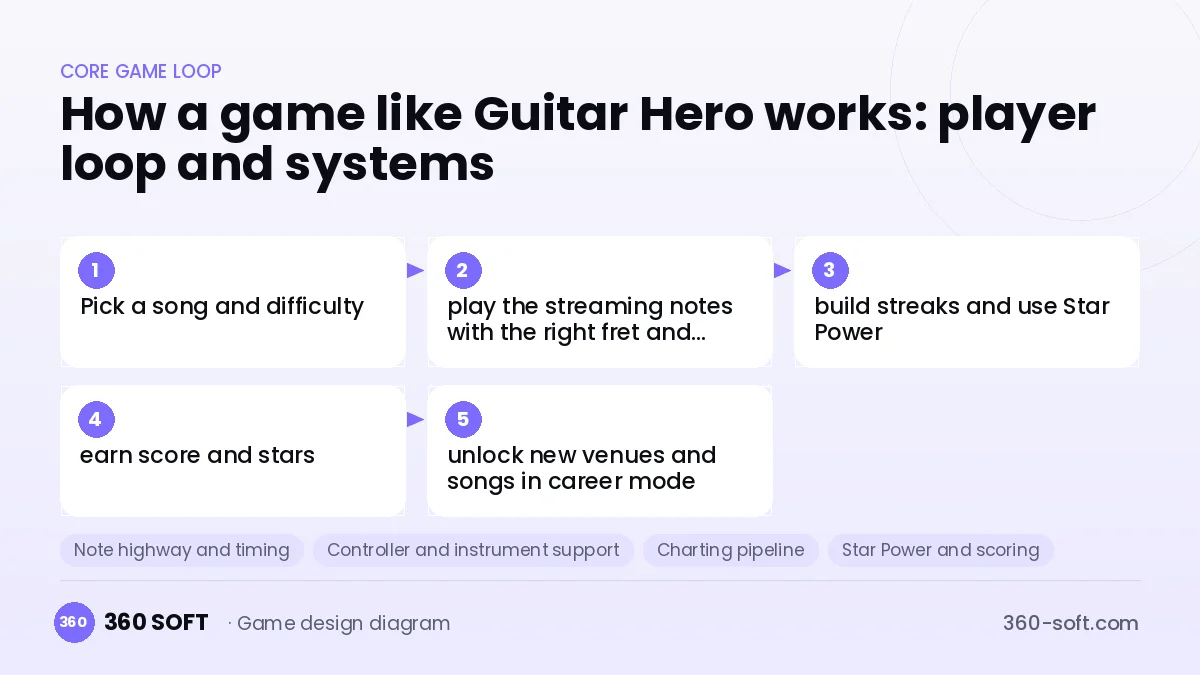
Why Guitar Hero works: the core loop
Systems you need to build a game like Guitar Hero
Note highway and timing
Streaming notes tied to the audio clock, chords and sustained notes, hit windows and latency calibration.
Controller and instrument support
Peripherals such as guitar, drums and microphone, plus standard gamepad and keyboard mapping.
Charting pipeline
Hand-made charts at four or five difficulty levels for every song, with a MIDI-based editor and testing tools.
Star Power and scoring
A power meter filled by flawless streaks, a score multiplier and crowd reactions.
Career and venue progression
Setlists that move from venue to venue, unlockable stages and character customisation.
Band and multiplayer mode
Playing together with multiple instruments on the same screen or online, with comparative scores.
What goes into the first version, what comes later
First version (soft launch)
- Note highway and timing engine
- Guitar mode on gamepad or keyboard
- A setlist of twenty to thirty licensed or original songs
- Career mode and a few venues
- Local two-player versus mode
Later updates
- Drum and vocal modes
- Online band mode
- Downloadable song packs
- Character and instrument cosmetics
The hard parts of this genre
Song licensing
For well-known songs, rights to both the composition (songwriter or publisher) and the recording (record label) are required; the process is long and costly, and licence terms are limited.
Hardware dependency
Dedicated controllers bring manufacturing, logistics and compatibility burdens; without standard gamepad support, the audience shrinks.
Charting volume
Hand-charting every song at every difficulty takes serious effort, and poor charts ruin the game feel.
Team, timeline and budget
The estimate is based on the genre’s core systems, content volume, multiplayer and live-ops needs plus QA and project management: about 450 person-days for the full scope and 203 person-days for the first version. Cutting scope (fewer levels, one map, fewer characters) lowers the budget directly. Store accounts, servers, audio licences and user-acquisition budget are separate items. We send a fixed written price within 24 hours after the game design document.
Monetisation
Full-price sales on console and PC plus paid song packs (DLC) are the classic model. Offering a large song catalogue by subscription is another option, depending on licence terms. A mobile adaptation can use free-to-play, song unlocks and a season pass; part of the revenue goes to rights holders as royalties.
Estimate your game budget and get a fixed quote
Let us scope it together and send a fixed written quote within 24 hours. NDA on request; you own the source code.
Calculated instantly from your choices, excl. VAT. A fixed written quote follows a free scoping call within 24 hours.
Choosing a game development company for a game like Guitar Hero
Most people searching “make a game like guitar hero” are really looking for a reliable game development company. When comparing quotes, check four things:
- Can you play their released 3D games on your own phone?
- Are the source code, art files and store accounts transferred to you by contract?
- Do they build a playable prototype first and show a demo every two weeks?
- Are multiplayer servers, anti-cheat and scaling costs written into the quote?
Copyright and originality
Game mechanics on their own are generally not protected, but names, logos, characters, art, audio and level designs are. That is why we build a game “like Guitar Hero” with your own name, art and world. This is not legal advice; we recommend a trademark search before launch.
Frequently asked questions
How long does it take to make a game like Guitar Hero?
The technical core can be built by a mid-sized team in a few months, but song licences, charts and stage art turn a full game into a long-term project.
Can I use famous songs?
Only by signing licence agreements with the rights holders; composition and recording rights usually belong to different parties. Original music or deals with independent artists are a more accessible route. This is not legal advice.
Is a dedicated guitar controller essential?
No, you can start with a gamepad, keyboard or touchscreen. Dedicated hardware enriches the experience but adds manufacturing and distribution costs.
What should I look for when choosing a rhythm game developer?
Look at experience with timing accuracy, audio engineering and charting tools. Having legal partners to advise on licensing is also an advantage.