2D gameCompetitive rhythm game with community mapsOriginal by ppy (Dean Herbert)
osu! is a competitive rhythm game built around clicking circles that appear on screen to the beat, following sliders and spinning discs. Its strength comes from players creating and sharing their own song maps (beatmaps) and from a detailed ranking system that measures skill. Fast, precise maps played with a mouse, tablet or keyboard give a constant sense of improvement, while global leaderboards fuel a culture of competition.
A similar game needs a precise timing and hit judgement engine, multiple game modes, a comprehensive beatmap editor, a map upload and ranked approval process, a ranking algorithm that calculates skill points, and replay recording. Because community content includes music, copyright management is a critical issue; a licensed artist programme and takedown processes should be planned from the start.
Why osu! works: the core loop
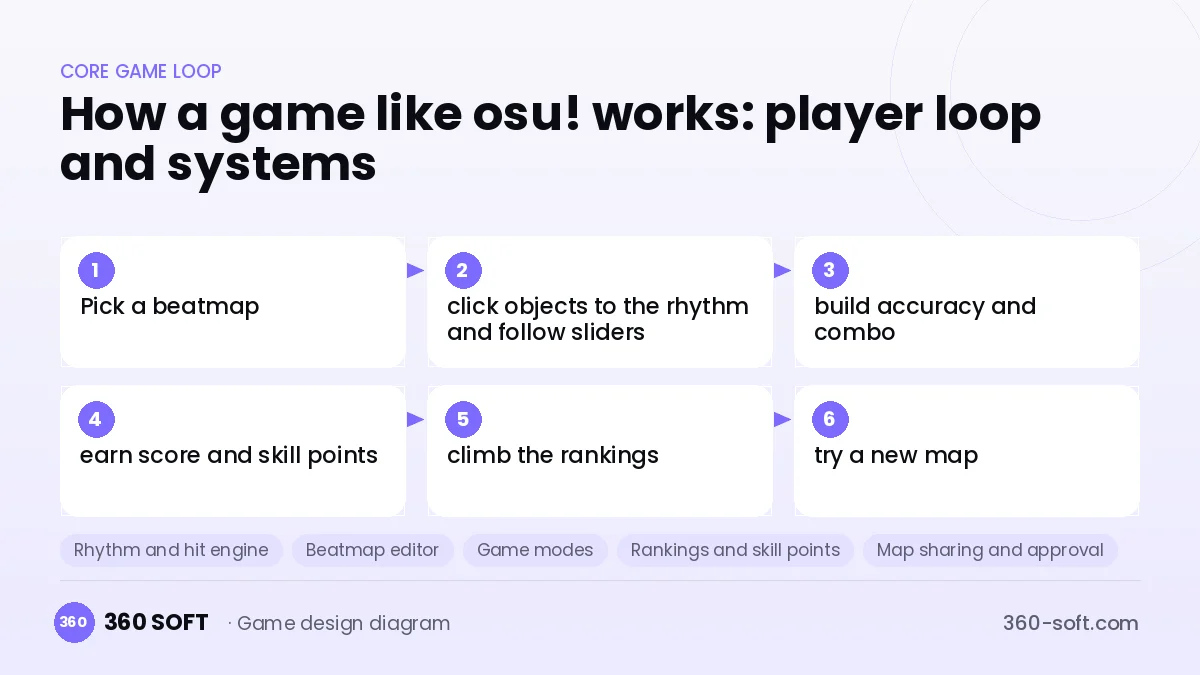
Systems you need to build a game like osu!
Rhythm and hit engine
Object timing tied to the audio clock, hit windows, accuracy percentage, combo and latency calibration.
Beatmap editor
Timeline, BPM and offset settings, placement of circles, sliders and spinners, and difficulty parameters.
Game modes
Different gameplay styles on the same foundation, such as clicking, drumming, fruit catching and vertical key modes.
Rankings and skill points
An algorithm that calculates points from map difficulty and player accuracy, with global and country rankings.
Map sharing and approval
Uploading community maps, quality checks and adding approved maps to the rankings.
Replays and anti-cheat
Storing plays as replay files, reviewing suspicious scores and client integrity checks.
What goes into the first version, what comes later
First version (soft launch)
- One game mode and a precise rhythm engine
- A basic beatmap editor
- A first map pack with licensed or original music
- Score, accuracy and local replay recording
- Latency calibration and skin support
Later updates
- Online map sharing and approval process
- Global rankings and skill points
- Extra game modes and multiplayer rooms
- Tournament tools and spectator mode
The hard parts of this genre
Precision and latency
In competitive rhythm games even a few milliseconds are noticeable; you need an architecture that minimises input and audio latency.
Music copyright
Community-uploaded maps may contain copyrighted songs; licensed artist deals, takedown procedures and a content policy are essential.
Cheating and fair rankings
Auto-play software and time manipulation break the rankings; replay analysis and server-side checks are required.
Team, timeline and budget
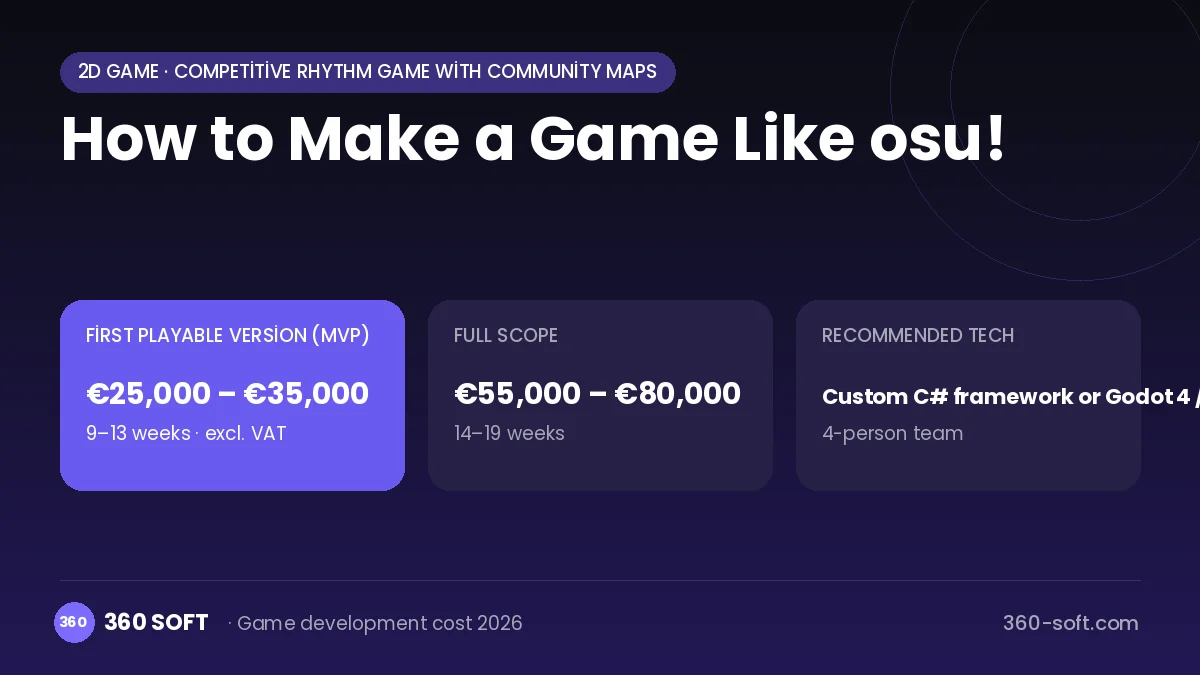
The estimate is based on the genre’s core systems, content volume, multiplayer and live-ops needs plus QA and project management: about 210 person-days for the full scope and 95 person-days for the first version. Cutting scope (fewer levels, one map, fewer characters) lowers the budget directly. Store accounts, servers, audio licences and user-acquisition budget are separate items. We send a fixed written price within 24 hours after the game design document.
Monetisation
In competitive community games like this, the game can stay free with an optional supporter subscription, cosmetic features and donations. Licensed song packs and tournament sponsorships add revenue. Selling in-game power is not accepted by competitive players; revenue should be built on a sense of contributing to the community.
Estimate your game budget and get a fixed quote
Let us scope it together and send a fixed written quote within 24 hours. NDA on request; you own the source code.
Calculated instantly from your choices, excl. VAT. A fixed written quote follows a free scoping call within 24 hours.
Choosing a game development company for a game like osu!
Most people searching “make a game like osu” are really looking for a reliable game development company. When comparing quotes, check four things:
- Can you play their released 2D games on your own phone?
- Are the source code, art files and store accounts transferred to you by contract?
- Do they build a playable prototype first and show a demo every two weeks?
- Are multiplayer servers, anti-cheat and scaling costs written into the quote?
Copyright and originality
Game mechanics on their own are generally not protected, but names, logos, characters, art, audio and level designs are. That is why we build a game “like osu!” with your own name, art and world. This is not legal advice; we recommend a trademark search before launch.
Frequently asked questions
How long does it take to make a game like osu!?
A version with one mode, an editor and local scores can be built by a small team in a few months. Online map sharing, rankings and anti-cheat infrastructure are long-term work.
Will there be copyright issues?
The mechanic of clicking objects to the rhythm is generally free to use. The game’s name, logo, interface and art cannot be copied; most importantly, the music used in maps needs a licence. This is not legal advice.
Where do I get the music?
Original compositions, licensing deals with independent artists and royalty-free music libraries are the safest options. A content policy and takedown process should be in place for user uploads.
Can it be played on mobile?
Touchscreens suit this kind of rhythm game, but precision and latency differ. On mobile, map difficulty and hit windows should be tuned separately.