3D gameStealth and puzzle-driven horrorOriginal by Dynamic Pixels, tinyBuild
The appeal of Hello Neighbor lies in turning simple curiosity into a game of cat and mouse. You sneak into your neighbour's house to find out what he hides in the basement; he chases you, sets traps and places cameras on the routes you use most. The enemy acting as if he is "learning" you turns every attempt into a personal rivalry. A colourful, cartoony art style also opens the game to younger audiences.
The technical heart of a similar game is adaptive enemy AI that reacts to the player's habits. You also need physics-driven objects (stacking boxes, breaking windows), hiding spots, sound and sight perception, key-and-lock puzzles and a single, carefully designed large house. A first release only needs one house and a short chapter; making the AI feel fair yet smart takes the most effort.
Why Hello Neighbor works: the core loop
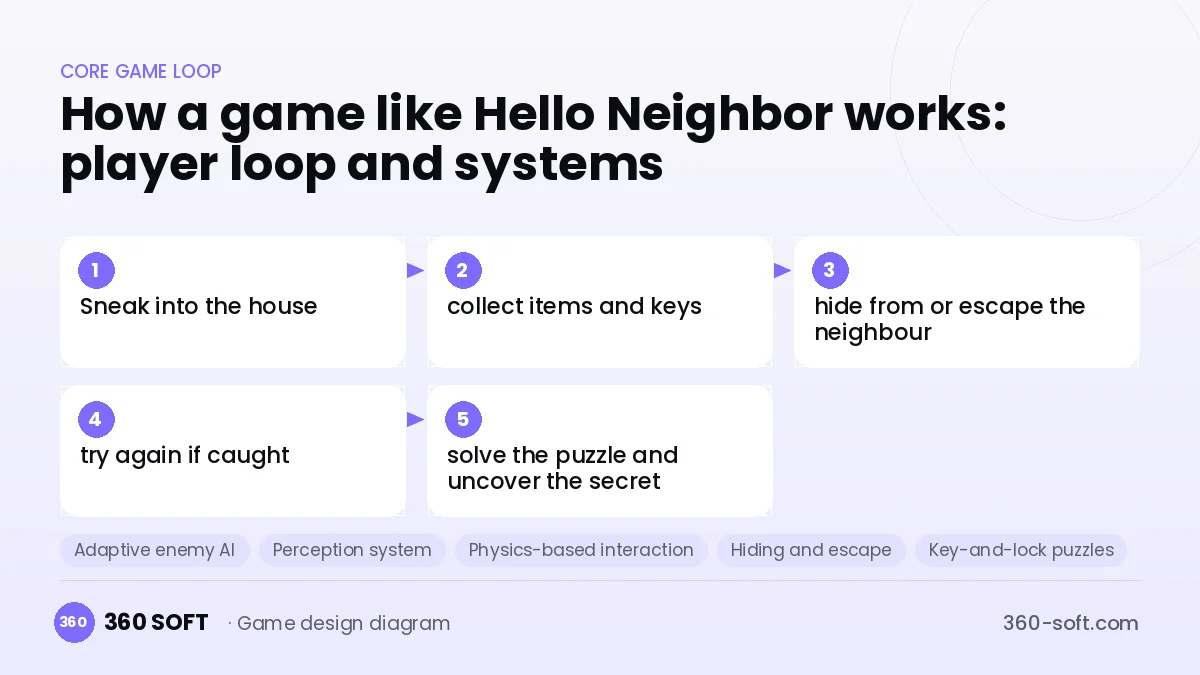
Systems you need to build a game like Hello Neighbor
Adaptive enemy AI
Remembering the player's favourite entry points and placing traps and cameras there; patrols that change over time.
Perception system
View cone, sound radius and suspicion level; cues that tell players whether they have been spotted.
Physics-based interaction
Objects that can be carried, thrown and stacked; freedom that allows creative solutions.
Hiding and escape
Hiding spots such as wardrobes and under beds, and rules for escaping a chase.
Key-and-lock puzzles
Coloured keys, mechanisms and clues hidden around the house; progression gates.
Level design
A complex multi-storey house with several entry routes that reveals a new secret on each attempt.
What goes into the first version, what comes later
First version (soft launch)
- One house and its surroundings (one chapter)
- Basic perception and chase AI
- Simple learning behaviours (placing traps / cameras)
- Physics objects and 5–8 puzzles
- Hiding spots and checkpoint saves
Later updates
- New chapters and story expansion
- Mobile and console versions
- An asymmetric multiplayer mode
- Difficulty levels and secret endings
The hard parts of this genre
Fair yet smart AI
An enemy that is too smart is frustrating, one that is too dumb is boring; learning behaviours must be readable to the player.
Physics and puzzle chaos
Free-form physics can let players bypass puzzles in unexpected ways or get stuck; thorough testing is essential.
Lack of guidance
Vague puzzles leave players lost; environmental cues and a gradual hint system are needed.
Team, timeline and budget
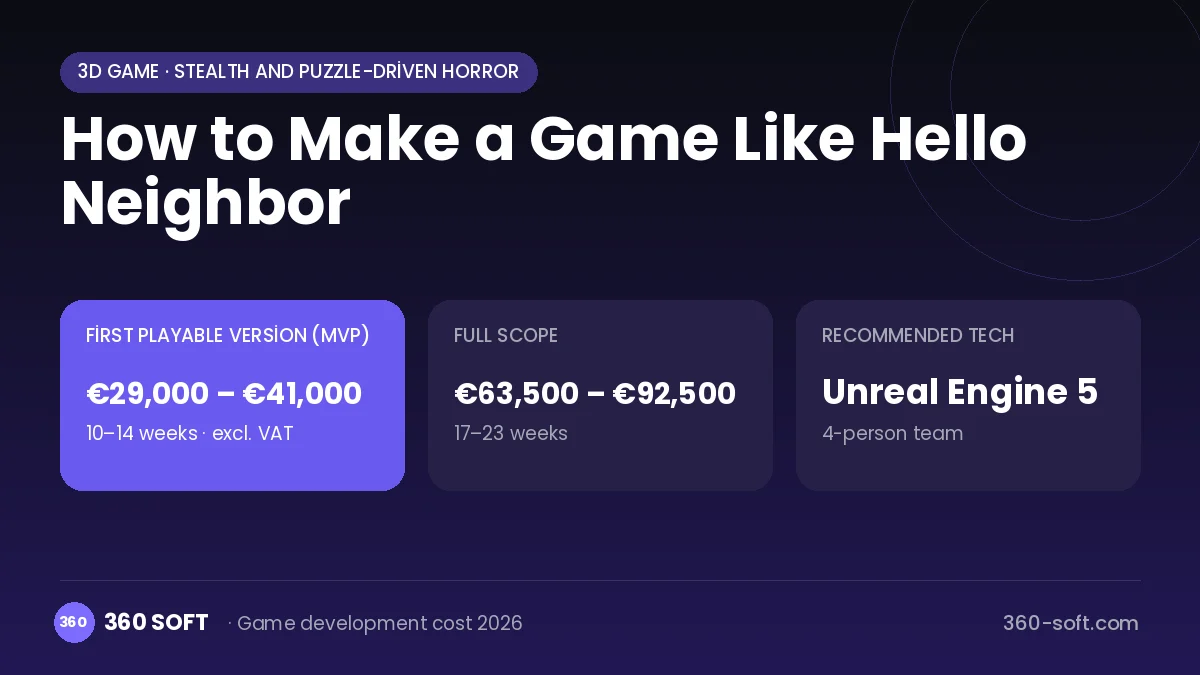
The estimate is based on the genre’s core systems, content volume, multiplayer and live-ops needs plus QA and project management: about 244 person-days for the full scope and 110 person-days for the first version. Cutting scope (fewer levels, one map, fewer characters) lowers the budget directly. Store accounts, servers, audio licences and user-acquisition budget are separate items. We send a fixed written price within 24 hours after the game design document.
Monetisation
Premium sales on PC and console, and on mobile a free first chapter with a one-off purchase to unlock the rest, is a suitable model. If the brand grows, spin-off games, books and licensed merchandise bring extra revenue; because of the young audience, ads and purchase flows must be designed carefully (COPPA, the UK Children's Code and GDPR rules for minors apply).
Estimate your game budget and get a fixed quote
Let us scope it together and send a fixed written quote within 24 hours. NDA on request; you own the source code.
Calculated instantly from your choices, excl. VAT. A fixed written quote follows a free scoping call within 24 hours.
Choosing a game development company for a game like Hello Neighbor
Most people searching “make a game like hello neighbor” are really looking for a reliable game development company. When comparing quotes, check four things:
- Can you play their released 3D games on your own phone?
- Are the source code, art files and store accounts transferred to you by contract?
- Do they build a playable prototype first and show a demo every two weeks?
- Are ads, in-app purchases and analytics set up as part of the quote?
Copyright and originality
Game mechanics on their own are generally not protected, but names, logos, characters, art, audio and level designs are. That is why we build a game “like Hello Neighbor” with your own name, art and world. This is not legal advice; we recommend a trademark search before launch.
Frequently asked questions
How long does it take to make a game like Hello Neighbor?
A playable version with one house and basic AI can be built by an experienced small team in a few months to a year. AI tuning and playtesting take a large share of the time.
Will there be copyright issues?
Mechanics such as sneaking into a house, a learning enemy and physics puzzles are generally free to use. The characters, house design, name, visuals and sounds cannot be copied. This is general information, not legal advice.
Which engine is a good fit?
Unreal Engine 5's behaviour trees and perception system provide a ready foundation for this kind of AI. Unity can do the same with behaviour tree plugins.
What should I look for in a company that makes games like Hello Neighbor?
Look at the company's concrete examples of game AI and level design. Ask for a short but playable prototype in which the enemy sets traps.