3D game3D avatar chat and social virtual worldOriginal by Together Labs
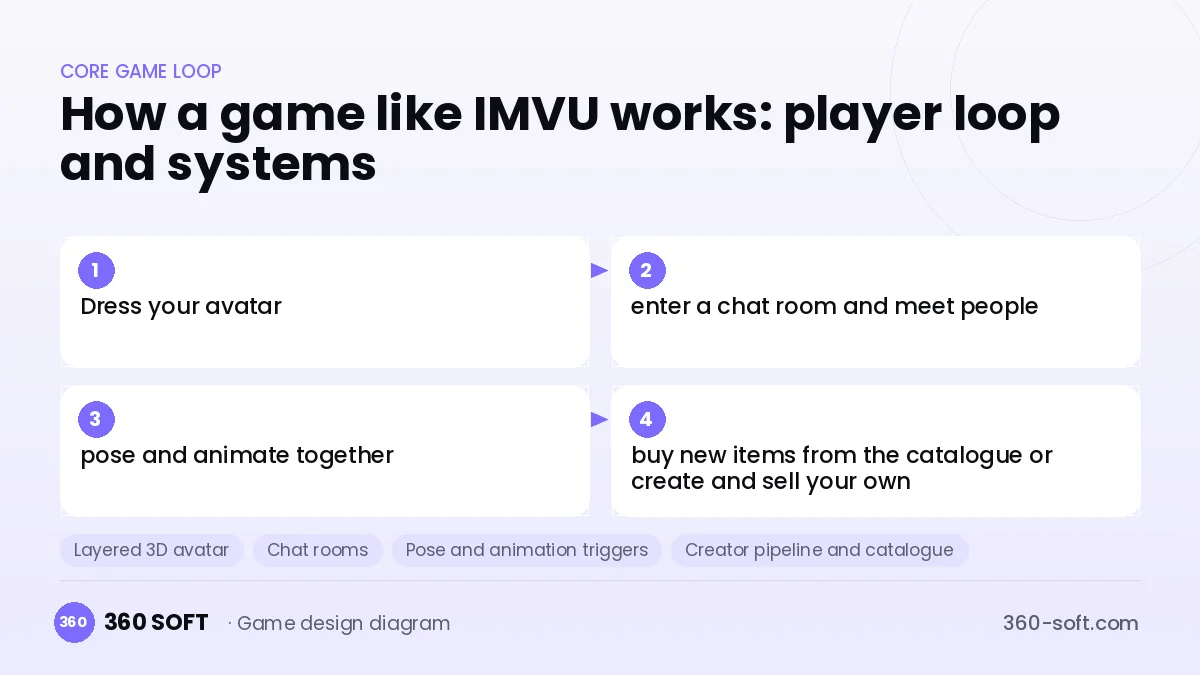
IMVU puts chatting with 3D avatars at the heart of a social experience. Players dress their avatars, enter rooms, meet new people, make friends and pose together. What sets the platform apart is a catalogue economy where outfits, furniture and rooms are largely made and sold by users, which delivers endless variety and lasting motivation for creators.
A similar platform needs layered 3D avatars, room-based multiplayer chat with pose and animation triggers, a creator pipeline for uploading models and textures, a product catalogue and virtual currency economy, plus friends and profiles. If there are adult areas, age verification and content separation are mandatory. Moderation, payment security, fraud prevention, GDPR and COPPA-style rules for younger users are a serious workload.
Why IMVU works: the core loop
Systems you need to build a game like IMVU
Layered 3D avatar
An avatar system built on standard skeleton and weighting rules so user-made clothing, hair, skins and accessories fit together.
Chat rooms
Multiplayer infrastructure that positions avatars in public and private rooms and syncs text chat with shared animations.
Pose and animation triggers
A system that lets two or more avatars interact through poses embedded in furniture and command-driven animations.
Creator pipeline and catalogue
A marketplace where users upload models, textures and animations, and items are listed after technical validation and content review.
Virtual economy
An economy layer that manages purchased and earned currencies, creator revenue share, refunds and fraud checks.
Profiles, friends and safety
Social and safety infrastructure with profile pages, friend lists, blocking, reporting and age-based access restrictions.
What goes into the first version, what comes later
First version (soft launch)
- Layered 3D avatar and official starter items
- Public and private chat rooms
- Basic pose and animation system
- Virtual currency and item store
- Reporting, blocking, an age gate and a moderation panel
Later updates
- User creator pipeline and revenue share
- Personal room design and persistent rooms
- Groups, events and community pages
- Full sync between desktop and mobile
The hard parts of this genre
Technical checks on user items
User-uploaded models must respect polygon, texture and skeleton rules without hurting performance, which needs an automated validation pipeline.
Economy and fraud
Economies that move value between users must be monitored continuously for fraudulent payments, account theft and abuse.
Age separation and moderation
Separating adult and younger users, complying with GDPR and COPPA-style rules and running strong chat moderation are all mandatory.
Team, timeline and budget
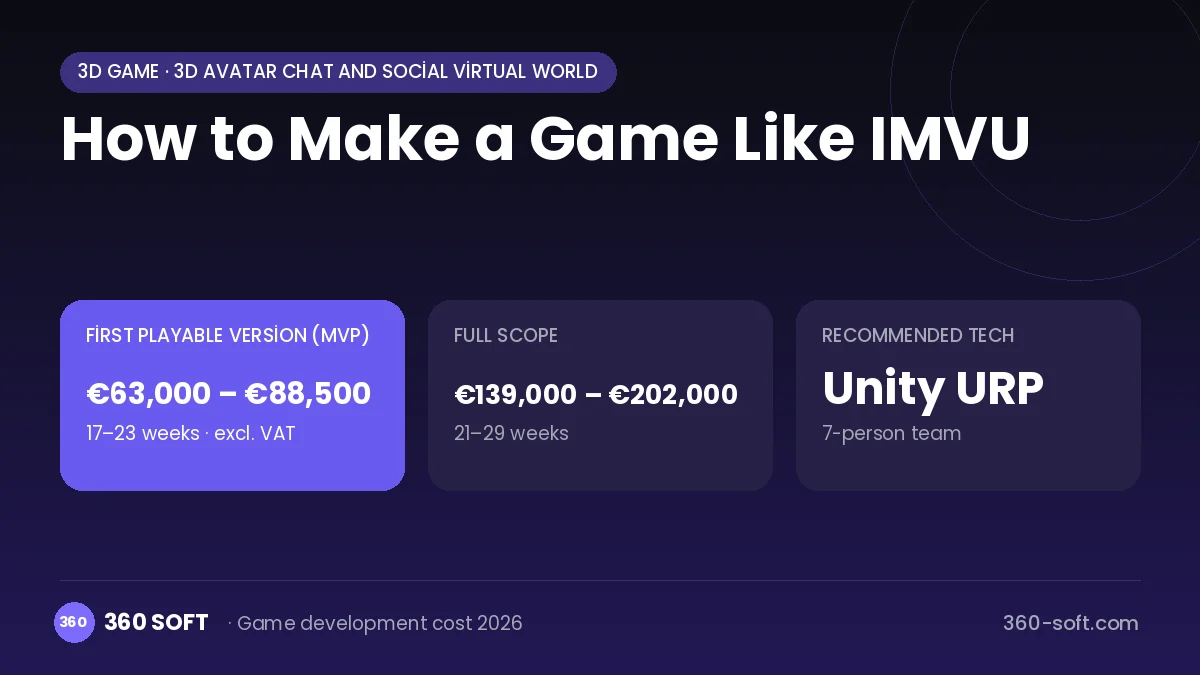
The estimate is based on the genre’s core systems, content volume, multiplayer and live-ops needs plus QA and project management: about 535 person-days for the full scope and 241 person-days for the first version. Cutting scope (fewer levels, one map, fewer characters) lowers the budget directly. Store accounts, servers, audio licences and user-acquisition budget are separate items. We send a fixed written price within 24 hours after the game design document.
Monetisation
Platforms like this earn from virtual currency sales, VIP membership, premium features such as private rooms and names, and a share of creator sales. A user-generated catalogue lowers content costs while growing the economy. Payment security, refund policies and spending limits for younger users are an integral part of the revenue model.
Estimate your game budget and get a fixed quote
Let us scope it together and send a fixed written quote within 24 hours. NDA on request; you own the source code.
Calculated instantly from your choices, excl. VAT. A fixed written quote follows a free scoping call within 24 hours.
Choosing a game development company for a game like IMVU
Most people searching “make a game like imvu” are really looking for a reliable game development company. When comparing quotes, check four things:
- Can you play their released 3D games on your own phone?
- Are the source code, art files and store accounts transferred to you by contract?
- Do they build a playable prototype first and show a demo every two weeks?
- Are multiplayer servers, anti-cheat and scaling costs written into the quote?
Copyright and originality
Game mechanics on their own are generally not protected, but names, logos, characters, art, audio and level designs are. That is why we build a game “like IMVU” with your own name, art and world. This is not legal advice; we recommend a trademark search before launch.
Frequently asked questions
How long does it take to build a platform like IMVU?
A first release with avatars, chat rooms and a store can be ready in a few months. A creator pipeline, economy security and scalable moderation may need a roadmap spanning years.
Will a platform similar to IMVU cause copyright problems?
The idea of 3D avatar chat with a user-made catalogue is free to use. The IMVU name, interface, avatar designs and items on the platform cannot be copied. This is not legal advice.
How do you manage user-generated content?
Every uploaded item should pass automated technical checks and content review, and a copyright takedown process must be in place. Clear rules and templates for creators raise quality.
What should I look for in a company to build a platform like IMVU?
Review the team's experience with 3D avatars, real-time chat infrastructure, marketplaces and payment security. Also ask how they set up GDPR compliance and moderation processes.